





Question: Could you please explain what the author means when he writesto calculate the EBITDA gained from the acquisition, we first calculate the average Enterprise Value
Could you please explain what the author means when he writes"to calculate the EBITDA gained from the acquisition, we first calculate the average Enterprise Value increase from a market capitalisation of similar companies"? This is the only part I don't understand, and I'd appreciate it if someone could explain it to me. I have access to Bloomberg, but I'm not sure what I'm looking for.
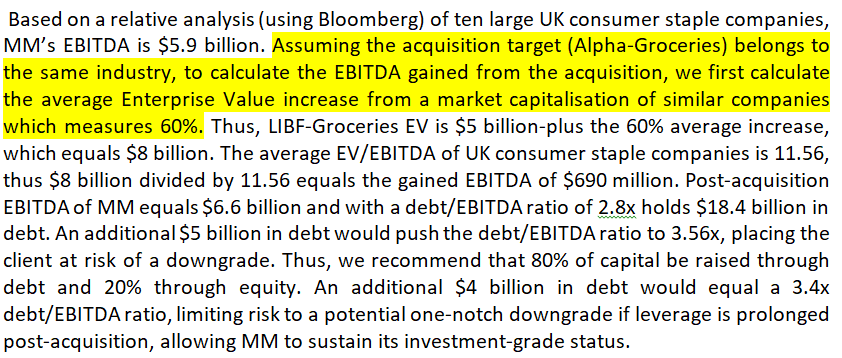
Based on a relative analysis (using Bloomberg) of ten large UK consumer staple companies, MM's EBITDA is $5.9 billion. Assuming the acquisition target (Alpha-Groceries) belongs to the same industry, to calculate the EBITDA gained from the acquisition, we first calculate the average Enterprise Value increase from a market capitalisation of similar companies which measures 60%. Thus, LIBF-Groceries EV is $5 billion-plus the 60% average increase, which equals $8 billion. The average EV/EBITDA of UK consumer staple companies is 11.56, thus $8 billion divided by 11.56 equals the gained EBITDA of $690 million. Post-acquisition EBITDA of MM equals $6.6 billion and with a debt/EBITDA ratio of 2.8x holds $18.4 billion in debt. An additional $5 billion in debt would push the debt/EBITDA ratio to 3.56x, placing the client at risk of a downgrade. Thus, we recommend that 80% of capital be raised through debt and 20% through equity. An additional $4 billion in debt would equal a 3.4x debt/EBITDA ratio, limiting risk to a potential one-notch downgrade if leverage is prolonged post-acquisition, allowing MM to sustain its investment-grade status
Step by Step Solution
There are 3 Steps involved in it
1 Expert Approved Answer
Step: 1 Unlock

Question Has Been Solved by an Expert!
Get step-by-step solutions from verified subject matter experts
Step: 2 Unlock
Step: 3 Unlock

Students Have Also Explored These Related Accounting Questions!