Question: could you please help me make a logic puzzle with the following guidelines to successfully complete the puzzle: Your puzzle must involve the principle of
could you please help me make a logic puzzle with the following guidelines to successfully complete the puzzle:
Your puzzle must involve the principle of inclusion and exclusion and must have a minimum of seven clues to help solve the puzzle.
Ensure that your puzzle is solvable by having a classmate or other appropriate partner try to solve it.
While you observe your partner solving the puzzle, record the strategies used in the puzzle solution.
After your partner has solved the puzzle, discuss which clues worked well and which clues may need a bit of improvement. Make these revisions to your puzzle.
You must include the following elements in your puzzle:
clear and concise clues to your puzzle
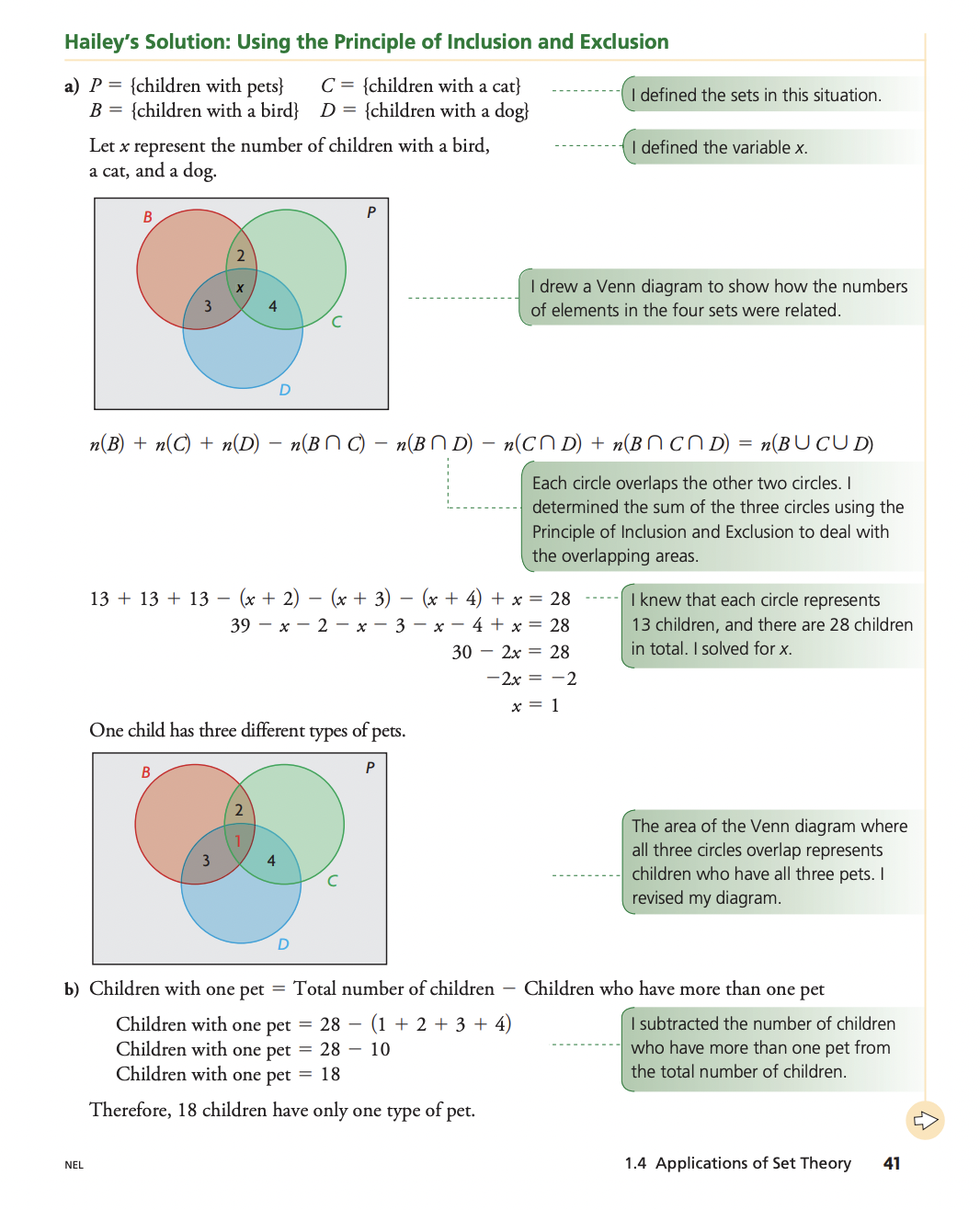
a detailed solution to your puzzle, which should include all diagrams, charts, formulas, algebraic steps, and a description of the logic used in solving the puzzle
References:
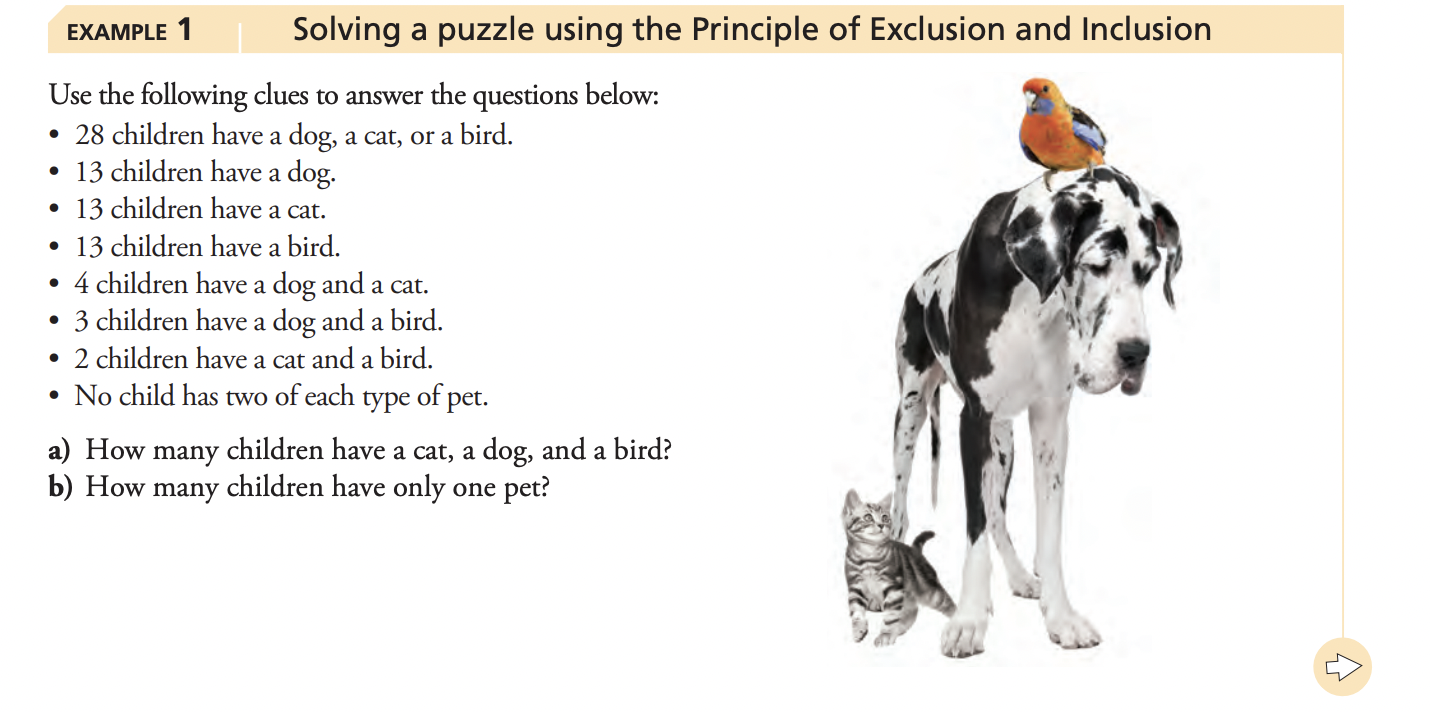
Here is an example of a puzzle:
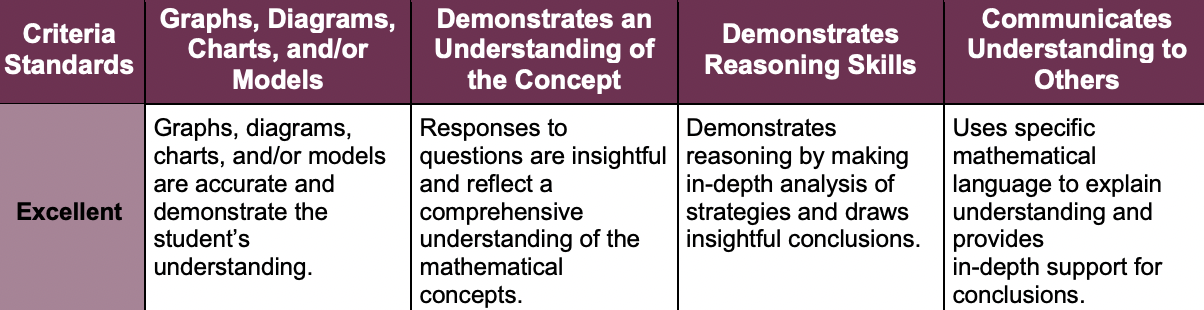
Communicates Understanding to Others Graphs, Diagrams, Demonstrates an Charts, andlor Understanding of Demonstrates Reasoning Skills Criteria Standards Models the Concept Demonstrates reasoning by making Graphs, diagrams. charts, and/or models Responses to questions are insightful Uses specific mathematical are accurate and and reect a in-depth analysis of language to explain demonstrate the comprehensive strategies and draws understanding and student's understanding of the insightful conclusions. provides understanding. mathematical in-depth support for concepts. conclusions. EXAMPLE 1 Solving a puzzle using the Principle of Exclusion and Inclusion Use the following clues to answer the questions below: - 28 children have a dog, a cat, or a bird. - 13 children have a dog. ' 13 children have a cat. ' 13 children have a bird. ' 4 children have a dog and a cat. ' 3 children have a dog and a bird. - 2 children have a cat and a bird. 0 No child has two of each type of pet. a) How many children have a cat, a dog, and a bird? b) How many children have only one pet? Hailey's Solution: Using the Principle of Inclusion and Exclusion a) P = {children with pets} C = {children with a cat} I defined the sets in this situation. B = {children with a bird} D = {children with a dog} Let x represent the number of children with a bird, I defined the variable x. a cat, and a dog. I drew a Venn diagram to show how the numbers of elements in the four sets were related. n(B) + n(C) + n(D) - n(BN C) - n(BND) - n(CN D) + n(Bn CND) = n(BU CUD) Each circle overlaps the other two circles. I determined the sum of the three circles using the Principle of Inclusion and Exclusion to deal with the overlapping areas. 13 + 13 + 13 - (x + 2) - (x + 3) - (x + 4) + x=28 I knew that each circle represents 39 - x-2 -x- 3-x- 4+x=28 13 children, and there are 28 children 30 - 2x = 28 in total. I solved for x. -2x = -2 x = 1 One child has three different types of pets. The area of the Venn diagram where all three circles overlap represents children who have all three pets. I revised my diagram. b) Children with one pet = Total number of children - Children who have more than one pet Children with one pet = 28 - (1 + 2 + 3 + 4) I subtracted the number of children Children with one pet = 28 - 10 who have more than one pet from Children with one pet = 18 the total number of children. Therefore, 18 children have only one type of pet. NEL 1.4 Applications of Set Theory 41
Step by Step Solution
There are 3 Steps involved in it
1 Expert Approved Answer
Step: 1 Unlock

Question Has Been Solved by an Expert!
Get step-by-step solutions from verified subject matter experts
Step: 2 Unlock
Step: 3 Unlock

Students Have Also Explored These Related Mathematics Questions!