







Question: Coulomb's Law PhET There are forces being exerted between electrically charged objects. What variables affect that force? To determine that answer, we will be using
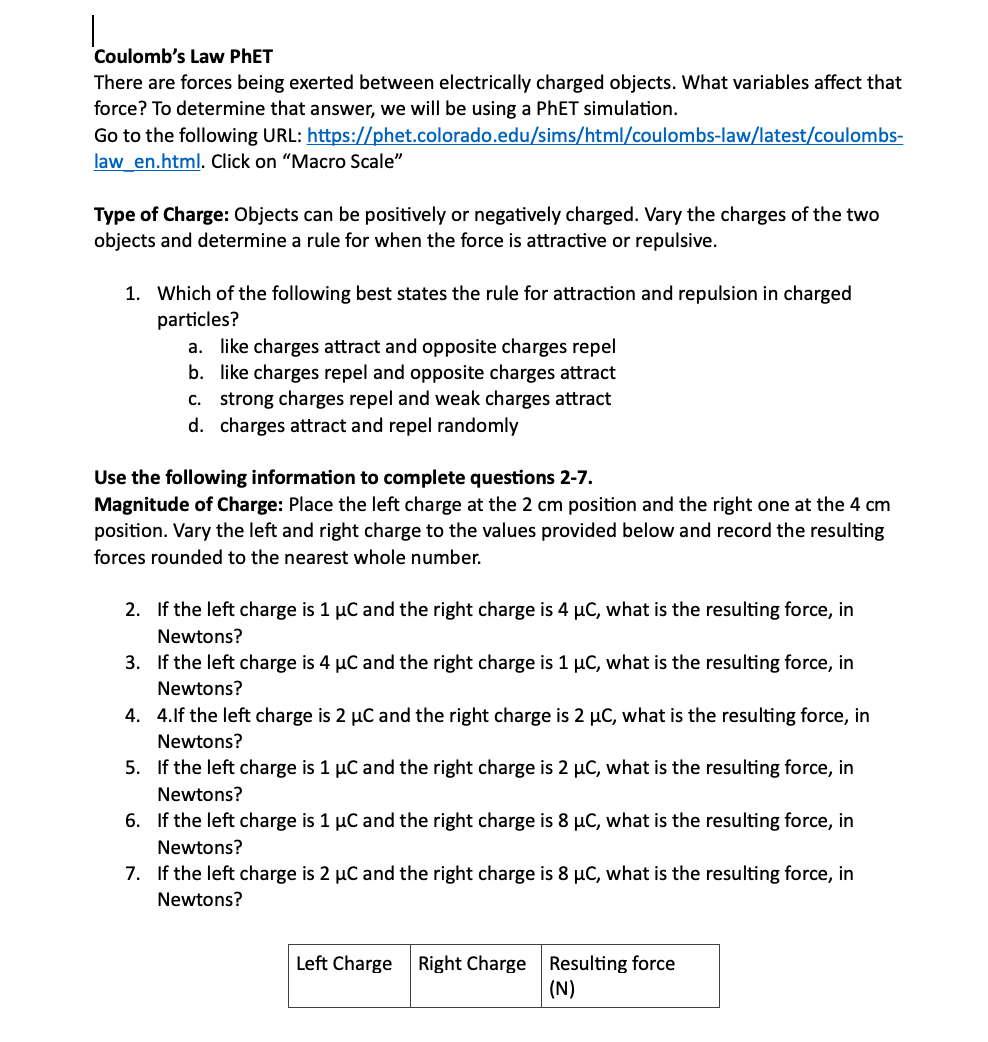
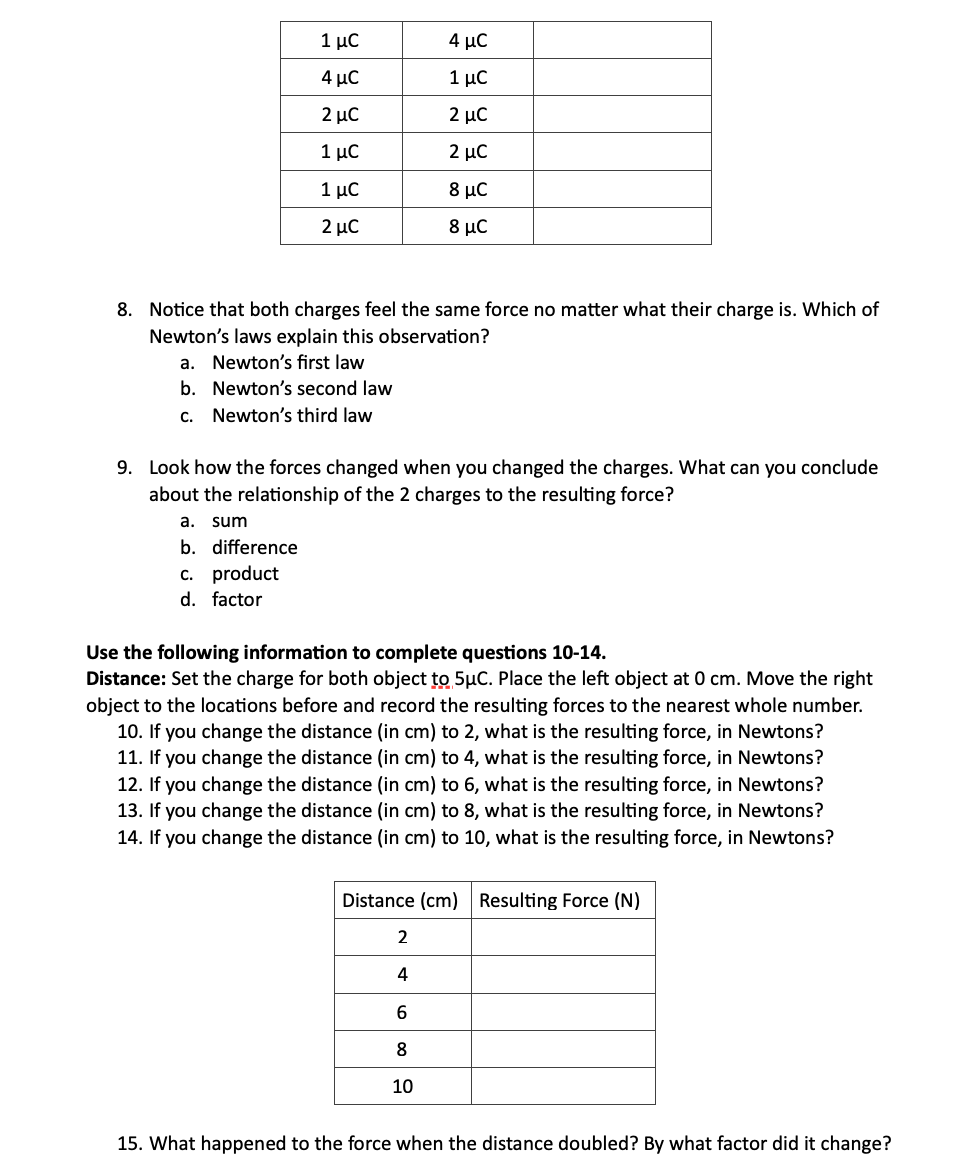
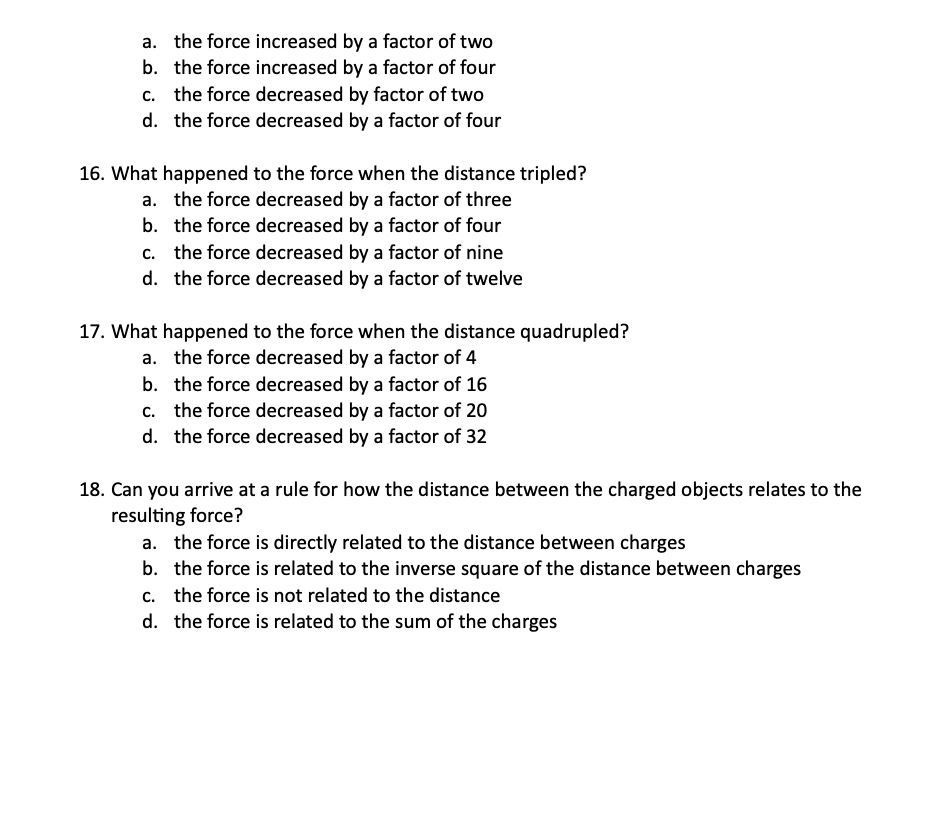
Coulomb's Law PhET There are forces being exerted between electrically charged objects. What variables affect that force? To determine that answer, we will be using a PhET simulation. Go to the following URL: httsz/phettolorado.edufsims/htmllcoulombs-lawllatest/coulombs- law en.html. Click on \"Macro Scale\" Type of Charge: Objects can be positively or negatively charged. Vary the charges of the two objects and determine a rule for when the force is attractive or repulsive. 1. Which of the following best states the rule for attraction and repulsion in charged particles? a. like charges attract and opposite charges repel b. like charges repel and opposite charges attract c. strong charges repel and weak charges attract d. charges attract and repel randomly Use the following information to complete questions 2-7. Magnitude of Charge: Place the left charge at the 2 cm position and the right one at the 4 cm position. Vary the left and right charge to the values provided below and record the resulting forces rounded to the nearest whole number. 2. If the left charge is 1 pC and the right charge is 4 uC, what is the resulting force, in Newtons? 3. If the left charge is 4 uC and the right charge is 1 uC, what is the resulting force, in Newtons? 4. 4.|f the left charge is 2 uC and the right charge is 2 uC, what is the resulting force, in Newtons? 5. If the left charge is 1 uC and the right charge is 2 uC, what is the resulting force, in Newtons? 6. If the left charge is 1 uC and the right charge is 8 uC, what is the resulting force, in Newtons? 7. If the left charge is 2 pC and the right charge is 8 uC, what is the resulting force, in Newtons? Left Charge Right Charge Resulting force (N) 8. Notice that both charges feel the same force no matter what their charge is. Which of Newton's laws explain this observation? a. Newton's first law b. Newton's second law c. Newton's third law 9. Look how the forces changed when you changed the charges. What can you conclude about the relationship of the 2 charges to the resulting force? a. sum b. difference c. product d. factor Use the following information to complete questions 10-14. Distance: Set the charge for both object FQSHC. Place the left object at 0 cm. Move the right object to the locations before and record the resulting forces to the nearest whole number. 10. If you change the distance (in cm) to 2, what is the resulting force, in Newtons? 11. If you change the distance (in cm) to 4, what is the resulting force, in Newtons? 12. If you change the distance (in cm) to 6, what is the resulting force, in Newtons? 13. If you change the distance (in cm) to 8, what is the resulting force, in Newtons? 14. If you change the distance (in cm) to 10', what is the resulting force, in Newtons? Distance (cm) Resulting Force (N) 2 4 6 8 10' 15. What happened to the force when the distance doubled? By what factor did it change? the force increased by a factor of two the force increased by a factor of four the force decreased by factor of two the force decreased by a factor of four so .09: 16. What happened to the force when the distance tripled? a. the force decreased by a factor of three b. the force decreased by a factor of four c. the force decreased by a factor of nine d. the force decreased by a factor of twelve 17. What happened to the force when the distance quadrupled? a. the force decreased by a factor of 4 b. the force decreased by a factor of 16 c. the force decreased by a factor of 20 d. the force decreased by a factor of 32 18. Can you arrive at a rule for how the distance between the charged objects relates to the resulting force? a. the force is directly related to the distance between charges b. the force is related to the inverse square of the distance between charges c. the force is not related to the distance d. the force is related to the sum of the charges
Step by Step Solution
There are 3 Steps involved in it

Get step-by-step solutions from verified subject matter experts
 Study Help