







Question: Counter In this lab, you'll implement the map abstract data type. This map uses strings as keys and integers as values, and supports fast lookup
Counter
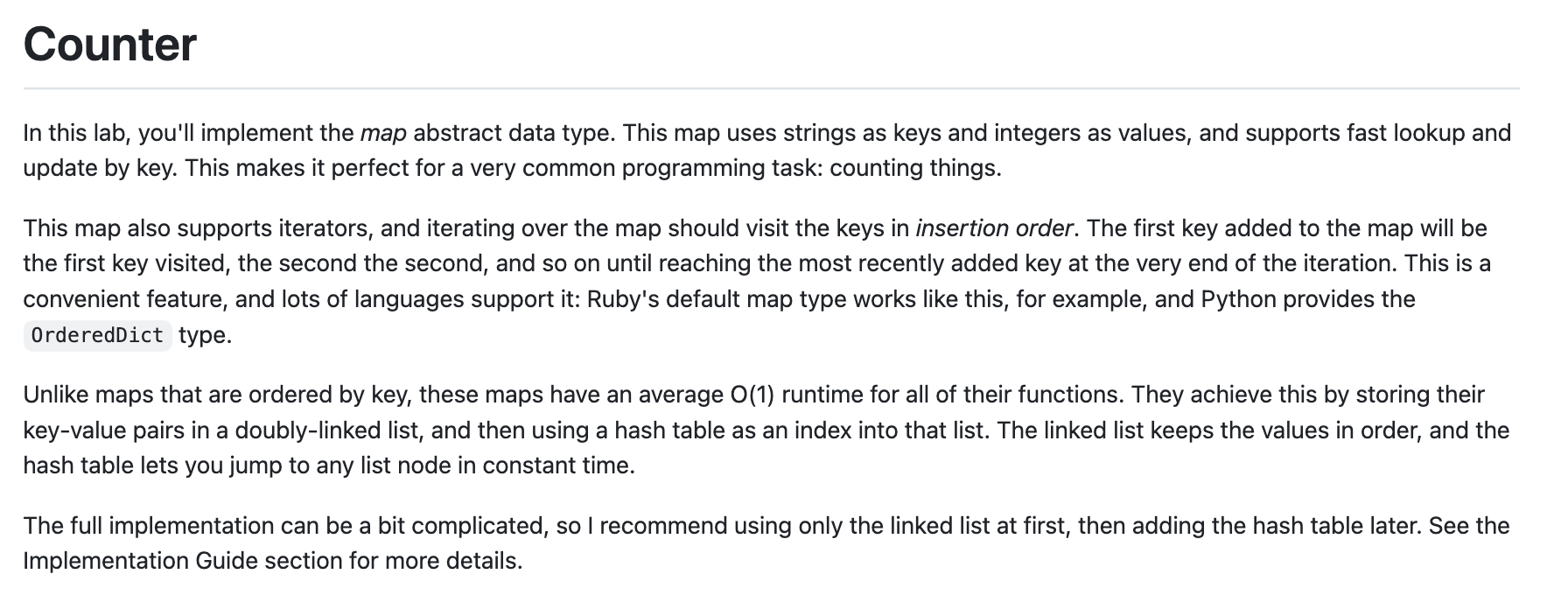
In this lab, you'll implement the map abstract data type. This map uses strings as keys and integers as values, and supports fast lookup and
update by key. This makes it perfect for a very common programming task: counting things.
This map also supports iterators, and iterating over the map should visit the keys in insertion order. The first key added to the map will be
the first key visited, the second the second, and so on until reaching the most recently added key at the very end of the iteration. This is a
convenient feature, and lots of languages support it: Ruby's default map type works like this, for example, and Python provides the
OrderedDict type.
Unlike maps that are ordered by key, these maps have an average runtime for all of their functions. They achieve this by storing their
keyvalue pairs in a doublylinked list, and then using a hash table as an index into that list. The linked list keeps the values in order, and the
hash table lets you jump to any list node in constant time.
The full implementation can be a bit complicated, so I recommend using only the linked list at first, then adding the hash table later. See the
Implementation Guide section for more details.
Step by Step Solution
There are 3 Steps involved in it
1 Expert Approved Answer
Step: 1 Unlock

Question Has Been Solved by an Expert!
Get step-by-step solutions from verified subject matter experts
Step: 2 Unlock
Step: 3 Unlock
 Study Help