



Question: Course: Computer Architecture and Organisation Can you solve this Exercises 1 & 2? Exercise 1 [3pts] Based on Neumann architecture, any piece of information (e.g.,
Course: Computer Architecture and Organisation
Can you solve this Exercises 1 & 2?
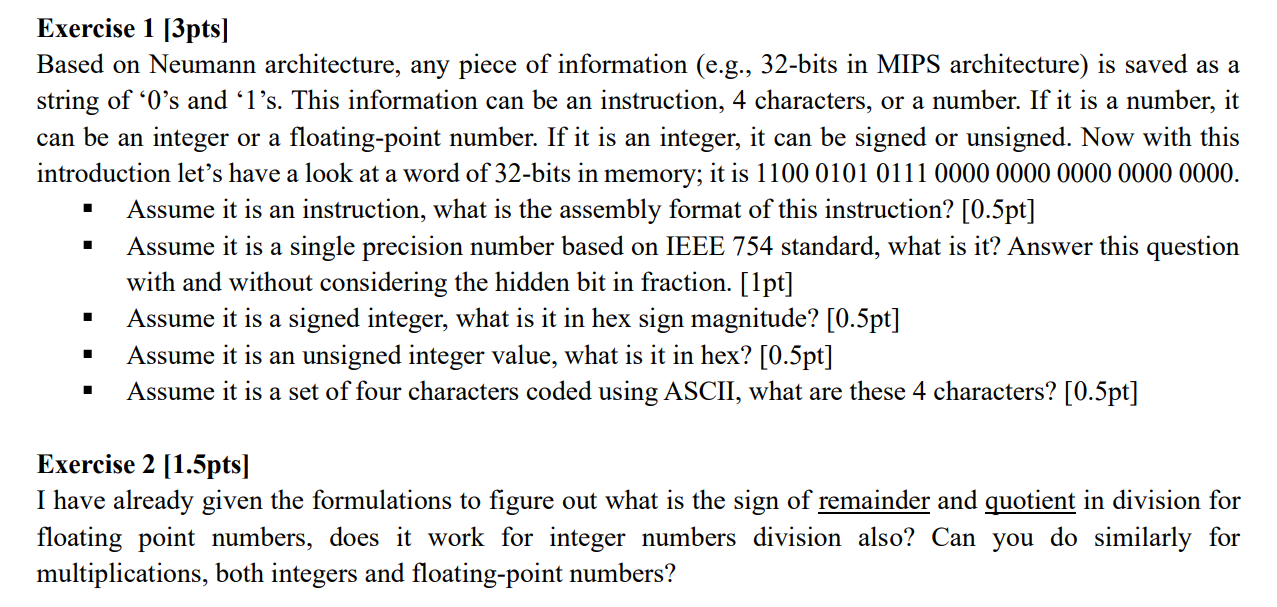
Exercise 1 [3pts] Based on Neumann architecture, any piece of information (e.g., 32-bits in MIPS architecture) is saved as a string of ' 0 's and ' 1 's. This information can be an instruction, 4 characters, or a number. If it is a number, it can be an integer or a floating-point number. If it is an integer, it can be signed or unsigned. Now with this introduction let's have a look at a word of 32-bits in memory; it is 11000101011100000000000000000000 . - Assume it is an instruction, what is the assembly format of this instruction? [0.5pt] - Assume it is a single precision number based on IEEE 754 standard, what is it? Answer this question with and without considering the hidden bit in fraction. [1pt] - Assume it is a signed integer, what is it in hex sign magnitude? [0.5pt] - Assume it is an unsigned integer value, what is it in hex? [0.5pt] - Assume it is a set of four characters coded using ASCII, what are these 4 characters? [0.5pt] Exercise 2 [1.5pts] I have already given the formulations to figure out what is the sign of remainder and quotient in division for floating point numbers, does it work for integer numbers division also? Can you do similarly for multiplications, both integers and floating-point numbers
Step by Step Solution
There are 3 Steps involved in it

Get step-by-step solutions from verified subject matter experts