Question: COURSE : Program Management & Impact Assesment PROJECT: Germany will finance renewable energy facilities in le Maurice (100% renewable energy for public primary education institutions),
COURSE: Program Management & Impact Assesment
PROJECT: Germany will finance renewable energy facilities in le Maurice (100% renewable energy for public primary education institutions), to offset the renewable energy production and take in the renewable bonus.
TOPIC: We came up with an imaginary project we need to present, and I will be in charge of the following part: Monitoring and Risk Management (Risk Mngmt Plan, Risk Matrix etc)
Interconnection:Monitoring ensures the project stays on track towards achieving the desired impact, while risk management addresses potential issues proactively.
TASK: Help me getting the Monitoring and Risk Managment anlysis for our project, and also helping with what have to put into the pp presentation, considering that I should be talking for about 3minutes.
This is what I have come up so far in terms of Risks:
Byproducts from install (trash/waste, unusable resources) -> pollution to the ocean from all the extra trash during install ( mitigation could be using them for training programs)
What do we do with the panels at the end of the life cycle (30 years)
NO AI PLEASE
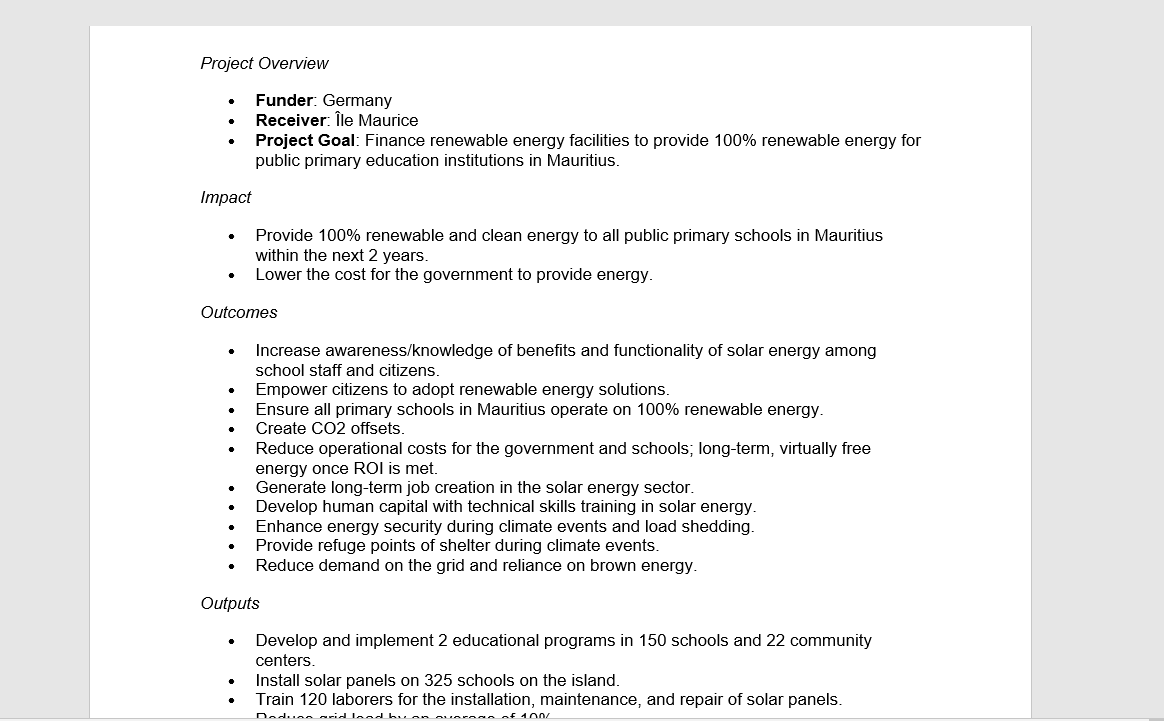
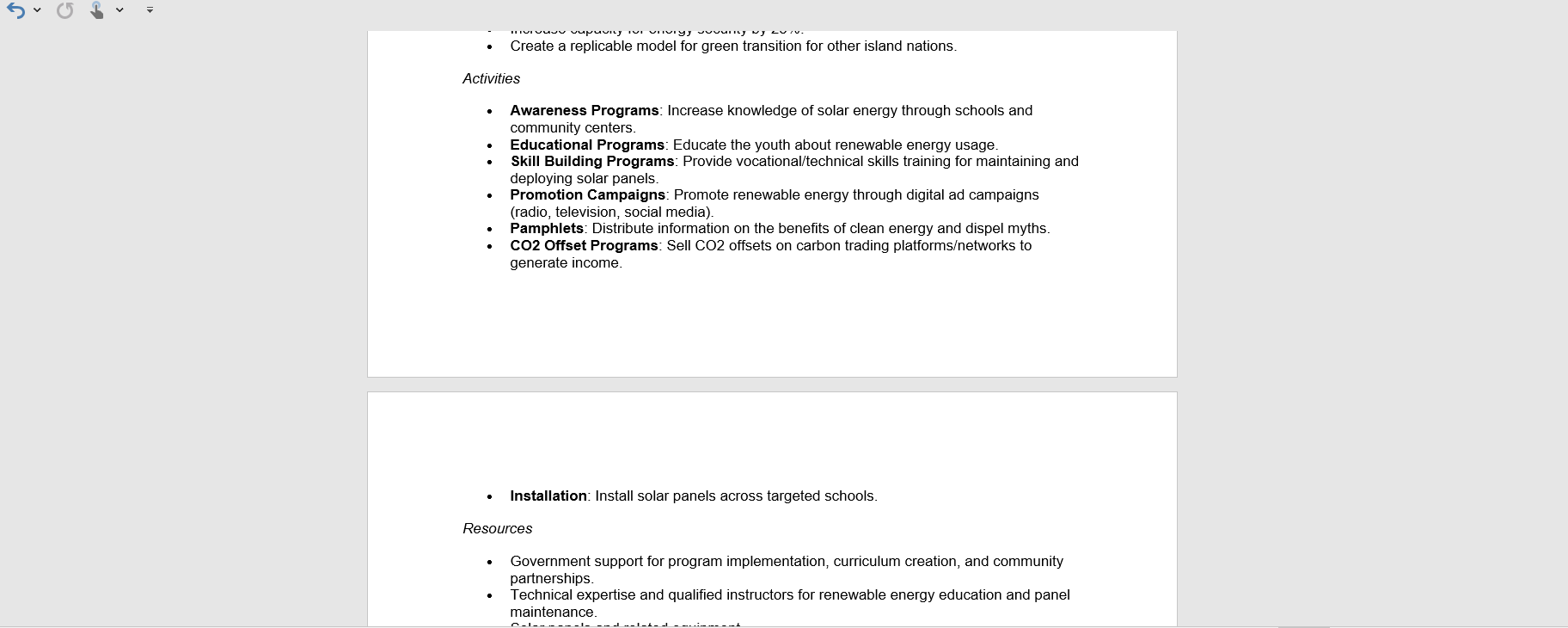
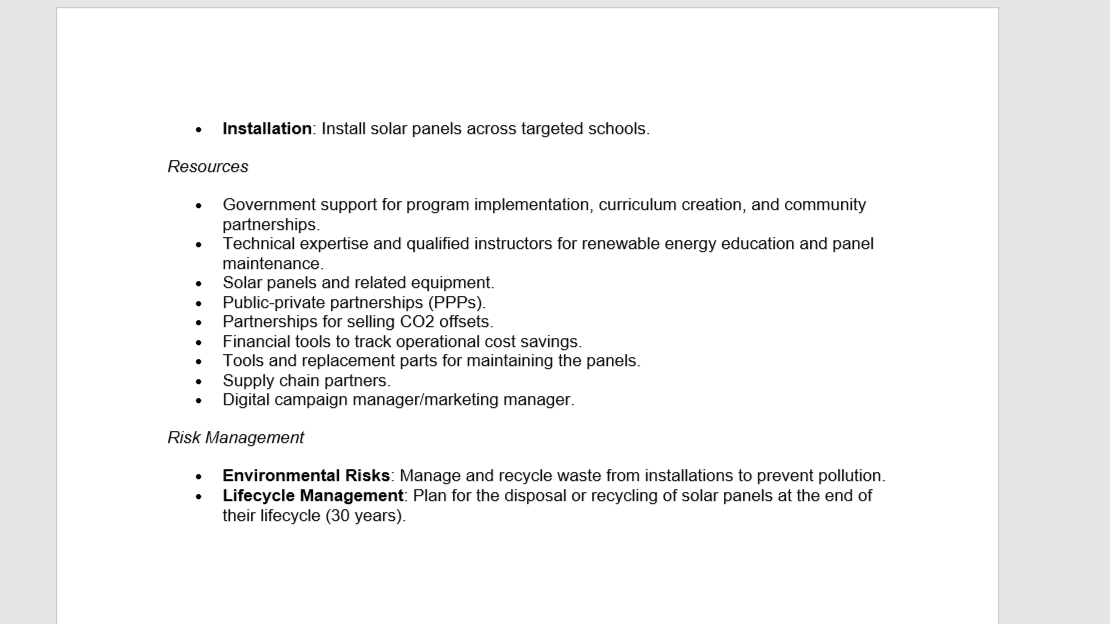
Project Overview Funder: Germany . . Receiver: lle Maurice Project Goal: Finance renewable energy facilities to provide 100% renewable energy for public primary education institutions in Mauritius. Impact . Provide 100% renewable and clean energy to all public primary schools in Mauritius within the next 2 years. . Lower the cost for the government to provide energy. Outcomes . Increase awareness/knowledge of benefits and functionality of solar energy among school staff and citizens. Empower citizens to adopt renewable energy solutions. Ensure all primary schools in Mauritius operate on 100% renewable energy. . . . . Create CO2 offsets Reduce operational costs for the government and schools; long-term, virtually free energy once ROI is met. Generate long-term job creation in the solar energy sector. Develop human capital with technical skills training in solar energy. Enhance energy security during climate events and load shedding. . . . Provide refuge points of shelter during climate events. Reduce demand on the grid and reliance on brown energy. Outputs . Develop and implement 2 educational programs in 150 schools and 22 community centers. Install solar panels on 325 schools on the island. . . Train 120 laborers for the installation, maintenance, and repair of solar panels. n.e ease. Create a replicable model for green transition for other island nations. Activities Awareness Programs: Increase knowledge of solar energy through schools and community centers Educational Programs: Educate the youth about renewable energy usage. Skill Building Programs: Provide vocational/technical skills training for maintaining and deploying solar panels. Promotion Campaigns: Promote renewable energy through digital ad campaigns (radio, television, social media). Pamphlets: Distribute information on the benefits of clean energy and dispel myths. CO02 Offset Programs: Sell CO2 offsets on carbon trading platformsetworks to generate income Installation: Install solar panels across targeted schools. Resources Government support for program implementation, curriculum creation, and community partnerships Technical expertise and qualified instructors for renewable energy education and panel maintenance Installation: Install solar panels across targeted schools. Resources Government support for program implementation, curriculum creation, and community partnerships. Technical expertise and qualified instructors for renewable energy education and panel maintenance. Solar panels and related equipment. Public-private partnerships (PPPs). Partnerships for selling CO2 offsets. Financial tools to track operational cost savings. Tools and replacement parts for maintaining the panels. Supply chain partners. Digital campaign manager/marketing manager. Risk Management Environmental Risks: Manage and recycle waste from installations to prevent pollution. Lifecycle Management: Plan for the disposal or recycling of solar panels at the end of their lifecycle (30 years)
Step by Step Solution
There are 3 Steps involved in it
1 Expert Approved Answer
Step: 1 Unlock
Question Has Been Solved by an Expert!
Get step-by-step solutions from verified subject matter experts
Step: 2 Unlock
Step: 3 Unlock
Students Have Also Explored These Related General Management Questions!









 Study Help