Question: Course Title: Reliability and Maintenance Management. Course No.: 57024403-3. Project Descriptions: You are asked to run an inspection for the living room and submit a
Course Title: Reliability and Maintenance
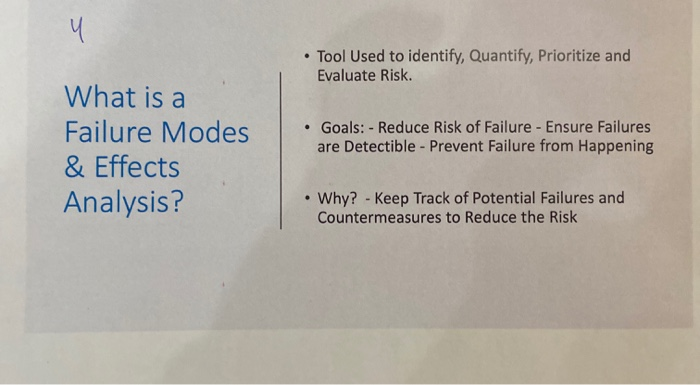
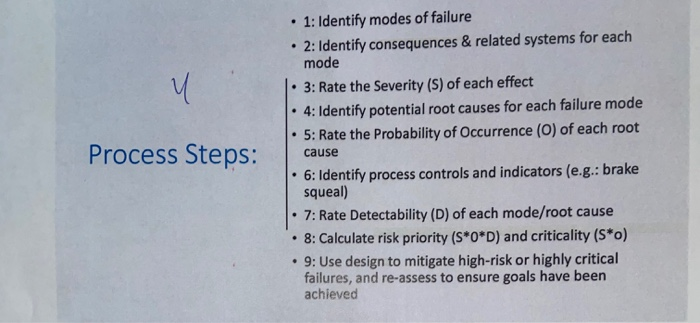
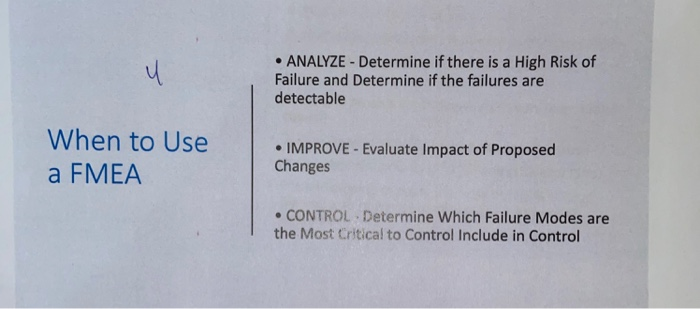
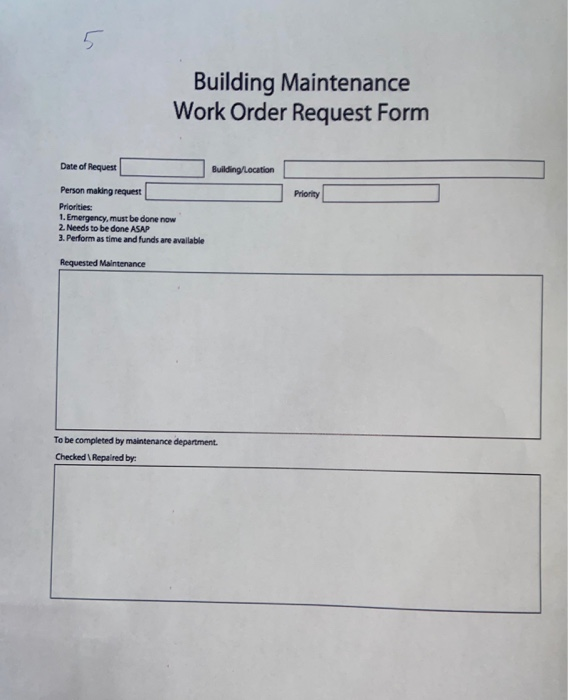
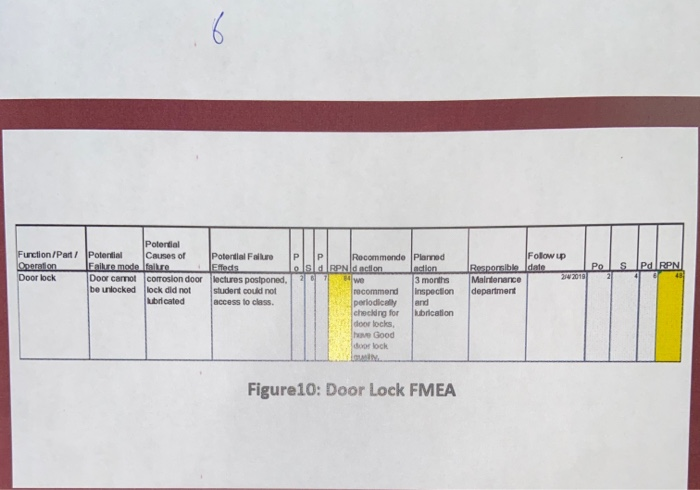
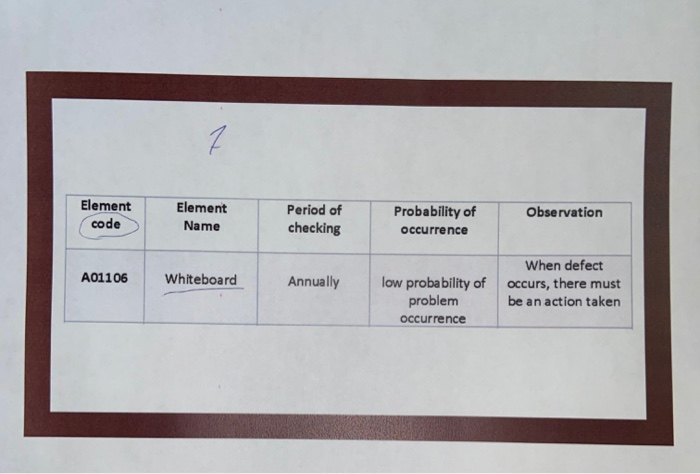
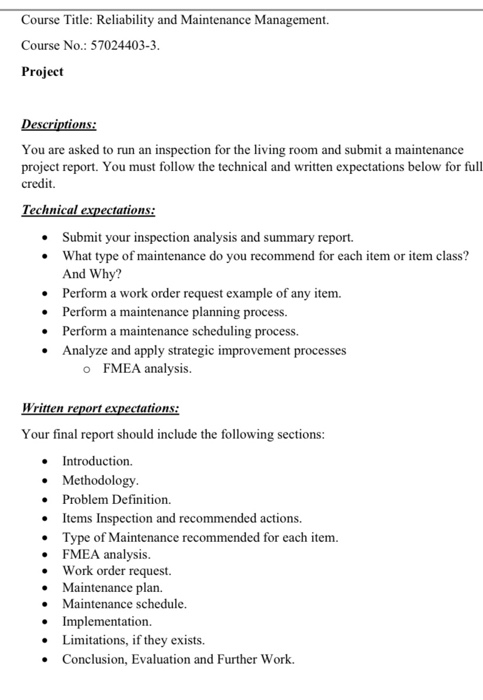
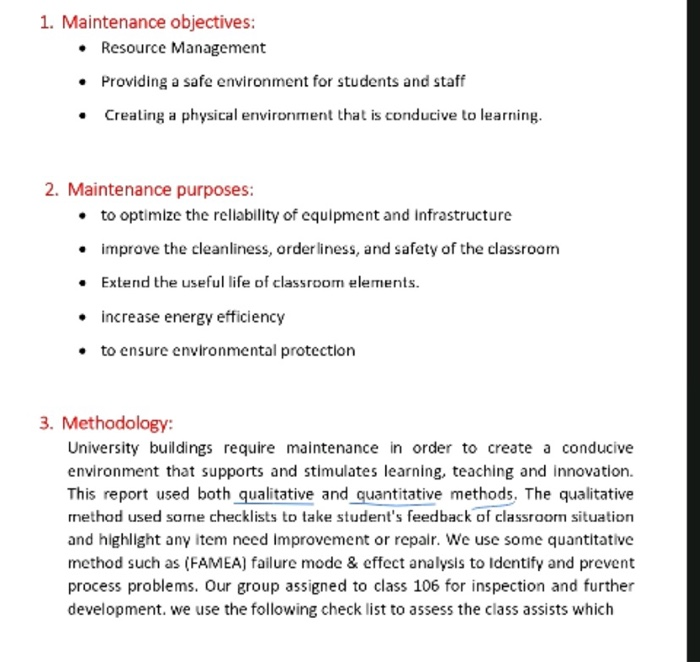
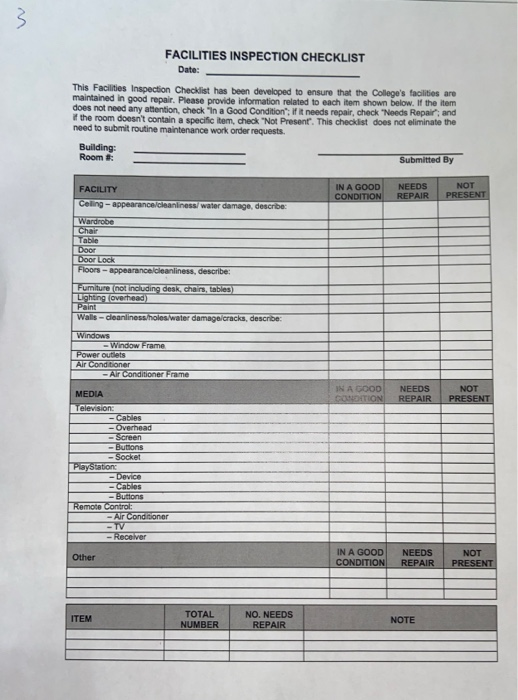
Course Title: Reliability and Maintenance Management. Course No.: 57024403-3. Project Descriptions: You are asked to run an inspection for the living room and submit a maintenance project report. You must follow the technical and written expectations below for full credit. Technical expectations: Submit your inspection analysis and summary report. What type of maintenance do you recommend for each item or item class? And Why? Perform a work order request example of any item. Perform a maintenance planning process. Perform a maintenance scheduling process. Analyze and apply strategic improvement processes OFMEA analysis. Written report expectations: Your final report should include the following sections: Introduction Methodology. Problem Definition. Items Inspection and recommended actions. FMEA analysis. Work order request. Maintenance plan. Maintenance schedule. Implementation. Limitations, if they exists. Conclusion, Evaluation and Further Work. 1. Maintenance objectives: Resource Management Providing a safe environment for students and staff Creating a physical environment that is conducive to learning. 2. Maintenance purposes: to optimize the reliability of equipment and infrastructure improve the cleanliness, orderliness, and safety of the classroom Extend the useful life of classroom elements. increase energy efficiency to ensure environmental protection 3. Methodology: University buildings require maintenance in order to create a conducive environment that supports and stimulates learning, teaching and innovation. This report used both qualitative and quantitative methods. The qualitative method used some checklists to take student's feedback of classroom situation and highlight any item need Improvement or repair. We use some quantitative method such as (FAMEA) failure mode & effect analysis to identify and prevent process problems. Our group assigned to class 106 for inspection and further development. We use the following check list to assess the class assists which FACILITIES INSPECTION CHECKLIST Date: This Facilities Inspection Checklist has been developed to ensure that the College's faces are maintained in good repair. Please provide information related to each item shown below. If the Rom does not need any attention, check in a Good Condition, it needs repair, check "Needs Repair, and the room doesn't contain a specific term, check "Not Present. This checklist does not liminate the need to submit routine maintenance work order requests Building Room Submitted by IN A GOOD CONDITION NEEDS REPAIR NOT PRESENT Coling - appearance cleanliness water damage describe: Wardrobe Chair Table Door Door LOCK Floors-appearance cleanliness, describe: Furniture not including desk, chairs, tables Lighting Overhead) Paint Walls - cleanliness/holes/water damage cracks, describe: -Window Frame Power outlets Air Conditioner - Air Conditioner Frame IN A GOOD ATION NEEDS REPAIR NOT PRESENT C MEDIA levision -Cables Bons -Socket - Ar Condi IN A GOOD NEEDS CONDITIONREPAIR NOT PRESENT TOTALN O. NEEDS NUMBER REPAIR NOTE Tool Used to identify, Quantify, Prioritize and Evaluate Risk. What is a Failure Modes & Effects Analysis? Goals: - Reduce Risk of Failure - Ensure Failures are Detectible - Prevent Failure from Happening Why? - Keep Track of Potential Failures and Countermeasures to Reduce the Risk Process Steps: 1: Identify modes of failure 2: Identify consequences & related systems for each mode . 3: Rate the severity (S) of each effect 4: Identify potential root causes for each failure mode 5: Rate the probability of Occurrence (O) of each root cause 6: Identify process controls and indicators (e.g.: brake squeal) 7: Rate Detectability (D) of each mode/root cause 8: Calculate risk priority (S*0*D) and criticality (S*o) 9: Use design to mitigate high-risk or highly critical failures, and re-assess to ensure goals have been achieved ANALYZE - Determine if there is a High Risk of Failure and Determine if the failures are detectable When to Use a FMEA IMPROVE - Evaluate Impact of Proposed Changes CONTROL Determine which Failure Modes are the Most Critical to Control Include in Control Building Maintenance Work Order Request Form Building Location Priority Date of Request Person making request Priorities: 1. Emergency must be done now 2. Needs to be done ASAP 3. Perform as time and funds are available Requested Maintenance To be completed by maintenance department. Checked\Repaired by: Pols Pd RP Potential Function/Part/ Potential Causes of potential Four Recommende planned Operation Failure made faire Fifas To Isla RPN daction action Door lock Door cannot corrosion door lectures postponed, 3 months be unlocked lock did not student could not recommend Inspection Lubricated access to class periodically checiding for brication door locks, have Good laoorbok Follow up Responsible date Maintenance department and Figure 10: Door Lock FMEA Observation Element code Element Name Period of checking Probability of occurrence A01106 Whiteboard Annually low probability of problem occurrence When defect occurs, there must be an action taken
Step by Step Solution

There are 3 Steps involved in it

1 Expert Approved Answer
Step: 1 Unlock blur-text-image

Question Has Been Solved by an Expert!

Get step-by-step solutions from verified subject matter experts

Step: 2 Unlock
Step: 3 Unlock

Students Have Also Explored These Related General Management Questions!