







Question: Coursepack, p. 461 MAT 133: 1.4 WS 2 p.2 2. Suppose a church is considering purchasing new hymnals (books that contain the hymns sung
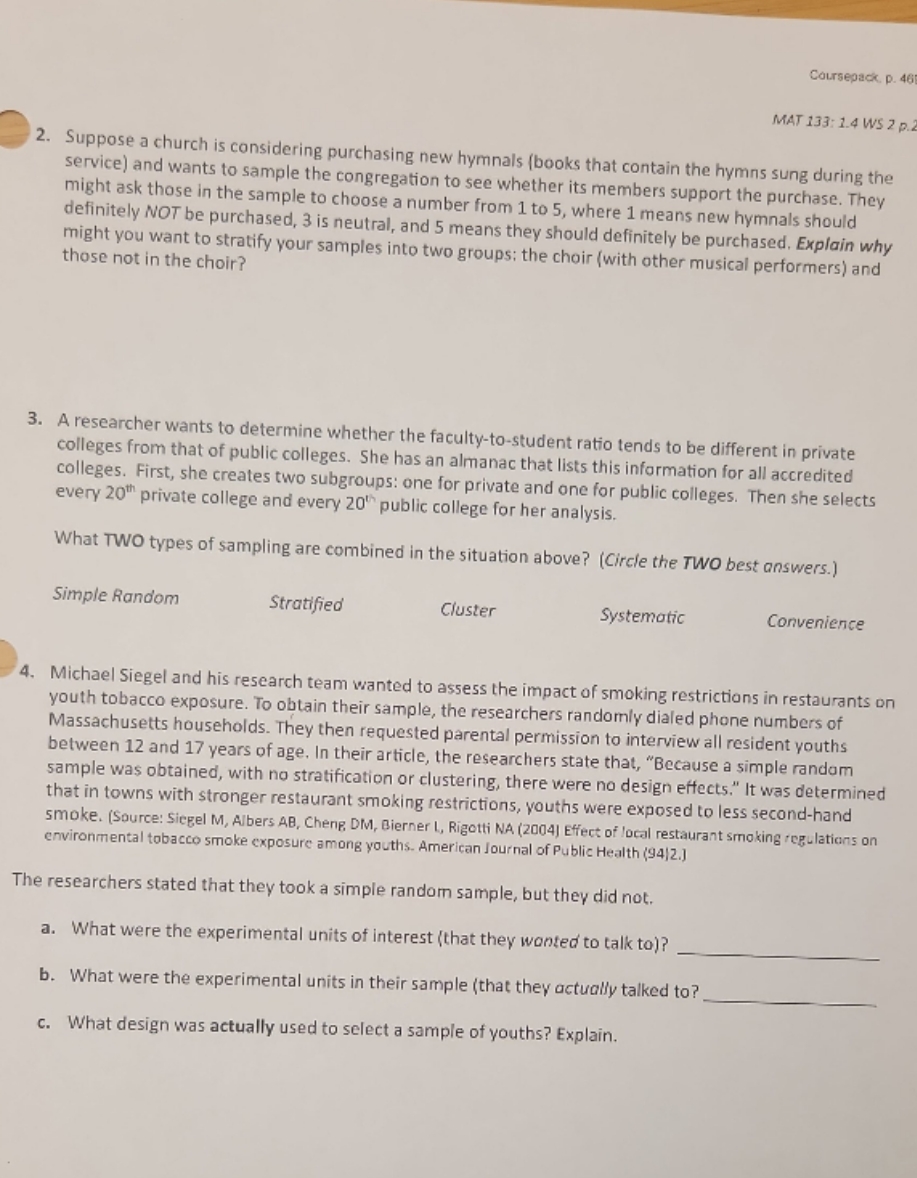
Coursepack, p. 461 MAT 133: 1.4 WS 2 p.2 2. Suppose a church is considering purchasing new hymnals (books that contain the hymns sung during the service) and wants to sample the congregation to see whether its members support the purchase. They might ask those in the sample to choose a number from 1 to 5, where 1 means new hymnals should definitely NOT be purchased, 3 is neutral, and 5 means they should definitely be purchased. Explain why might you want to stratify your samples into two groups: the choir (with other musical performers) and those not in the choir? 3. A researcher wants to determine whether the faculty-to-student ratio tends to be different in private colleges from that of public colleges. She has an almanac that lists this information for all accredited colleges. First, she creates two subgroups: one for private and one for public colleges. Then she selects every 20th private college and every 20 public college for her analysis. What TWO types of sampling are combined in the situation above? (Circle the TWO best answers.) Simple Random Stratified Cluster Systematic Convenience 4. Michael Siegel and his research team wanted to assess the impact of smoking restrictions in restaurants on youth tobacco exposure. To obtain their sample, the researchers randomly dialed phone numbers of Massachusetts households. They then requested parental permission to interview all resident youths between 12 and 17 years of age. In their article, the researchers state that, "Because a simple random sample was obtained, with no stratification or clustering, there were no design effects." It was determined that in towns with stronger restaurant smoking restrictions, youths were exposed to less second-hand smoke. (Source: Siegel M, Albers AB, Cheng DM, Bierner L, Rigotti NA (2004) Effect of local restaurant smoking regulations on environmental tobacco smoke exposure among youths. American Journal of Public Health (94)2.) The researchers stated that they took a simple random sample, but they did not. a. What were the experimental units of interest (that they wanted to talk to)? b. What were the experimental units in their sample (that they actually talked to? c. What design was actually used to select a sample of youths? Explain.
Step by Step Solution
There are 3 Steps involved in it

Get step-by-step solutions from verified subject matter experts
 Study Help