







Question: Courses Home - Google Drive Reflection B - Google Docs Grammarly Case Files and Memos Ethical Lenses - Resources - Contact Us trenell.gibson@utoledo.edu - The
Courses
Home Google Drive
Reflection B Google Docs
Grammarly
Case Files and Memos
Ethical Lenses
Resources
Contact Us
trenell.gibson@utoledo.edu
The Case of the Lamentable Launch Page of
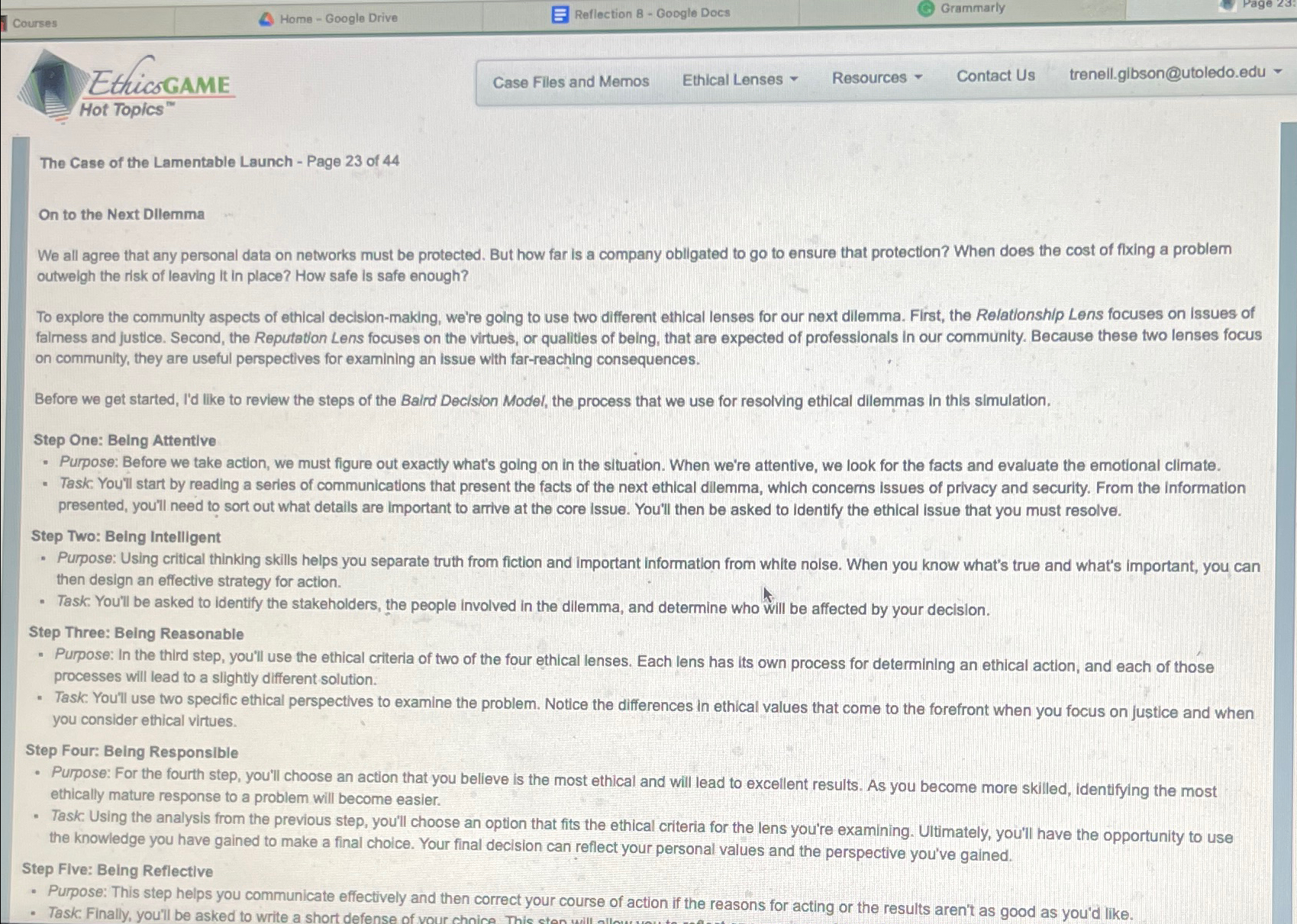
On to the Next Dilemma
We all agree that any personal data on networks must be protected. But how far is a company obligated to go to ensure that protection? When does the cost of fixing a problem outweigh the risk of leaving it in place? How safe is safe enough?
To explore the community aspects of ethical decisionmaking, we're going to use two different ethical lenses for our next dilemma. First, the Relationship Lens focuses on issues of falmess and justice. Second, the Reputation Lens focuses on the virtues, or qualities of being, that are expected of professionals in our community. Because these two lenses focus on community, they are useful perspectives for examining an issue with farreaching consequences.
Before we get started, Id like to review the steps of the Balrd Decision Model, the process that we use for resolving ethical dilemmas in this simulation.
Step One: Belng Attentive
Purpose: Before we take action, we must figure out exactly what's going on in the situation. When we're attentive, we look for the facts and evaluate the emotional climate.
Task. You'il start by reading a series of communications that present the facts of the next ethical dilemma, which concerns issues of privacy and security. From the information presented, you'll need to sort out what details are important to arrive at the core issue. You'll then be asked to identify the ethical issue that you must resolve.
Step Two: Being Intelligent
Purpose: Using critical thinking skills helps you separate truth from fiction and important information from white nolse. When you know what's true and what's important, you can then design an effective strategy for action.
Task: You'll be asked to identify the stakeholders, the people involved in the dilemma, and determine who will be affected by your decision.
Step Three: Being Reasonable
Purpose: In the third step, you'll use the ethical criteria of two of the four ethical lenses. Each lens has its own process for determining an ethical action, and each of those processes will lead to a slightly different solution.
Task: You'll use two specific ethical perspectives to examine the problem. Notice the differences in ethical values that come to the forefront when you focus on justice and when you consider ethical virtues.
Step Four: Being Responslble
Purpose: For the fourth step, you'll choose an action that you believe is the most ethical and will lead to excellent results. As you become more skilled, identifying the most ethically mature response to a problem will become easier.
Task: Using the analysis from the previous step, you'll choose an option that fits the ethical criteria for the lens you're examining. Ultimately, you'll have the opportunity to use the knowledge you have galned to make a final choice. Your final decision can reflect your personal values and the perspective you've gained.
Step FIve: Being Reflective
Step by Step Solution
There are 3 Steps involved in it
1 Expert Approved Answer
Step: 1 Unlock

Question Has Been Solved by an Expert!
Get step-by-step solutions from verified subject matter experts
Step: 2 Unlock
Step: 3 Unlock
 Study Help