



Question: /courses/_5650_1/outline/file/_245804_1 in your lab report. . Part B - Forces of Friction on Incline Surface: 1. Determine the accepted final positions of the objects on
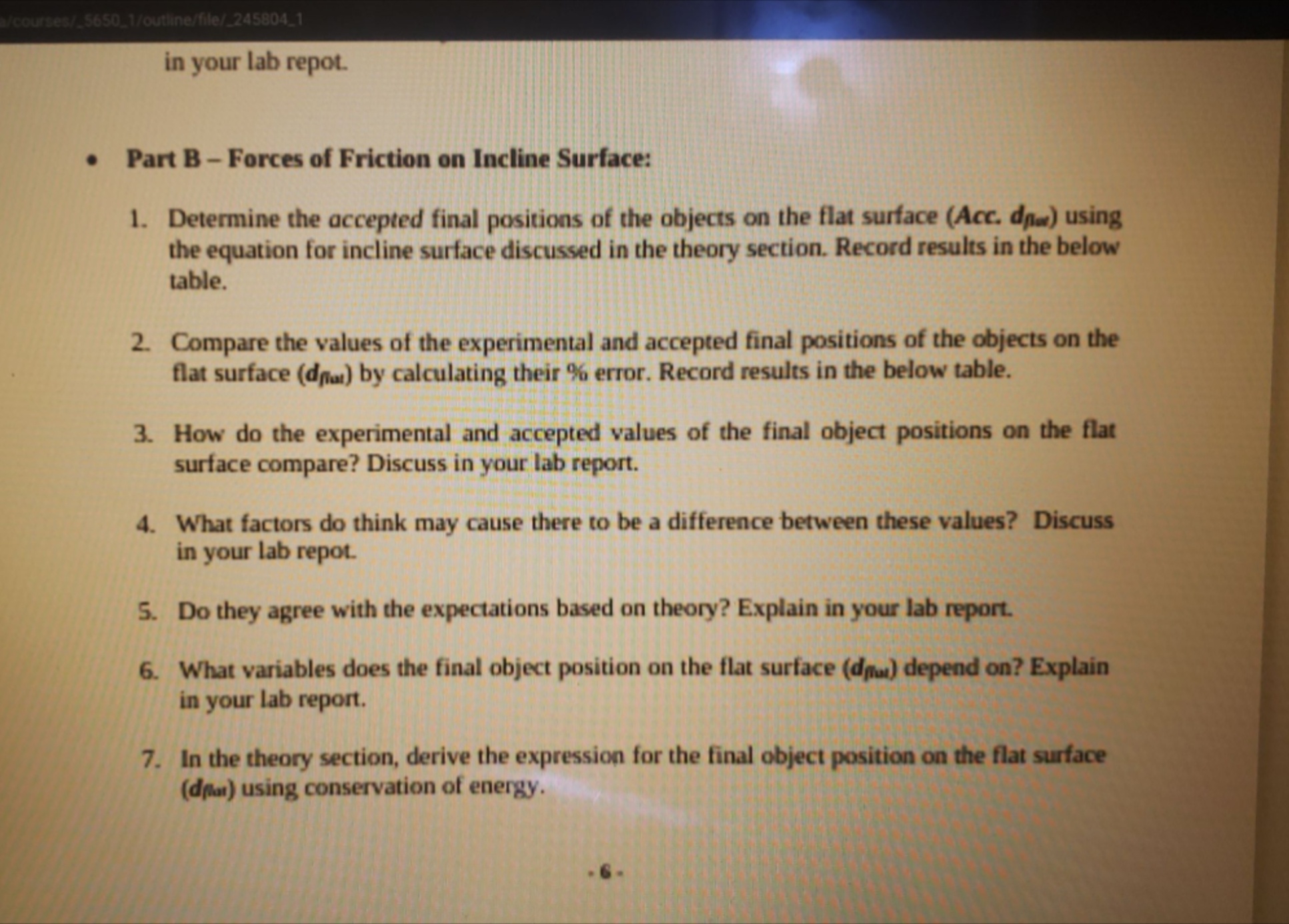

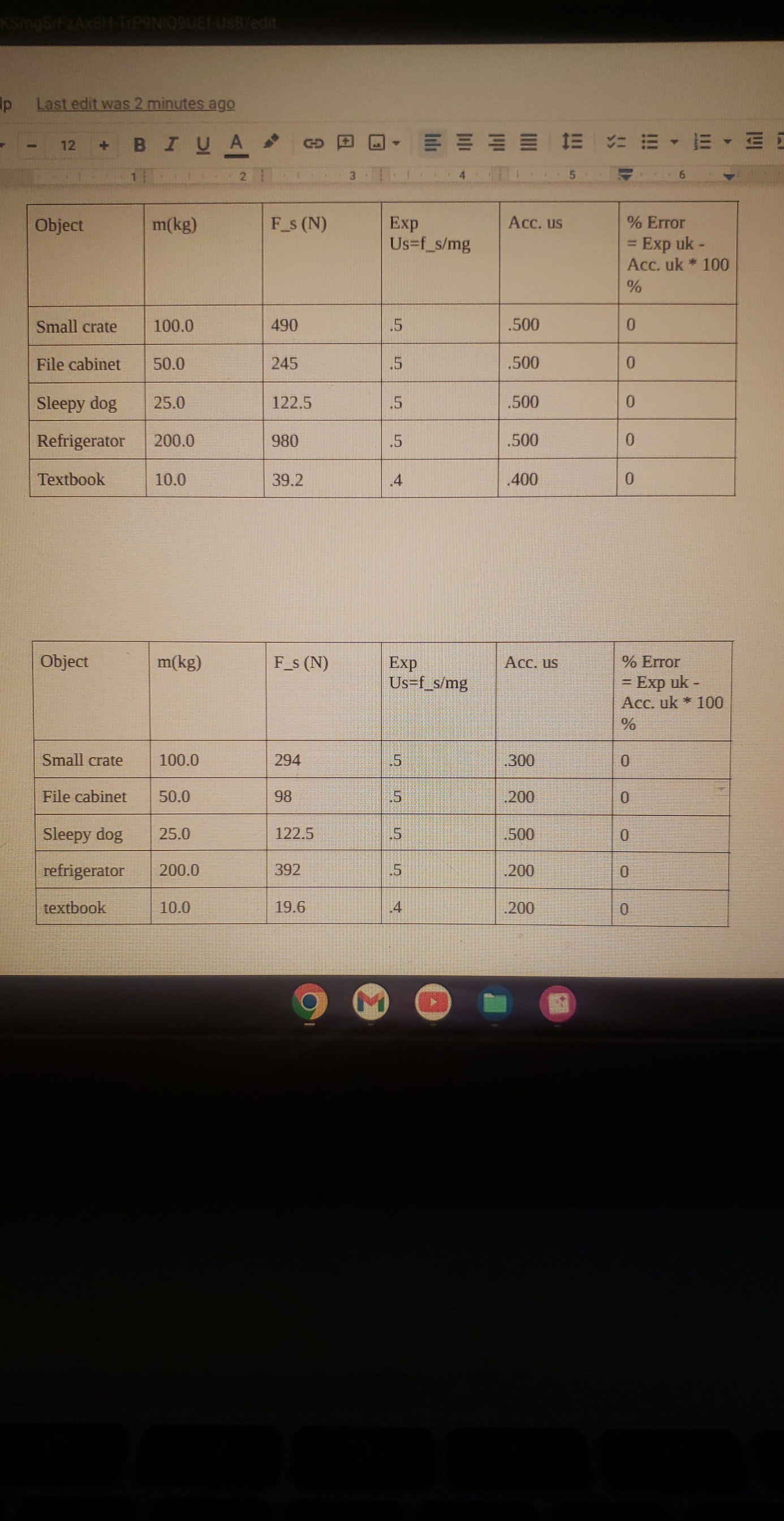
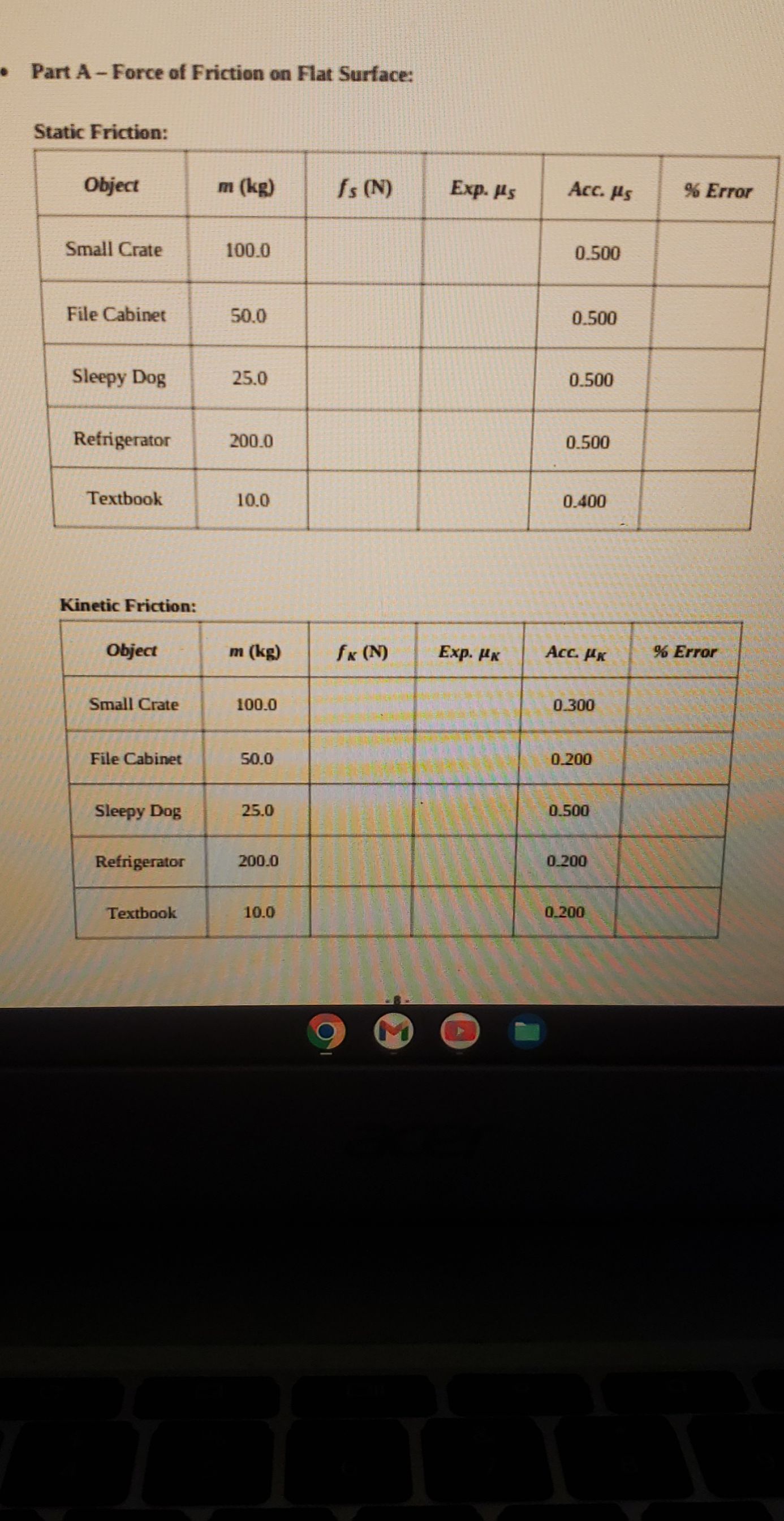
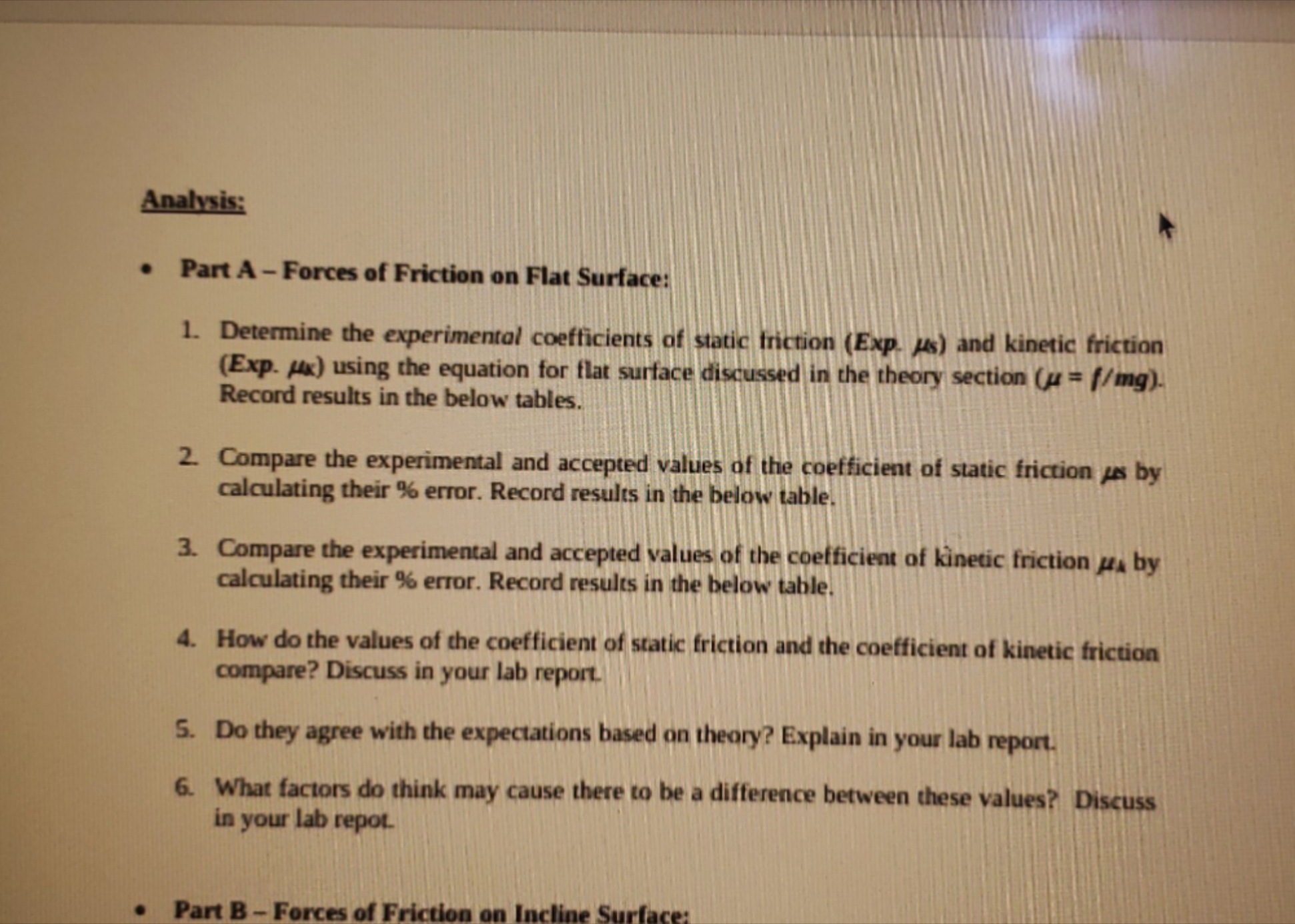
/courses/_5650_1/outline/file/_245804_1 in your lab report. . Part B - Forces of Friction on Incline Surface: 1. Determine the accepted final positions of the objects on the flat surface (Acc. dad) using the equation for incline surface discussed in the theory section. Record results in the below table. 2. Compare the values of the experimental and accepted final positions of the objects on the flat surface (dfar) by calculating their % error. Record results in the below table. 3. How do the experimental and accepted values of the final object positions on the flat surface compare? Discuss in your lab report. 4. What factors do think may cause there to be a difference between these values? Discuss in your lab report. 5. Do they agree with the expectations based on theory? Explain in your lab report. 6. What variables does the final object position on the flat surface (down) depend on? Explain in your lab report. 7. In the theory section, derive the expression for the final object position on the flat surface (dfar) using conservation of energy.Part B - Force Friction on Inclined Surface: Object died (m) Exp. Acc. m (kg) HK HS dfar (m) dflex (m) % Error Small Crate 100.0 0.30 0.50 7.0 File Cabinet 50.0 0.20 0.50 4.0 Sleepy Dog 25.0 0.50 0.50 8.0 Refrigerator 200.0 0.20 0.50 5.0 Textbook 10.0 0.20 0.40 3.0 ( Note: For all trials incline angle 8 = 30.0 ) MUs8/edit Ip Last edit was 2 minutes ago - 12 + B I U AN O PO . BE = BE SE . E. E 2 1 1 3 . | | 4 1 5 5 6 Object m(kg) F_s (N) Exp Acc. us % Error Us=f_s/mg = Exp uk - Acc. uk * 100 % Small crate 100.0 490 15 500 0 File cabinet 50.0 245 15 500 0 Sleepy dog 25.0 122.5 5 .500 Refrigerator 200.0 980 15 .500 0 Textbook 10.0 39.2 4 400 0 Object m(kg) F_S (N) Exp Acc. us % Error Us=f_s/mg = Exp uk - Acc. uk * 100 % Small crate 100.0 294 5 .300 0 File cabinet 50.0 98 200 Sleepy dog 25.0 122.5 .5 500 refrigerator 200.0 392 200 0 textbook 10.0 19.6 4 200 0 9Part A - Force of Friction on Flat Surface: Static Friction: Object m (kg) Is (N) Exp. Hs Acc. Hs % Error Small Crate 100.0 0.500 File Cabinet 50.0 0.500 Sleepy Dog 25.0 0.500 Refrigerator 200.0 0.500 Textbook 10.0 0.400 Kinetic Friction: Object m (kg) fx (N) Exp. HK Acc. HK % Error Small Crate 100.0 0.300 File Cabinet 50.0 0.200 Sleepy Dog 25.0 0.500 Refrigerator 200.0 0.200 Textbook 10.0 0.200Analysis: . Part A - Forces of Friction on Flat Surface: 1. Determine the experimental coefficients of static friction (Exp. us) and kinetic friction (Exp. /x) using the equation for flat surface discussed in the theory section (u = f/mg). Record results in the below tables. 2. Compare the experimental and accepted values of the coefficient of static friction us by calculating their % error. Record results in the below table. 3. Compare the experimental and accepted values of the coefficient of kinetic friction #A by calculating their % error. Record results in the below table. 4. How do the values of the coefficient of static friction and the coefficient of kinetic friction compare? Discuss in your lab report. 5. Do they agree with the expectations based on theory? Explain in your lab report. 6. What factors do think may cause there to be a difference between these values? Discuss in your lab repot. Part B - Forces of Friction on Incline Surfaces
Step by Step Solution
There are 3 Steps involved in it

Get step-by-step solutions from verified subject matter experts