







Question: CPS2390 Computer Assembly Language Chapter 2 2.34 Compute the following: Name: (a) NOT(0110) OR NOT(1100) (b) NOT(1000 AND (0110 OR 0101) (c) NOTINOT(1001)) (d) (0100
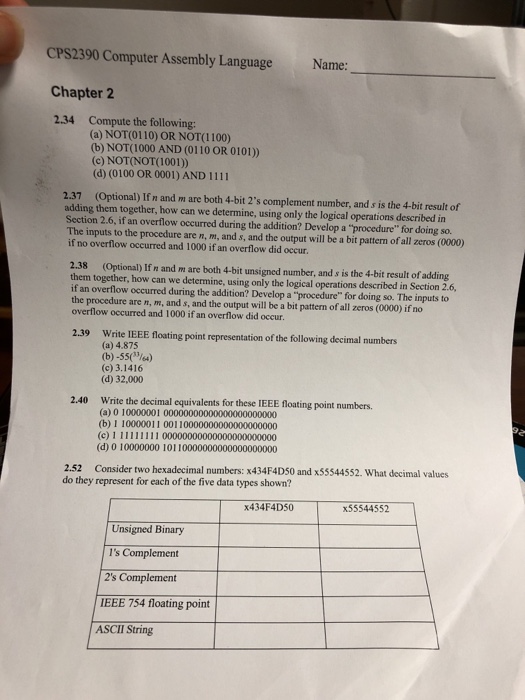
CPS2390 Computer Assembly Language Chapter 2 2.34 Compute the following: Name: (a) NOT(0110) OR NOT(1100) (b) NOT(1000 AND (0110 OR 0101) (c) NOTINOT(1001)) (d) (0100 OR 0001) AND 1111 2.37 (Optional) If n and m are both 4-bit 2's complement number, and s is the 4-bit result of adding them together, how can we determine, using only the logical operations described in Section 2.6, if an overflow occurred during the addition? Develop a "procedure" for doing so. The inputs to the procedure are n, m, and s, and the output will be a bit pattern of all zeros (0000) if no overflow occurred and 1000 if an overflow did occur 2.38 (Optional) If n and m are both 4-bit unsigned number, and s is the 4-bit result of adding them together, how can we determine, using only the logical operations described in Section 2.6, if an overflow occurred during the addition? Develop a-procedure" for doing so. The inputs to the procedure are n, m, and s, and the output will be a bit pattern of all zeros (0000) if no overflow occurred and 1000 if an overflow did occur. Write IEEE floating point representation of the following decimal numbers (a) 4.875 (b) -550/64) (c) 3.1416 (d) 32,000 2.39 Write the decimal equivalents for these IEEE floating point numbers. (a) 0 10000001 00000000000000000000000 (b) 1 10000011 00110000000000000000000 (c) 1 11111111 00000000000000000000000 (d) 0 10000000 10110000000000000000000 2.40 2.52 Consider two hexadecimal numbers: x434F4DS0 and x55544552. What decimal valuers do they represent for each of the five data types shown? x434F4D50 x55544552 Unsigned Binary I's Complemert 2's Complement IEEE 754 floating point ASCII String
Step by Step Solution
There are 3 Steps involved in it

Get step-by-step solutions from verified subject matter experts
 Study Help