







Question: (+ c.r.) Suppose we have a function y(r) that is the composition of three functions f(x), g(r) and h(x), such that y(x) = f(g(h(x))). However,
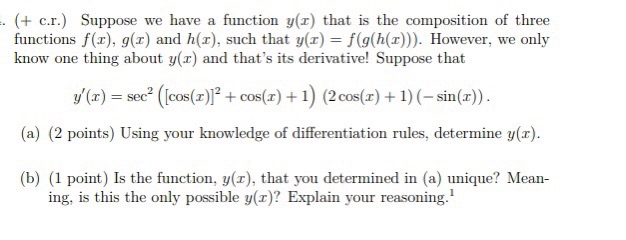
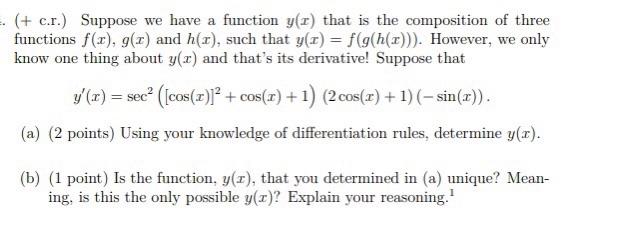
(+ c.r.) Suppose we have a function y(r) that is the composition of three functions f(x), g(r) and h(x), such that y(x) = f(g(h(x))). However, we only know one thing about y(x) and that's its derivative! Suppose that y'(x) = sec? ([cos(x)]2 + cos(r) + 1) (2 cos(x) + 1) (- sin(r)) . (a) (2 points) Using your knowledge of differentiation rules, determine y(r). (b) (1 point) Is the function, y(r), that you determined in (a) unique? Mean- ing, is this the only possible y(r)? Explain your reasoning."
Step by Step Solution
There are 3 Steps involved in it
1 Expert Approved Answer
Step: 1 Unlock

Question Has Been Solved by an Expert!
Get step-by-step solutions from verified subject matter experts
Step: 2 Unlock
Step: 3 Unlock
 Study Help