







Question: Two random binary signals, A and B, combine to form an output C where C=AB. In other words, C = 1 only when {A
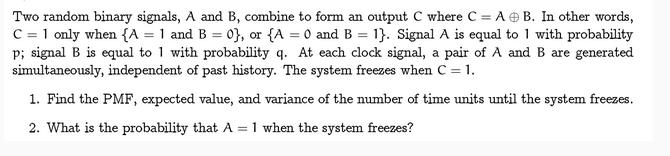
Two random binary signals, A and B, combine to form an output C where C=AB. In other words, C = 1 only when {A = 1 and B = 0}, or {A = 0 and B = 1}. Signal A is equal to 1 with probability p; signal B is equal to 1 with probability q. At each clock signal, a pair of A and B are generated simultaneously, independent of past history. The system freezes when C = 1. 1. Find the PMF, expected value, and variance of the number of time units until the system freezes. 2. What is the probability that A = 1 when the system freezes?
Step by Step Solution
There are 3 Steps involved in it
1 Expert Approved Answer
Step: 1 Unlock

Question Has Been Solved by an Expert!
Get step-by-step solutions from verified subject matter experts
Step: 2 Unlock
Step: 3 Unlock
 Study Help