







Question: Create a customer interview guide so that the EcoWash partners can gather information to assess whether they are solving a pressing problem / pain point.
-
Create a customer interview guide so that the EcoWash partners can gather information to assess whether they are solving a pressing problem / pain point. The interview questions should be targeted to car dealerships.
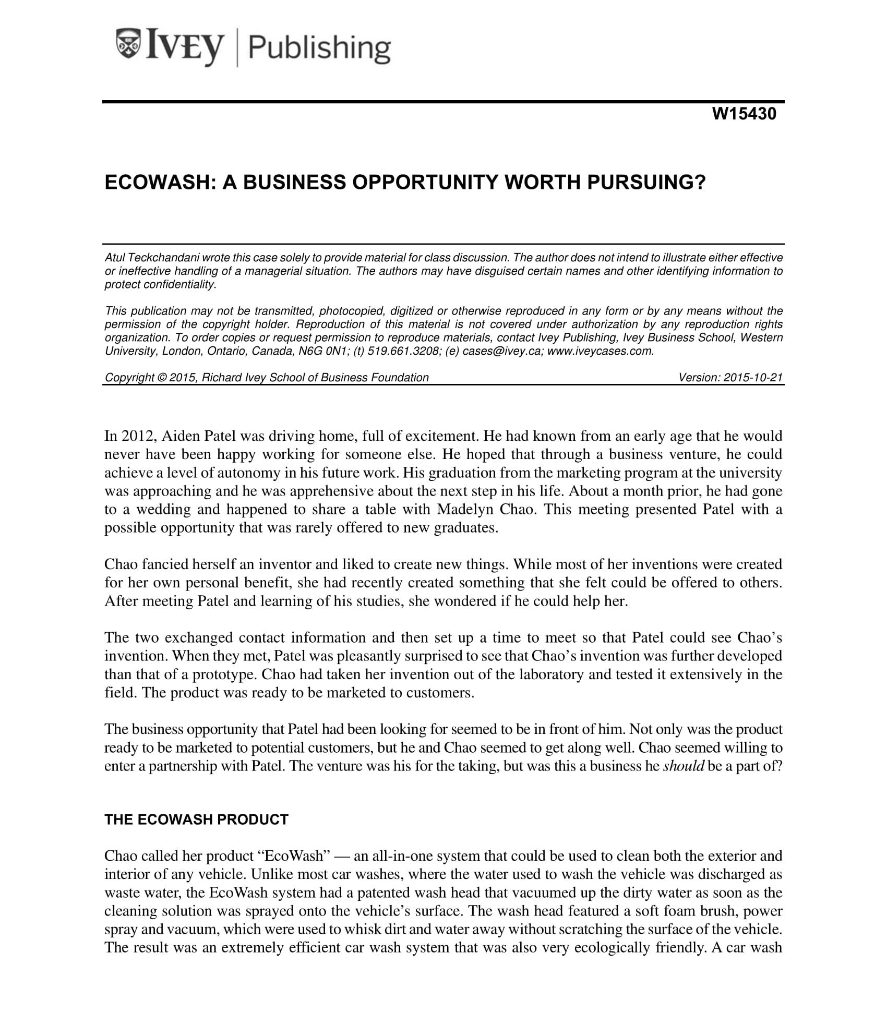
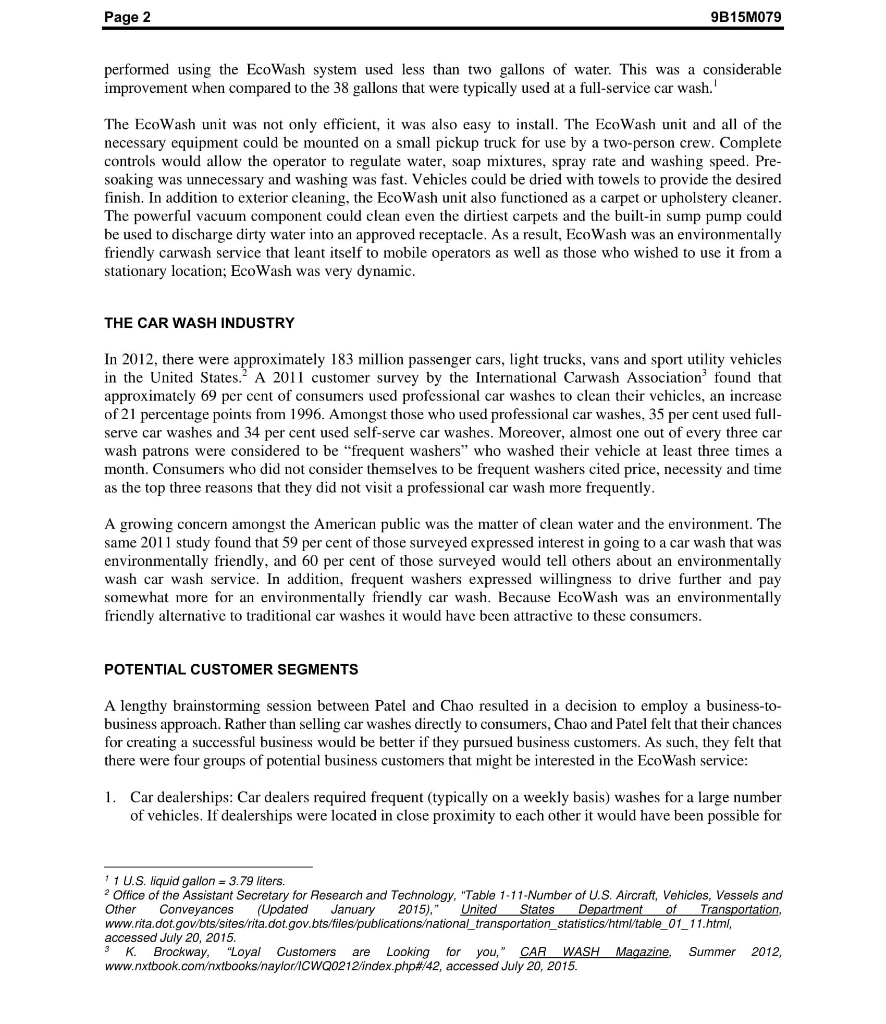
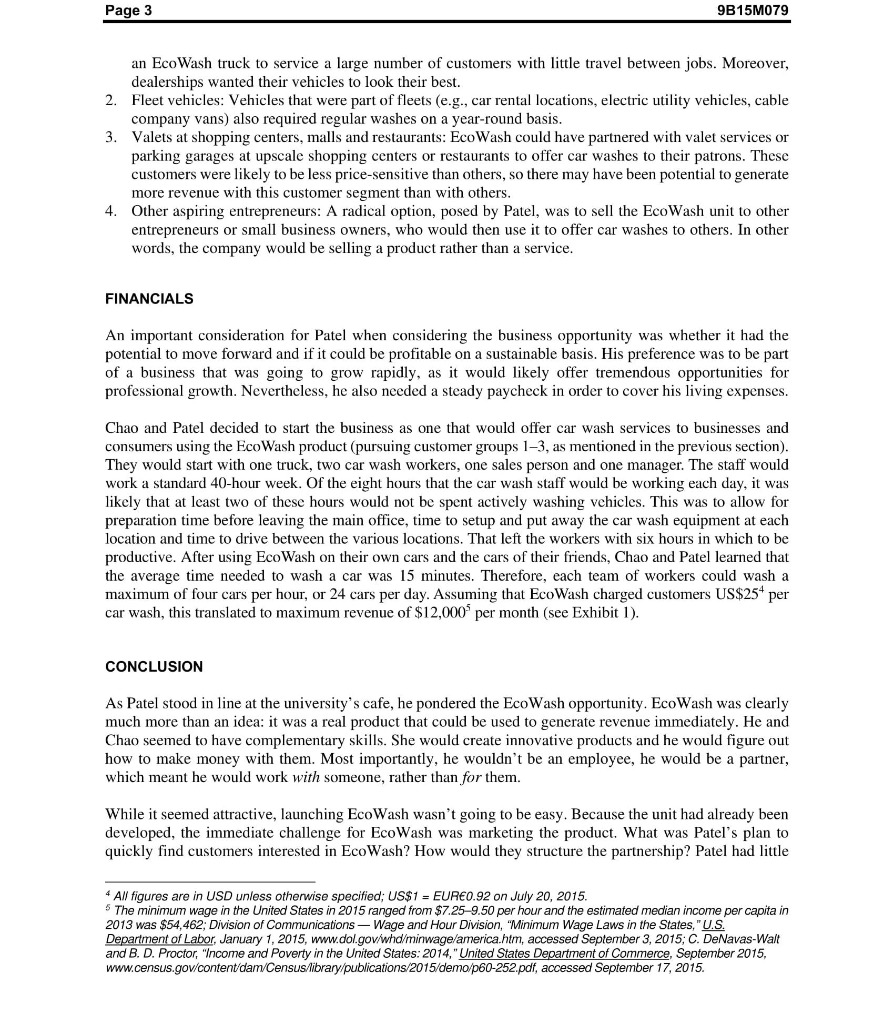
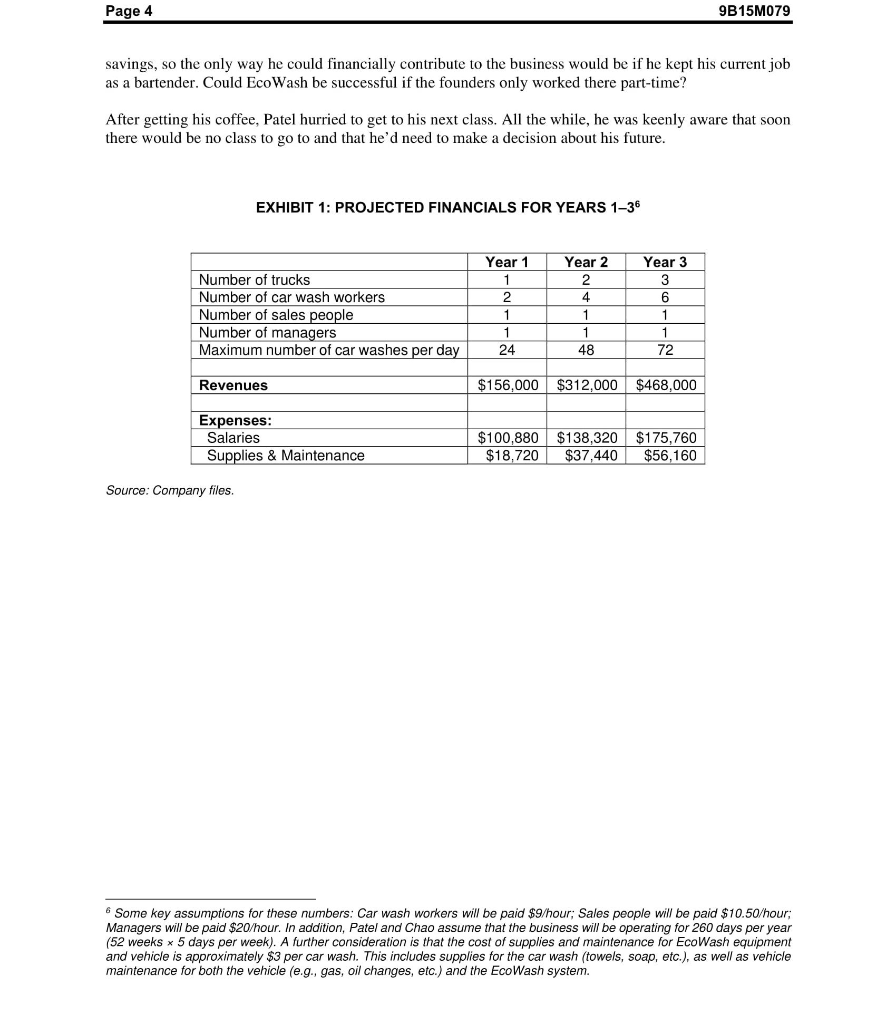
Ivey Publishing W15430 ECOWASH: A BUSINESS OPPORTUNITY WORTH PURSUING? Atul Teckchandani wrote this case solely to provide material for class discussion. The author does not intend to illustrate either effective or ineffective handling of a managerial situation. The authors may have disguised certain names and other identifying information to protect confidentiality. This publication may not be transmitted, photocopied, digitized or otherwise reproduced in any form or by any means without the permission of the copyright holder. Reproduction of this material is not covered under authorization by any reproduction rights organization. To order copies or request permission to reproduce materials, contact Ivey Publishing, Ivey Business School, Western University, London, Ontario, Canada, NOG ON1; (1) 519.661.3208: (e) cases@ivey.ca; www.iveycases.com. Copyright 2015, Richard Ivey School of Business Foundation Version: 2015-10-21 In 2012, Aiden Patel was driving home, full of excitement. He had known from an early age that he would never have been happy working for someone else. He hoped that through a business venture, he could achieve a level of autonomy in his future work. His graduation from the marketing program at the university was approaching and he was apprehensive about the next step in his life. About a month prior, he had gone to a wedding and happened to share a table with Madelyn Chao. This meeting presented Patel with a possible opportunity that was rarely offered to new graduates. Chao fancied herself an inventor and liked to create new things. While most of her inventions were created for her own personal benefit, she had recently created something that she felt could be offered to others. After meeting Patel and learning of his studies, she wondered if he could help her. The two exchanged contact information and then set up a time to meet so that Patel could see Chao's invention. When they met, Patel was pleasantly surprised to see that Chao's invention was further developed than that of a prototype. Chao had taken her invention out of the laboratory and tested it extensively in the field. The product was ready to be marketed to customers. The business opportunity that Patel had been looking for seemed to be in front of him. Not only was the product ready to be marketed to potential customers, but he and Chao seemed to get along well. Chao seemed willing to enter a partnership with Patel. The venture was his for the taking, but was this a business he should be a part of? THE ECOWASH PRODUCT Chao called her product "EcoWash" - an all-in-one system that could be used to clean both the exterior and interior of any vehicle. Unlike most car washes, where the water used to wash the vehicle was discharged as waste water, the EcoWash system had a patented wash head that vacuumed up the dirty water as soon as the cleaning solution was sprayed onto the vehicle's surface. The wash head featured a soft foam brush, power spray and vacuum, which were used to whisk dirt and water away without scratching the surface of the vehicle. The result was an extremely efficient car wash system that was also very ecologically friendly. A car wash Page 2 9B15M079 performed using the EcoWash system used less than two gallons of water. This was a considerable improvement when compared to the 38 gallons that were typically used at a full-service car wash.' The EcoWash unit was not only efficient, it was also easy to install. The EcoWash unit and all of the necessary equipment could be mounted on a small pickup truck for use by a two-person crew. Complete controls would allow the operator to regulate water, soap mixtures, spray rate and washing speed. Pre- soaking was unnecessary and washing was fast. Vehicles could be dried with towels to provide the desired finish. In addition to exterior cleaning, the EcoWash unit also functioned as a carpet or upholstery cleaner. The powerful vacuum component could clean even the dirtiest carpets and the built-in sump pump could be used to discharge dirty water into an approved receptacle. As a result, EcoWash was an environmentally friendly carwash service that leant itself to mobile operators as well as those who wished to use it from a stationary location; EcoWash was very dynamic. THE CAR WASH INDUSTRY In 2012, there were approximately 183 million passenger cars, light trucks, vans and sport utility vehicles in the United States. A 2011 customer survey by the International Carwash Association found that approximately 69 per cent of consumers used professional car washes to clean their vehicles, an increase of 21 percentage points from 1996. Amongst those who used professional car washes, 35 per cent used full- serve car washes and 34 per cent used self-serve car washes. Moreover, almost one out of every three car wash patrons were considered to be "frequent washers" who washed their vehicle at least three times a month. Consumers who did not consider themselves to be frequent washers cited price, necessity and time as the top three reasons that they did not visit a professional car wash more frequently. A growing concern amongst the American public was the matter of clean water and the environment. The same 2011 study found that 59 per cent of those surveyed expressed interest in going to a car wash that was environmentally friendly, and 60 per cent of those surveyed would tell others about an environmentally wash car wash service. In addition, frequent washers expressed willingness to drive further and pay somewhat more for an environmentally friendly car wash. Because EcoWash was an environmentally friendly alternative to traditional car washes it would have been attractive to these consumers. POTENTIAL CUSTOMER SEGMENTS A lengthy brainstorming session between Patel and Chao resulted in a decision to employ a business-to- business approach. Rather than selling car washes directly to consumers, Chao and Patel felt that their chances for creating a successful business would be better if they pursued business customers. As such, they felt that there were four groups of potential business customers that might be interested in the EcoWash service: 1. Car dealerships: Car dealers required frequent (typically on a weekly basis) washes for a large number of vehicles. If dealerships were located in close proximity to each other it would have been possible for 11 U.S. liquid gallon = 3.79 liters. 2 Office of the Assistant Secretary for Research and Technology, "Table 1-11-Number of U.S. Aircraft, Vehicles, Vessels and Other Conveyances (Updated January 2015)," United States Department of Transportation www.rita.dot.gov/bts/sites/rita.dot.gov.bts/files/publicationsational_transportation statistics/html/table_01_11.html, accessed July 20, 2015. 3 K. Brockway, "Loyal Customers are looking for you," CAR WASH Magazine, Summer 2012, www.nxtbook.comxtbooksaylor/ICWQ0212/index.php#42, accessed July 20, 2015. Page 4 9B15M079 savings, so the only way he could financially contribute to the business would be if he kept his current job as a bartender. Could EcoWash be successful if the founders only worked there part-time? After getting his coffee, Patel hurried to get to his next class. All the while, he was keenly aware that soon there would be no class to go to and that he'd need to make a decision about his future. EXHIBIT 1: PROJECTED FINANCIALS FOR YEARS 1-36 Year 1 Year 2 2 4 Year 3 3 6 2 Number of trucks Number of car wash workers Number of sales people Number of managers | Maximum number of car washes per day 24 48 72 Revenues $156,000 $312,000 $468,000 Expenses: Salaries Supplies & Maintenance $100,880 $18,720 $138,320 $37,440 $175,760 $56,160 Source: Company files. 6 Some key assumptions for these numbers: Car wash workers will be paid $9/hour; Sales people will be paid $10.50/hour; Managers will be paid $20/hour. In addition, Patel and Chao assume that the business will be operating for 260 days per year (52 weeks 5 days per week). A further consideration is that the cost of supplies and maintenance for EcoWash equipment and vehicle is approximately $3 per car wash. This includes supplies for the car wash (towels, soap, etc.), as well as vehicle maintenance for both the vehicle (e.g., gas, oil changes, etc.) and the EcoWash system. Ivey Publishing W15430 ECOWASH: A BUSINESS OPPORTUNITY WORTH PURSUING? Atul Teckchandani wrote this case solely to provide material for class discussion. The author does not intend to illustrate either effective or ineffective handling of a managerial situation. The authors may have disguised certain names and other identifying information to protect confidentiality. This publication may not be transmitted, photocopied, digitized or otherwise reproduced in any form or by any means without the permission of the copyright holder. Reproduction of this material is not covered under authorization by any reproduction rights organization. To order copies or request permission to reproduce materials, contact Ivey Publishing, Ivey Business School, Western University, London, Ontario, Canada, NOG ON1; (1) 519.661.3208: (e) cases@ivey.ca; www.iveycases.com. Copyright 2015, Richard Ivey School of Business Foundation Version: 2015-10-21 In 2012, Aiden Patel was driving home, full of excitement. He had known from an early age that he would never have been happy working for someone else. He hoped that through a business venture, he could achieve a level of autonomy in his future work. His graduation from the marketing program at the university was approaching and he was apprehensive about the next step in his life. About a month prior, he had gone to a wedding and happened to share a table with Madelyn Chao. This meeting presented Patel with a possible opportunity that was rarely offered to new graduates. Chao fancied herself an inventor and liked to create new things. While most of her inventions were created for her own personal benefit, she had recently created something that she felt could be offered to others. After meeting Patel and learning of his studies, she wondered if he could help her. The two exchanged contact information and then set up a time to meet so that Patel could see Chao's invention. When they met, Patel was pleasantly surprised to see that Chao's invention was further developed than that of a prototype. Chao had taken her invention out of the laboratory and tested it extensively in the field. The product was ready to be marketed to customers. The business opportunity that Patel had been looking for seemed to be in front of him. Not only was the product ready to be marketed to potential customers, but he and Chao seemed to get along well. Chao seemed willing to enter a partnership with Patel. The venture was his for the taking, but was this a business he should be a part of? THE ECOWASH PRODUCT Chao called her product "EcoWash" - an all-in-one system that could be used to clean both the exterior and interior of any vehicle. Unlike most car washes, where the water used to wash the vehicle was discharged as waste water, the EcoWash system had a patented wash head that vacuumed up the dirty water as soon as the cleaning solution was sprayed onto the vehicle's surface. The wash head featured a soft foam brush, power spray and vacuum, which were used to whisk dirt and water away without scratching the surface of the vehicle. The result was an extremely efficient car wash system that was also very ecologically friendly. A car wash Page 2 9B15M079 performed using the EcoWash system used less than two gallons of water. This was a considerable improvement when compared to the 38 gallons that were typically used at a full-service car wash.' The EcoWash unit was not only efficient, it was also easy to install. The EcoWash unit and all of the necessary equipment could be mounted on a small pickup truck for use by a two-person crew. Complete controls would allow the operator to regulate water, soap mixtures, spray rate and washing speed. Pre- soaking was unnecessary and washing was fast. Vehicles could be dried with towels to provide the desired finish. In addition to exterior cleaning, the EcoWash unit also functioned as a carpet or upholstery cleaner. The powerful vacuum component could clean even the dirtiest carpets and the built-in sump pump could be used to discharge dirty water into an approved receptacle. As a result, EcoWash was an environmentally friendly carwash service that leant itself to mobile operators as well as those who wished to use it from a stationary location; EcoWash was very dynamic. THE CAR WASH INDUSTRY In 2012, there were approximately 183 million passenger cars, light trucks, vans and sport utility vehicles in the United States. A 2011 customer survey by the International Carwash Association found that approximately 69 per cent of consumers used professional car washes to clean their vehicles, an increase of 21 percentage points from 1996. Amongst those who used professional car washes, 35 per cent used full- serve car washes and 34 per cent used self-serve car washes. Moreover, almost one out of every three car wash patrons were considered to be "frequent washers" who washed their vehicle at least three times a month. Consumers who did not consider themselves to be frequent washers cited price, necessity and time as the top three reasons that they did not visit a professional car wash more frequently. A growing concern amongst the American public was the matter of clean water and the environment. The same 2011 study found that 59 per cent of those surveyed expressed interest in going to a car wash that was environmentally friendly, and 60 per cent of those surveyed would tell others about an environmentally wash car wash service. In addition, frequent washers expressed willingness to drive further and pay somewhat more for an environmentally friendly car wash. Because EcoWash was an environmentally friendly alternative to traditional car washes it would have been attractive to these consumers. POTENTIAL CUSTOMER SEGMENTS A lengthy brainstorming session between Patel and Chao resulted in a decision to employ a business-to- business approach. Rather than selling car washes directly to consumers, Chao and Patel felt that their chances for creating a successful business would be better if they pursued business customers. As such, they felt that there were four groups of potential business customers that might be interested in the EcoWash service: 1. Car dealerships: Car dealers required frequent (typically on a weekly basis) washes for a large number of vehicles. If dealerships were located in close proximity to each other it would have been possible for 11 U.S. liquid gallon = 3.79 liters. 2 Office of the Assistant Secretary for Research and Technology, "Table 1-11-Number of U.S. Aircraft, Vehicles, Vessels and Other Conveyances (Updated January 2015)," United States Department of Transportation www.rita.dot.gov/bts/sites/rita.dot.gov.bts/files/publicationsational_transportation statistics/html/table_01_11.html, accessed July 20, 2015. 3 K. Brockway, "Loyal Customers are looking for you," CAR WASH Magazine, Summer 2012, www.nxtbook.comxtbooksaylor/ICWQ0212/index.php#42, accessed July 20, 2015. Page 4 9B15M079 savings, so the only way he could financially contribute to the business would be if he kept his current job as a bartender. Could EcoWash be successful if the founders only worked there part-time? After getting his coffee, Patel hurried to get to his next class. All the while, he was keenly aware that soon there would be no class to go to and that he'd need to make a decision about his future. EXHIBIT 1: PROJECTED FINANCIALS FOR YEARS 1-36 Year 1 Year 2 2 4 Year 3 3 6 2 Number of trucks Number of car wash workers Number of sales people Number of managers | Maximum number of car washes per day 24 48 72 Revenues $156,000 $312,000 $468,000 Expenses: Salaries Supplies & Maintenance $100,880 $18,720 $138,320 $37,440 $175,760 $56,160 Source: Company files. 6 Some key assumptions for these numbers: Car wash workers will be paid $9/hour; Sales people will be paid $10.50/hour; Managers will be paid $20/hour. In addition, Patel and Chao assume that the business will be operating for 260 days per year (52 weeks 5 days per week). A further consideration is that the cost of supplies and maintenance for EcoWash equipment and vehicle is approximately $3 per car wash. This includes supplies for the car wash (towels, soap, etc.), as well as vehicle maintenance for both the vehicle (e.g., gas, oil changes, etc.) and the EcoWash system
Step by Step Solution
There are 3 Steps involved in it

Get step-by-step solutions from verified subject matter experts
 Study Help