







Question: Create a digital Tip Jar with tips over how to embed each standard into your future classroom. - These can be written in bulleted lists
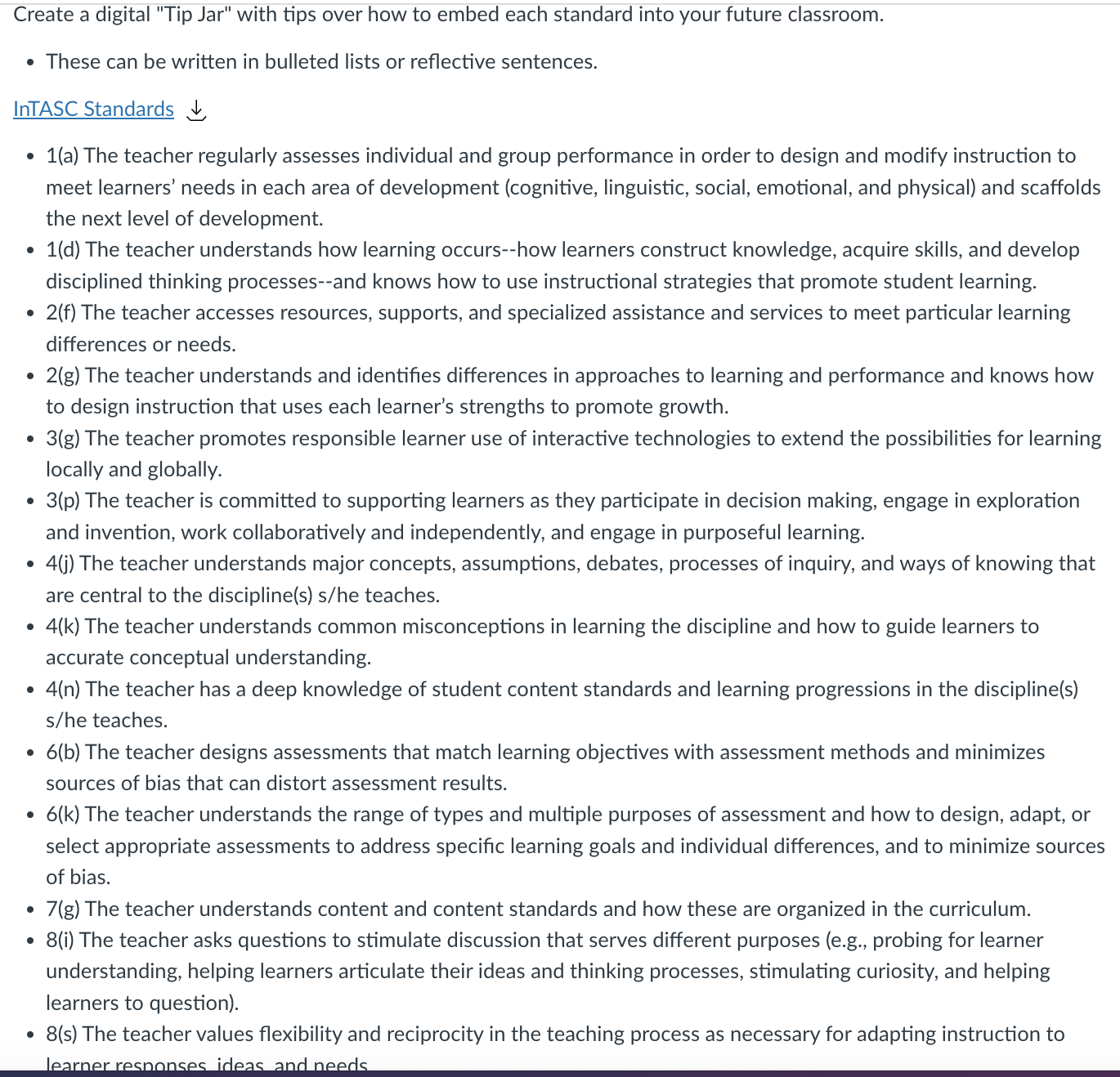
Create a digital "Tip Jar" with tips over how to embed each standard into your future classroom. - These can be written in bulleted lists or reective sentences. InTASC Standards i, - 1(a) The teacher regularly assesses individual and group performance in order to design and modify instruction to meet learners' needs in each area of development (cognitive, linguistic, social, emotional. and physical) and scaffolds the next level of development. - lid) The teacher understands how learning occurs--how learners construct knowledge, acquire skills, and develop disciplined thinking processes--and knows how to use instructional strategies that promote student learning. - 2(f) The teacher accesses resources, supports, and specialized assistance and services to meet particular learning differences or needs. - 2(g) The teacher understands and identies differences in approaches to learning and performance and knows how to design instruction that uses each learner's strengths to promote growth. - 3(g) The teacher promotes responsible learner use of interactive technologies to extend the possibilities for learning locally and globally. - 3(p) The teacher is committed to supporting learners as they participate in decision making, engage in exploration and invention, work collaboratively and independently, and engage in purposeful learning. - 4G) The teacher understands major concepts, assumptions, debates, processes of inquiry, and ways of knowing that are central to the discipline(s) s/he teaches. - 4(k) The teacher understands common misconceptions in learning the discipline and how to guide learners to accurate conceptual understanding. - 4(n) The teacher has a deep knowledge of student content standards and learning progressions in the discipline(s) s/he teaches. - 6(b) The teacher designs assessments that match learning objectives with assessment methods and minimizes sources of bias that can distort assessment results. - 6(k) The teacher understands the range of types and multiple purposes of assessment and how to design, adapt, or select appropriate assessments to address specic learning goals and individual differences, and to minimize sources of bias. - 7(g) The teacher understands content and content standards and how these are organized in the curriculum. - 8(i) The teacher asks questions to stimulate discussion that serves different purposes (e.g., probing for learner understanding, helping learners articulate their ideas and thinking processes, stimulating curiosity, and helping learners to question). 0 8(5) The teacher values exibility and reciprocity in the teaching process as necessary for adapting instruction to w
Step by Step Solution
There are 3 Steps involved in it

Get step-by-step solutions from verified subject matter experts
 Study Help