







Question: create a Financial Plan and an Executive summary for a business Section 6. Financial Plan a. Current financial status' b. Financing Needed If you are
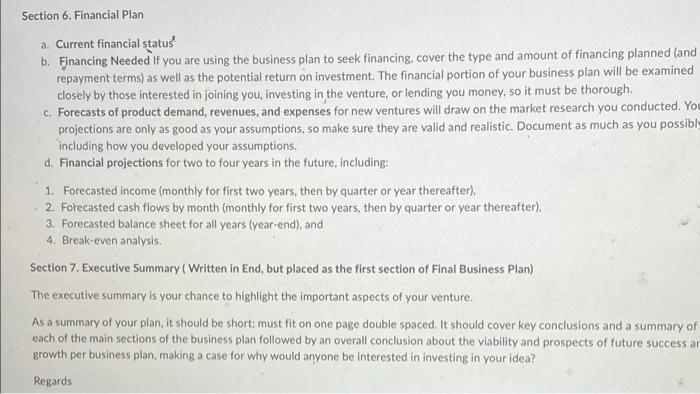
Section 6. Financial Plan a. Current financial status' b. Financing Needed If you are using the business plan to seek financing, cover the type and amount of financing planned (and repayment terms) as well as the potential return on investment. The financial portion of your business plan will be examined closely by those interested in joining you, investing in the venture, or lending you money, so it must be thorough. c. Forecasts of product demand, revenues, and expenses for new ventures will draw on the market research you conducted. You projections are only as good as your assumptions, so make sure they are valid and realistic. Document as much as you possible including how you developed your assumptions. d. Financial projections for two to four years in the future, including: 1. Forecasted income (monthly for first two years, then by quarter or year thereafter). 2. Forecasted cash flows by month (monthly for first two years, then by quarter or year thereafter). 3. Forecasted balance sheet for all years (year-end), and 4. Break even analysis. Section 7. Executive Summary ( Written in End, but placed as the first section of Final Business Plan) The executive summary is your chance to highlight the important aspects of your venture. As a summary of your plan, it should be short, must fit on one page double spaced. It should cover key conclusions and a summary of each of the main sections of the business plan followed by an overall conclusion about the viability and prospects of future success ar growth per business plan, making a case for why would anyone be interested in investing in your idea? Regards Section 6. Financial Plan a. Current financial status' b. Financing Needed If you are using the business plan to seek financing, cover the type and amount of financing planned (and repayment terms) as well as the potential return on investment. The financial portion of your business plan will be examined closely by those interested in joining you, investing in the venture, or lending you money, so it must be thorough. c. Forecasts of product demand, revenues, and expenses for new ventures will draw on the market research you conducted. You projections are only as good as your assumptions, so make sure they are valid and realistic. Document as much as you possible including how you developed your assumptions. d. Financial projections for two to four years in the future, including: 1. Forecasted income (monthly for first two years, then by quarter or year thereafter). 2. Forecasted cash flows by month (monthly for first two years, then by quarter or year thereafter). 3. Forecasted balance sheet for all years (year-end), and 4. Break even analysis. Section 7. Executive Summary ( Written in End, but placed as the first section of Final Business Plan) The executive summary is your chance to highlight the important aspects of your venture. As a summary of your plan, it should be short, must fit on one page double spaced. It should cover key conclusions and a summary of each of the main sections of the business plan followed by an overall conclusion about the viability and prospects of future success ar growth per business plan, making a case for why would anyone be interested in investing in your idea? Regards
Step by Step Solution
There are 3 Steps involved in it

Get step-by-step solutions from verified subject matter experts
 Study Help