







Question: Create a function LU_factorization that performs the LU factorization of a matrix A. You may use the previous functios you implemented. The header should at
Create a function LU_factorization that performs the LU factorization of a matrix A. You may use the previous functios you implemented. The header should at least contain
function [L,U] = LU_factorization(A)
How is the following pseudocode be translated and written in MATLAB?
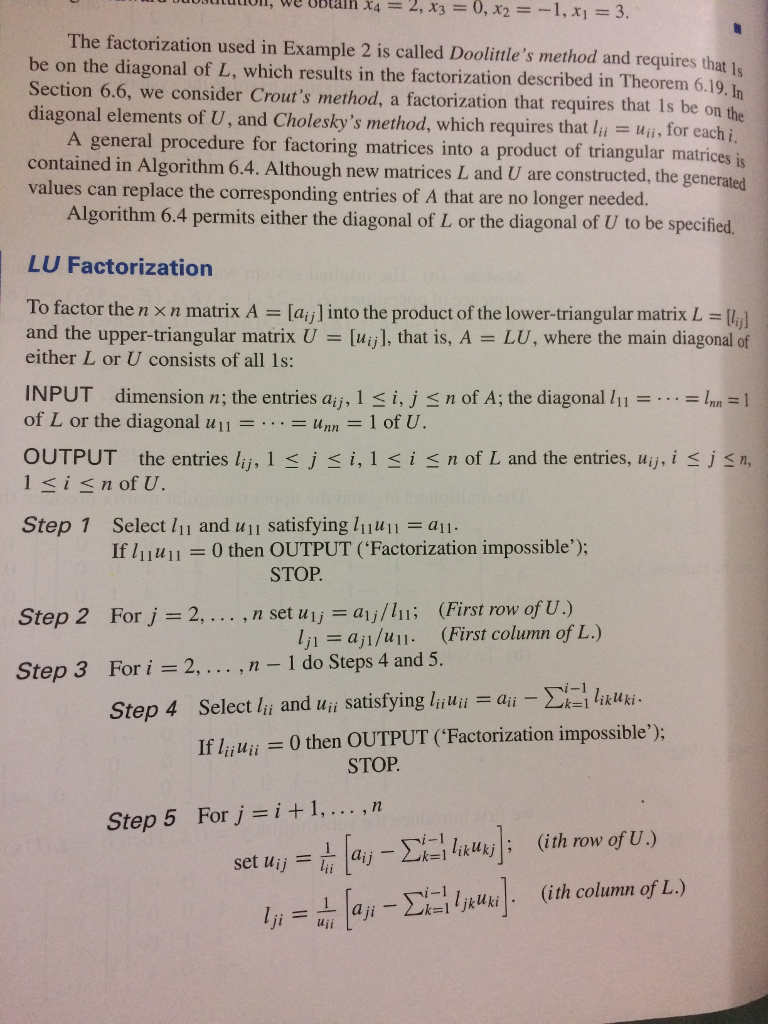
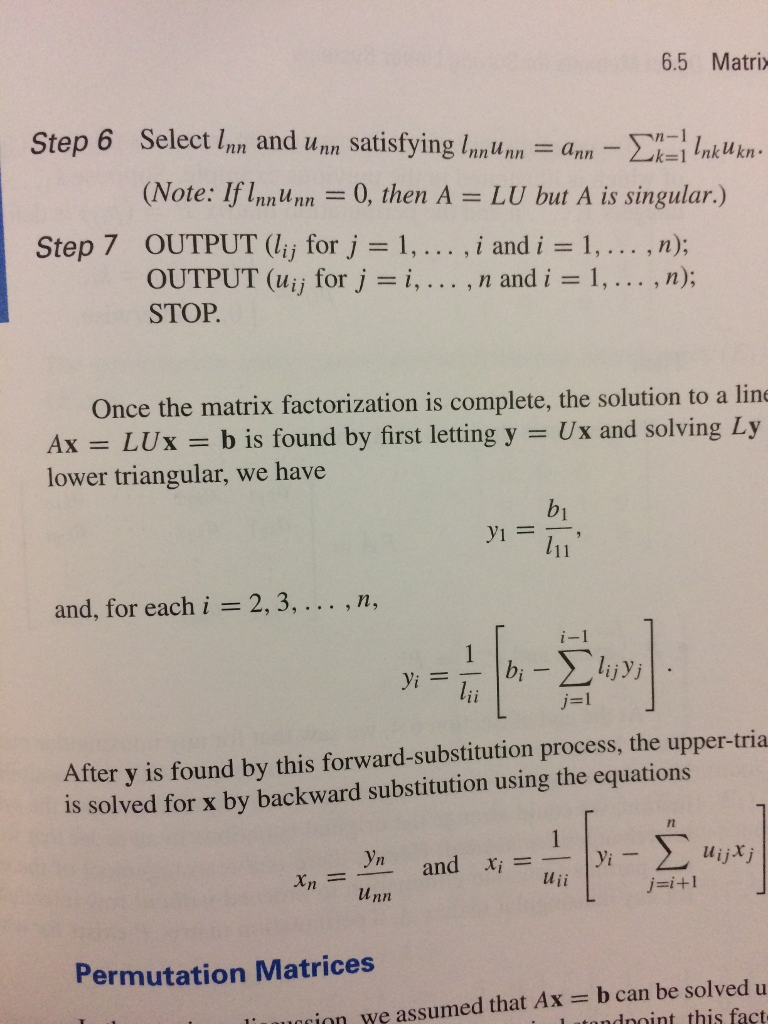
obtain x4 = , X3 = , X2 =-1, x| osti tution we 2 0 , 3. The factorization used in Example 2 is called Doolittle's method and requires that ls be on the diagonal of L, which results in the factorization described in Theorem 6.19,In Section 6.6, we consider Crout's method, a factorization that requires that 1s be on the diagonal elements of U, and Cholesky's method, which requires that lii = , for each i. general procedure for factoring matrices into a product of triangular matrices is the generated contained in Algorithm 6.4. Although new matrices L and U are constructed, values can replace th e corresponding entries of A that are no longer needed Algorithm 6.4 permits either the diagonal of L or the diagonal of U to be specified. LU Factorization To factor the n x n matrix A = [aij ] into the product of the lower-triangular matrix L = [ and the upper-triangular matrix U uijl, that is, A LU, where the main diagonal cf either L or U consists of all 1s: INPUT dimension n; the entries aij, l i, j n of A; the diagonal 11--n-1 of L or the diagonal 1111 = . . . = unn-I of U OUTPUT the entries lij, 1 s j s i, 1 si sn of L and the entries, uij, i S jsn, 1 Sisnof U Step 1 Select /11 and u 1 satisfying Inu1a11. If lnu11 0 then OUTPUT ('Factorization impossible'); For j=2, For i = 2, . . . , n-1 do Steps 4 and 5. Step 4 STOP ,nset ulj=a1j/hi ljl=ajl/u11. (First row ofU.) (First column of L.) Step 2 Step 3 Select liiand ilii satisfying liiu;i=Wi-_lijuki. If Iii uii = 0 then OUTPUT (Factorization impossible' ); STOP ,n Step 5 For j = i +1, k=1 likukjl; klki. (i th row of U.) set uij=lhlaij- (ith column of L.) obtain x4 = , X3 = , X2 =-1, x| osti tution we 2 0 , 3. The factorization used in Example 2 is called Doolittle's method and requires that ls be on the diagonal of L, which results in the factorization described in Theorem 6.19,In Section 6.6, we consider Crout's method, a factorization that requires that 1s be on the diagonal elements of U, and Cholesky's method, which requires that lii = , for each i. general procedure for factoring matrices into a product of triangular matrices is the generated contained in Algorithm 6.4. Although new matrices L and U are constructed, values can replace th e corresponding entries of A that are no longer needed Algorithm 6.4 permits either the diagonal of L or the diagonal of U to be specified. LU Factorization To factor the n x n matrix A = [aij ] into the product of the lower-triangular matrix L = [ and the upper-triangular matrix U uijl, that is, A LU, where the main diagonal cf either L or U consists of all 1s: INPUT dimension n; the entries aij, l i, j n of A; the diagonal 11--n-1 of L or the diagonal 1111 = . . . = unn-I of U OUTPUT the entries lij, 1 s j s i, 1 si sn of L and the entries, uij, i S jsn, 1 Sisnof U Step 1 Select /11 and u 1 satisfying Inu1a11. If lnu11 0 then OUTPUT ('Factorization impossible'); For j=2, For i = 2, . . . , n-1 do Steps 4 and 5. Step 4 STOP ,nset ulj=a1j/hi ljl=ajl/u11. (First row ofU.) (First column of L.) Step 2 Step 3 Select liiand ilii satisfying liiu;i=Wi-_lijuki. If Iii uii = 0 then OUTPUT (Factorization impossible' ); STOP ,n Step 5 For j = i +1, k=1 likukjl; klki. (i th row of U.) set uij=lhlaij- (ith column of L.)
Step by Step Solution
There are 3 Steps involved in it

Get step-by-step solutions from verified subject matter experts
 Study Help