







Question: Create a Matlab Monte Carlo simulation for 4-QAM (QPSK) (Monte Carlo simply means repeated trials of a probabilistic experiment). Make this a baseband simulation, using
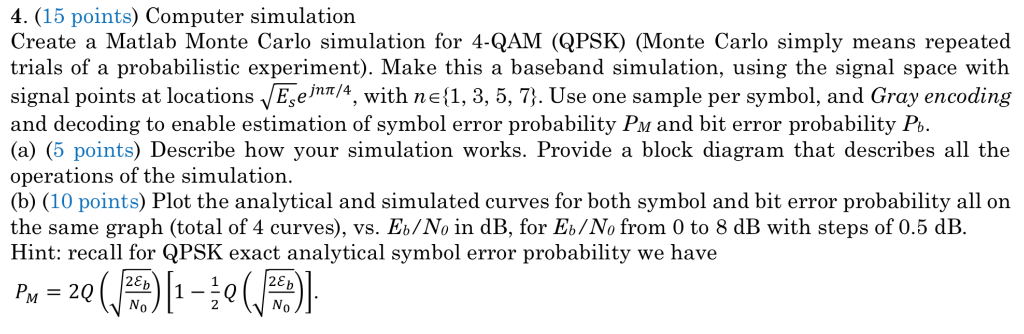 Create a Matlab Monte Carlo simulation for 4-QAM (QPSK) (Monte Carlo simply means repeated trials of a probabilistic experiment). Make this a baseband simulation, using the signal space with signal points at locations /4, with n{1, 3, 5, 7}. Use one sample per symbol, and Gray encoding and decoding to enable estimation of symbol error probability PM and bit error probability Pb. (a) (5 points) Describe how your simulation works. Provide a block diagram that describes all the operations of the simulation. (b) (10 points) Plot the analytical and simulated curves for both symbol and bit error probability all on the same graph (total of 4 curves), vs. Eb/N0 in dB, for Eb/N0 from 0 to 8 dB with steps of 0.5 dB. Hint: recall for QPSK exact analytical symbol error probability we have =2(2E)[11(2E)]. 0 2 0
4. (15 points) Computer simulation Create a Matlab Monte Carlo simulation for 4-QAM (QPSK) (Monte Carlo simply means repeated trials of a probabilistic experiment). Make this a baseband simulation, using the signal space with signal points at locations vE,e1"r4, with ne1, 3, 5, 7. Use one sample per symbol, and Gray encoding and decoding to enable estimation of symbol error probability Pw and bit error probability P. (a) (5 points) Describe how your simulation works. Provide a block diagram that describes all the operations of the simulatiorn (b) (10 points) Plot the analytical and simulated curves for both symbol and bit error probability all on the same graph (total of 4 curves), vs. Eb/No in dB, for Eb/No from 0 to 8 dB with steps of 0.5 dB. Hint: recall for QPSK exact analytical symbol error probability we have 0 4. (15 points) Computer simulation Create a Matlab Monte Carlo simulation for 4-QAM (QPSK) (Monte Carlo simply means repeated trials of a probabilistic experiment). Make this a baseband simulation, using the signal space with signal points at locations vE,e1"r4, with ne1, 3, 5, 7. Use one sample per symbol, and Gray encoding and decoding to enable estimation of symbol error probability Pw and bit error probability P. (a) (5 points) Describe how your simulation works. Provide a block diagram that describes all the operations of the simulatiorn (b) (10 points) Plot the analytical and simulated curves for both symbol and bit error probability all on the same graph (total of 4 curves), vs. Eb/No in dB, for Eb/No from 0 to 8 dB with steps of 0.5 dB. Hint: recall for QPSK exact analytical symbol error probability we have 0
Step by Step Solution
There are 3 Steps involved in it

Get step-by-step solutions from verified subject matter experts
 Study Help