





Question: Create a paper how your selected STARBUCKS external and internal environments influence or affect its strengths, weaknesses, opportunities, and threats. For guidance in creating an
Create a paper how your selected STARBUCKS external and internal environments influence or affect its strengths, weaknesses, opportunities, and threats.
For guidance in creating an effective strategic profile and case analysis, refer to Table 1 in the Case Studies section of the textbook.
- Strategic Profile and Case Analysis Purpose
- Situation Analysis: (a) General Environmental Analysis Focus on the trends in the seven segments of the general environment and predict which segments you expect to have the most significance to your company in coming years; (b) Industry Analysis Reference the five forces of competition model to judge the attractiveness of the industry (or segment of the industry) in which your company is competing; (c) Competitor Analysis Identify your competitor's strategies so your company can learn to predict their responses; (d) Internal Analysis Analyze your company's value chain to assess the organization's overall strengths and weaknesses.
- SWOT Analysis (Environmental Opportunities and Threats and Firm Strengths and Weaknesses) How will the findings identified in the Situation Analysis enable the company to maximize its strengths and capitalize on advantageous opportunities while minimizing its weaknesses and evading environmental threats?
- Strategy Formulation Synthesize the results of your Situation and SWOT Analysis to develop alternatives that make use of environmental opportunities while avoiding environmental threats. Evaluate which alternative is the best option and defend the selection: (a) strategic alternatives, (b) alternative evaluation, and (c) alternative choice.
- Strategic Alternative Implementation Design your proposed implementation of the chosen strategy. Consider and evaluate a variety of potentially critical implementation issues: (a) action items and (b) action plan.
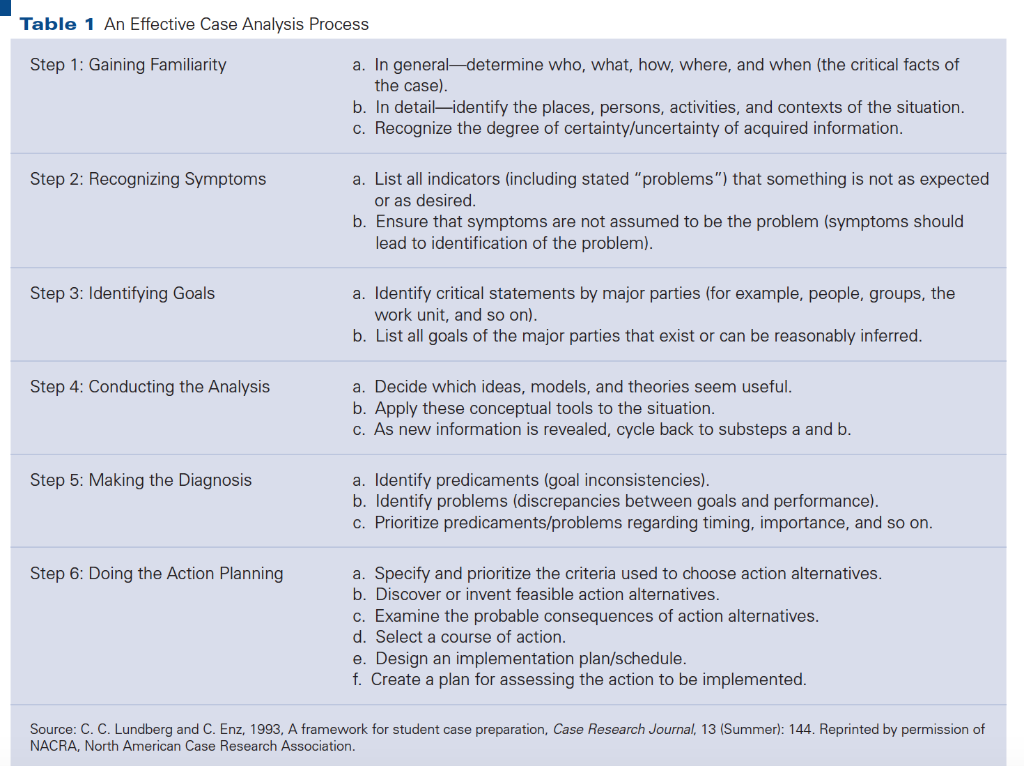
Table 1 An Effective Case Analysis Process Step 1: Gaining Familiarity a. In general determine who, what, how, where, and when (the critical facts of the case). b. In detail-identify the places, persons, activities, and contexts of the situation. c. Recognize the degree of certainty/uncertainty of acquired information. Step 2: Recognizing Symptoms a. List all indicators (including stated "problems") that something is not as expected or as desired. b. Ensure that symptoms are not assumed to be the problem (symptoms should lead to identification of the problem). Step 3: Identifying Goals a. Identify critical statements by major parties (for example, people, groups, the work unit, and so on). b. List all goals of the major parties that exist or can be reasonably inferred. Step 4: Conducting the Analysis a. Decide which ideas, models, and theories seem useful. b. Apply these conceptual tools to the situation. c. As new information is revealed, cycle back to substeps a and b. Step 5: Making the Diagnosis a. Identify predicaments (goal inconsistencies). b. Identify problems (discrepancies between goals and performance). c. Prioritize predicaments/problems regarding timing, importance, and so on. Step 6: Doing the Action Planning a. Specify and prioritize the criteria used to choose action alternatives. b. Discover or invent feasible action alternatives. c. Examine the probable consequences of action alternatives. d. Select a course of action. e. Design an implementation plan/schedule. f. Create a plan for assessing the action to be implemented. Source: C. C. Lundberg and C. Enz, 1993, A framework for student case preparation, Case Research Journal, 13 (Summer): 144. Reprinted by permission of NACRA, North American Case Research Association. Table 1 An Effective Case Analysis Process Step 1: Gaining Familiarity a. In general determine who, what, how, where, and when (the critical facts of the case). b. In detail-identify the places, persons, activities, and contexts of the situation. c. Recognize the degree of certainty/uncertainty of acquired information. Step 2: Recognizing Symptoms a. List all indicators (including stated "problems") that something is not as expected or as desired. b. Ensure that symptoms are not assumed to be the problem (symptoms should lead to identification of the problem). Step 3: Identifying Goals a. Identify critical statements by major parties (for example, people, groups, the work unit, and so on). b. List all goals of the major parties that exist or can be reasonably inferred. Step 4: Conducting the Analysis a. Decide which ideas, models, and theories seem useful. b. Apply these conceptual tools to the situation. c. As new information is revealed, cycle back to substeps a and b. Step 5: Making the Diagnosis a. Identify predicaments (goal inconsistencies). b. Identify problems (discrepancies between goals and performance). c. Prioritize predicaments/problems regarding timing, importance, and so on. Step 6: Doing the Action Planning a. Specify and prioritize the criteria used to choose action alternatives. b. Discover or invent feasible action alternatives. c. Examine the probable consequences of action alternatives. d. Select a course of action. e. Design an implementation plan/schedule. f. Create a plan for assessing the action to be implemented. Source: C. C. Lundberg and C. Enz, 1993, A framework for student case preparation, Case Research Journal, 13 (Summer): 144. Reprinted by permission of NACRA, North American Case Research Association

