







Question: CREATE A SCRIPT WHICH IS THE SAME AS THIS: Role Play Scenario: Navigating Workplace Conflict with Thomas - Kilmann Conflict Handling Styles Objective To explore
CREATE A SCRIPT WHICH IS THE SAME AS THIS:
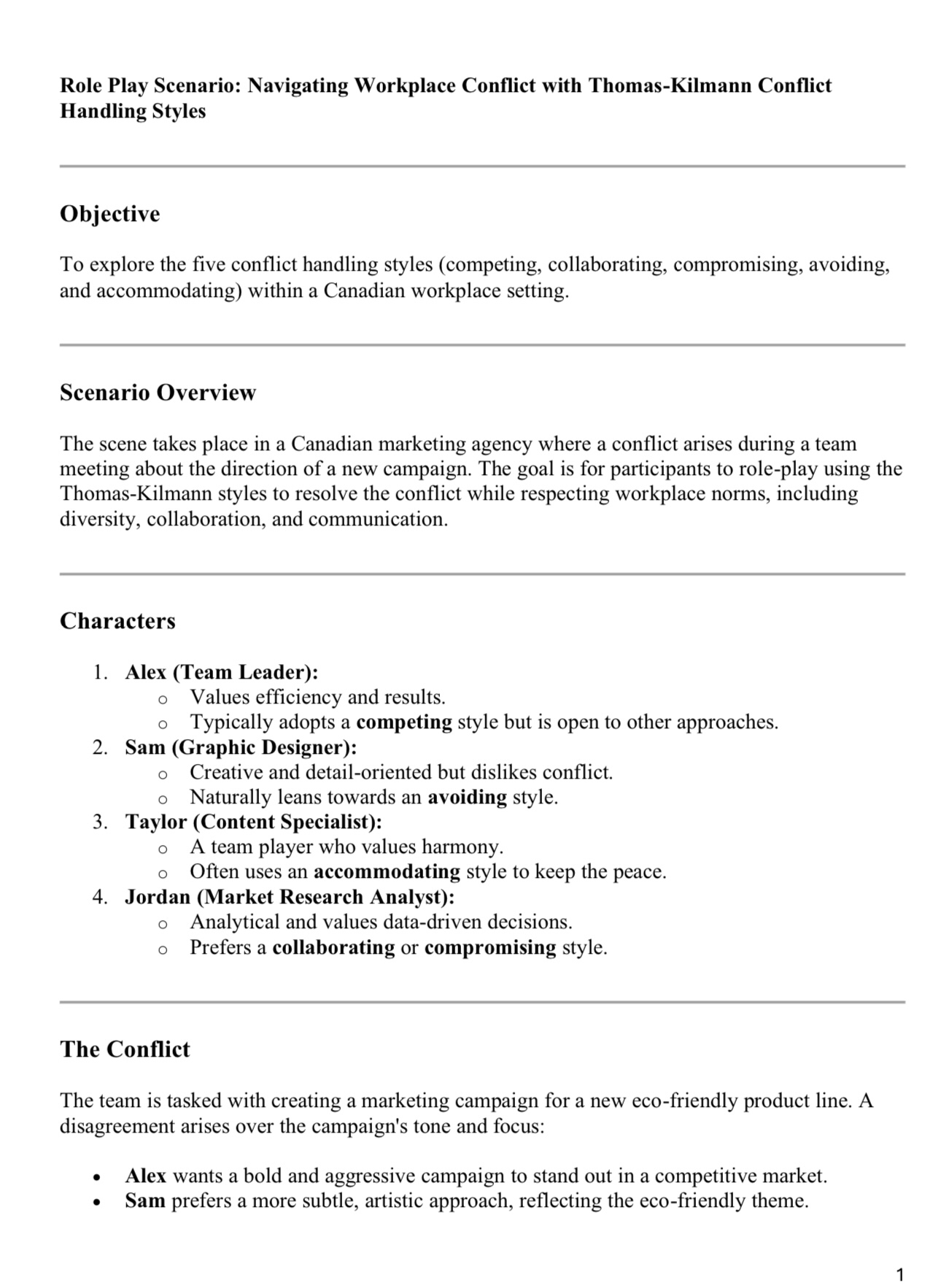
Role Play Scenario: Navigating Workplace Conflict with ThomasKilmann Conflict Handling Styles
Objective
To explore the five conflict handling styles competing collaborating, compromising, avoiding, and accommodating within a Canadian workplace setting.
Scenario Overview
The scene takes place in a Canadian marketing agency where a conflict arises during a team meeting about the direction of a new campaign. The goal is for participants to roleplay using the ThomasKilmann styles to resolve the conflict while respecting workplace norms, including diversity, collaboration, and communication.
Characters
Alex Team Leader:
Values efficiency and results.
Typically adopts a competing style but is open to other approaches.
Sam Graphic Designer:
Creative and detailoriented but dislikes conflict.
Naturally leans towards an avoiding style.
Taylor Content Specialist:
A team player who values harmony.
Often uses an accommodating style to keep the peace.
Jordan Market Research Analyst:
Analytical and values datadriven decisions.
Prefers a collaborating or compromising style.
The Conflict
The team is tasked with creating a marketing campaign for a new ecofriendly product line. A disagreement arises over the campaign's tone and focus:
Alex wants a bold and aggressive campaign to stand out in a competitive market.
Sam prefers a more subtle, artistic approach, reflecting the ecofriendly theme.
Taylor is concerned the conflict will harm team dynamics and suggests prioritizing team harmony.
Jordan argues for a datadriven approach based on consumer surveys.
Step : Setting the Stage
The team gathers in a meeting room with a whiteboard and project outlines. Alex begins by presenting their idea for a bold campaign, leading to pushback from the team.
Step : Role Play
Round : Initial Reactions Conflict Emerges
Alex: We need a campaign that grabs attention immediately. Subtle won't cut it in this market!" competing
Sam: "But bold might alienate the ecoconscious audience we're targeting." avoiding
Taylor: "Can we just pick something that everyone agrees on We're wasting time." accommodating
Jordan: "Let's look at the data. The surveys suggest consumers prefer campaigns with an authentic, subtle tone." collaborating
Round : Applying Conflict Styles
The facilitator prompts each participant to try a specific style:
Competing Alex
Alex insists their idea is best, dismissing Jordan's data.
Outcome: The others push back harder, increasing tension.
Avoiding Sam
Sam tries to change the topic, suggesting they revisit the discussion later.
Outcome: The conflict remains unresolved.
Accommodating Taylor
Taylor agrees with Alex just to keep the peace.
Outcome: Sam and Jordan feel unheard, reducing morale.
Collaborating Jordan
Jordan proposes combining Alex's boldness with Sam's artistic ideas, supported by Taylor's feedback and data insights.
Outcome: The team begins to work together on a balanced approach.
Round : Resolution
The facilitator encourages the team to use a compromising or collaborating style to reach a consensus.
The team agrees on a bold yet authentic campaign that reflects ecofriendly values, incorporating data and creative visuals.
Alex feels their need for boldness is addressed.
Sam's artistic input is valued.
Taylor feels harmony is restored.
Jordan appreciates the datadriven compromise.
Debrief Questions
How did each conflict style affect the team dynamics?
Which style felt most effective in this scenario and why?
How can these styles be adapted to a multicultural workplace in Canada?
What lessons can you apply to real workplace conflicts?
Debrief and Facilitator and Observer Notes
Encourage participants to think about how cultural norms in Canada eg inclusivity, collaboration, and open communication impact their conflict resolution choices.
Highlight the importance of flexibility and adapting styles based on the context.
Step by Step Solution
There are 3 Steps involved in it
1 Expert Approved Answer
Step: 1 Unlock

Question Has Been Solved by an Expert!
Get step-by-step solutions from verified subject matter experts
Step: 2 Unlock
Step: 3 Unlock
 Study Help