







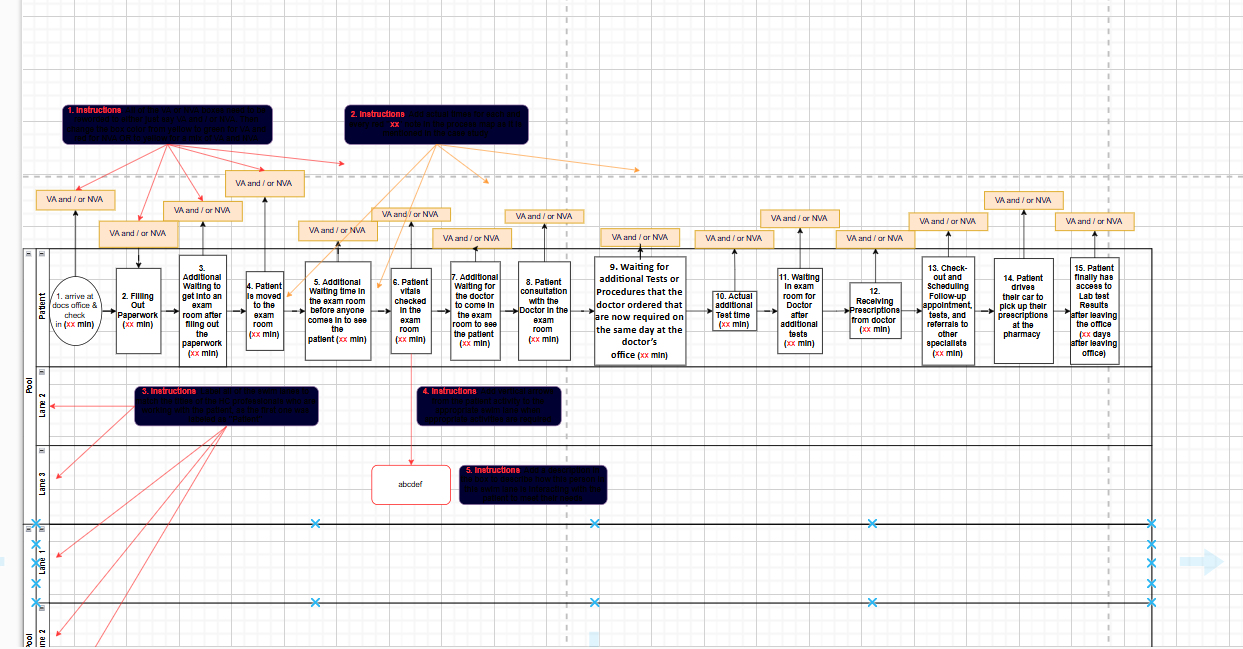
Question: Create a swim lane process map ( with draw.io ) for this story with a swim lane for each of the staff role that interacts
Create a swim lane process map with draw.io for this story with a swim lane for each of the staff role that interacts with the patient. Include cycle times durations for each step. Note whether it was a Value Added VA or NonValue added NVA step.
Create a toplevel Value Stream Map to include each of the mentioned steps with process times for each step, determine which of the abovenoted steps are VA or NVA, and indicate the total VA time aka PCE Process Cycle Efficiency total VA time total time x This compares the overall lead time from process steps to
Private Practice Case Study for Module : Essential Tools for Quality Improvement Background Summary: A family medicine practice, with a history of over two decades at the same location, was running with a full team, including a Doctor, a Physicians Assistant PA Medical Assistants MA Office Managers, and Clerks. Though a significant part of the staff had been with the practice for many years, the practice faced challenges. With nearly patient visits the prior year, they had shifted from paper to an electronic health record EHR system due to the Affordable Care Act ACA requirements, which proved to be a major transition. The practice struggled with the accuracy of their EHR system and lacked processoriented operations. A Lean Six Sigma consultant was called in emphasizing that the practice had issues with data management, process efficiency, and possibly its organizational culture. "A Really, Really Bad Day at the Office... Any yellow highlights sections are issues that affect the patient. Any bolded text represents the job titles of those working in the Doctors office. Summary of the case study: One of the two Medical Assistants MA came in to find a packed schedule, unaware of backtoback new patients. The day worsened as the other MA called in sick, and the Doctor was late, causing delays from the start. The first patient was kept waiting due to the Doctor's delay. A patient without an appointment was unhappy with the service and was allowed to skip ahead in line, frustrating other waiting patients. The solo MA faced multiple issues: she forgot supplies for a room, missed recording vitals, was criticized by both the Doctor and the PA and made an xray error. The Doctor's stress increased with the growing patient backlog. With an essential lunch meeting, the Doctor had to leave some patients to the PA risking further complaints. He even made an incorrect EHR entry and nearly prescribed the wrong medication to a patient. The CheckOut Clerk faced complaints from patients waiting for extended periods, made an error in providing a referral, and was emotionally affected by personal issues. The Office Manager juggled problems, including wrong deliveries and staffrelated concerns, alongside criticism from the Doctor over the day's disorganization. The Revenue Cycle Management Clerk identified documentation errors, faced challenges with inadequate coding details, and had to frequently "downcode" due to insurance denials. The tiring day ended late, leaving the staff fatigued and discontented. Both the MA and PA considered leaving their positions at the practice. The Doctor contemplated joining an accountable care organization, though hesitant about losing his independence. An accountable care organization ACO is a healthcare organization that brings together a group of coordinated health care practitioners, such as doctors, hospitals, and other providers, to deliver highquality and coordinated care to a designated group of patients. Patients were also not very happy at all today with the service they received and the excessive wait times. Here's the steps an average patient goes through at this practice and what the average duration times were for each step: Arrival and Checkin: Duration: minutes The patient spends time waiting in line, searching for necessary documents, and handling paperwork provided by the receptionist. Filling Out Paperwork: Duration: minutes Due to unclear instructions or lengthy forms, the patient takes an extended time to fill out or update their information. Additional Waiting to get into an exam room after filing out the paperwork: Duration: minutes The waiting area is crowded, and the office is running behind schedule, resulting in a prolonged wait. Patient is moved to the exam room: Duration: minute Additional Waiting time in the exam room before anyone comes in to see the patient: Duration: minutes Patient vitals checked in the exam room: Duration: minutes The medical assistant is juggling multiple tasks and is not immediately available. When they do arrive, the equipment might need recalibration or is temporarily nonfunctional. Additional Waiting for the doctor to come in the exam room to see the patient: Duration: minutes The Doctor is backed
Step by Step Solution
There are 3 Steps involved in it
1 Expert Approved Answer
Step: 1 Unlock

Question Has Been Solved by an Expert!
Get step-by-step solutions from verified subject matter experts
Step: 2 Unlock
Step: 3 Unlock
 Study Help