







Question: Create a value stream map with the following info: At the VSM kickoff, Joanie explained that she wanted the VSM to start with the event
Create a value stream map with the following info:
At the VSM kickoff, Joanie explained that she wanted the VSM to start with the event of receiving incoming mail, and continue until the invoice is resolved and the resolution is scanned into the document imaging system. At the VSM meeting, Bill Hutchins from the mailroom patiently explained what happened to incoming mail.
After its received, said Bill, its got to be opened and examined to determine whether or not it belongs to AP. If its not, then we have to re-route it to the right department.
What happens next if it doesnt have to be re-routed? asked Colleen.
Well, in that case, commented Bill, we have to check to see if it has a Purchase Order (PO) or not. If it doesnt, then we have to follow up with a call to the vendor contact person to straighten that out. On the other hand, if it does have a PO (or once we get the PO issue straightened out with the vendor), we next have to check to see whether or not the Purchase Order is for an item on the PFR system.
Okay, Colleen said, I get the picture. If it is a PFR item, then you just toss it since its already been paid for off the PFR system. If not, then it goes to the appropriate analyst. Since weve assigned companies to analysts alphabetically, that should be pretty straightforward.
Yes, said Bill, it is. Companies whose name starts with an Aa through Be go to Sullivan, and so on. What gets me though is why we get all those invoices for PFR Items. The vendors know theyre on the PFR system and we dont need an invoice to pay them.
Youre right, asserted Colleen. The problem is that some of the vendors are running accounting software that forces them to generate and send an invoice. Weve talked to some of them about this, but its just too expensive for some of them to change systems to meet the needs of only one customer. Still, itd sure be nice to do something about that.
Anyway, continued Colleen, lets try to nail down what happens once the PO gets to the analyst. Nicole, youve been working as an analyst for 5 years, how do you see the process?
Well, said Nicole, the first thing I have to do is check to see whether its a PFR item or not. Why on earth is that? asked Bill. Weve already checked for that in the mailroom.
Yes, and you do a good job of catching almost all of them, agreed Nicole. Still, she observed tactfully, a PFR item does slip through from time to time, so we still have to check.
Nicole, how long does it take to check whether or not an item is PFR? asked Colleen. Well, said Nicole, you know that we have to get into the SAP system to look it up. Probably, on average, that takes about 6 to 7 minutes. Okay, said Colleen. And if it is a PFR item, you toss it just like they do in the mailroom and otherwise it gets processed. So how do you see the rest of the process going?
What happens next, stated Nicole is that I determine whether or not it is ready to pay. If it is, I send it to Input where it is paid and the records are batched and scanned. If it isnt ready to pay, then I put it in a pile on my desk to work on later. When the issue is resolved, it goes to input where it is paid, and then the records are batched and scanned.
Why do you put it in a pile to work on later? asked Colleen. Couldnt you just work on it immediately?
Well, sure, said Nicole. Whether I work on it immediately or not, it takes about a minute to resolve. But the thing is, if I do work on it immediately, it throws me completely off my stride in checking for Ready to Pay. All of us analysts have tried completing the resolution before continuing on with the Ready to Pay checks, but it just doesnt seem to work---it slows us up way too much. So setting the items needing resolution aside until we complete the entire batch of Ready to Pay checks seems to be the only way to go.
The meeting continued for several more hours. At the end of that time, Colleen had painstakingly collected the data shown in Tables 2 and 3. Colleen and Joanie met once more to discuss the results of the VSM and decided, based on the VSM, to initiate an Accounts Payable RPI to determine how best to improve the process. The RPI event was scheduled for 3 days and would require 12 team members, 2 RPI workshop leaders, and 5 on-call experts
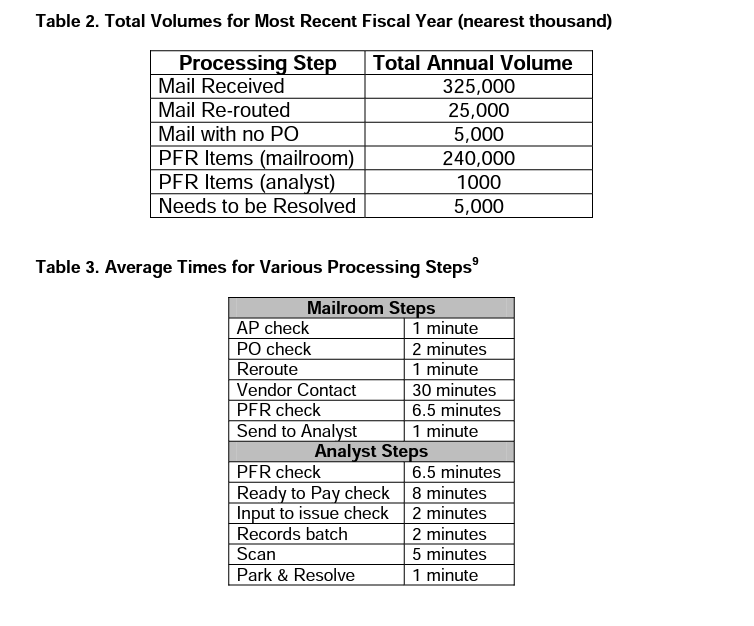
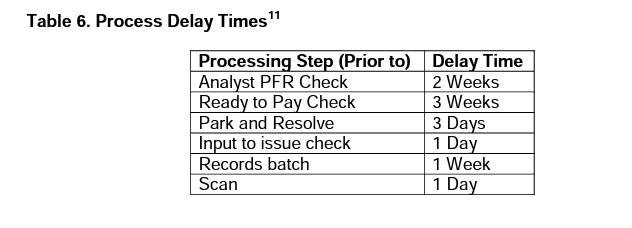
Table 2. Total Volumes for Most Recent Fiscal Year (nearest thousand) Table 3. Average Times for Various Processing Steps 9 Table 6. Process Delay Times 11
Step by Step Solution
There are 3 Steps involved in it

Get step-by-step solutions from verified subject matter experts
 Study Help