







Question: Create an A3 poster that represents 3 theories, each from a different perspective. You might like to choose theories from the Developmental, Socio-cultural,Socio-Behaviourist, Critical or
- Create an A3 poster that represents 3 theories, each from a different perspective. You might like to choose theories from the Developmental, Socio-cultural,Socio-Behaviourist, Critical or Post Structuralist perspectives.
- For each theory, indicate the perspective it refers to and insert 4 pieces of information that illustrate it. Please note: 1 piece of information should be a paragraph that explains the theory in your own words. The other 3 pieces should be visual. They might include a picture - drawing - quote - poem...etc. The 4 pieces together should provide the reader with an overview of the theory.
- At the end of the poster, include 300-200 words summaryto indicate your favourite theory,the reason of choice and how you can apply it in your practice as a teacher.?
- Write correctly, check grammar, spelling and sentence structure.
- Include in-text referencing and a reference list of at least 3 sources written according to the Harvard Style.
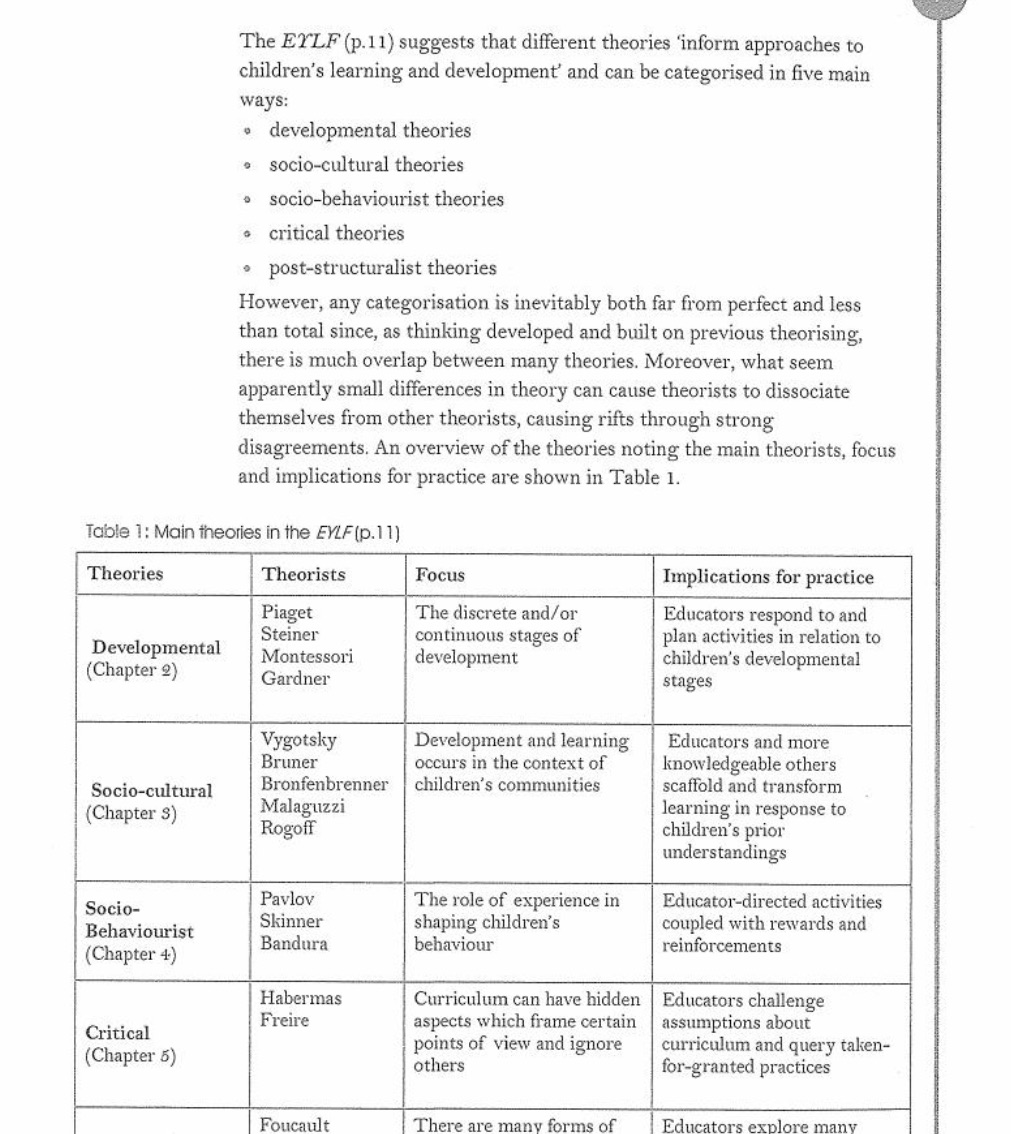
The ELF (p.11) suggests that different theories 'inform approaches to children's learning and development' and can be categorised in five main ways : . developmental theories socio-cultural theories . socio-behaviourist theories . critical theories post-structuralist theories However, any categorisation is inevitably both far from perfect and less than total since, as thinking developed and built on previous theorising, there is much overlap between many theories. Moreover, what seem apparently small differences in theory can cause theorists to dissociate themselves from other theorists, causing rifts through strong disagreements. An overview of the theories noting the main theorists, focus and implications for practice are shown in Table 1. Table 1: Main theories in the EYLF(p. 11) Theories Theorists Focus Implications for practice Piaget The discrete and/or Educators respond to and Steiner continuous stages of plan activities in relation to Developmental Montessori development children's developmental (Chapter 2) Gardner stages Vygotsky Development and learning Educators and more Bruner occurs in the context of knowledgeable others Socio-cultural Bronfenbrenner children's communities scaffold and transform (Chapter S) Malaguzzi learning in response to Rogoff children's prior understandings Socio- Pavlov The role of experience in Educator-directed activities Skinner shaping children's coupled with rewards and Behaviourist Bandura behaviour reinforcements (Chapter 4) Habermas Curriculum can have hidden Educators challenge Freire aspects which frame certain assumptions about Critical points of view and ignore curriculum and query taken- (Chapter 5) others for-granted practices Foucault Edi
Step by Step Solution
There are 3 Steps involved in it

Get step-by-step solutions from verified subject matter experts
 Study Help