







Question: CREATE TABLE Title ( Title_Code varchar(255) not null Primary Key, Title_Discription varchar(255), Salary Number(11)); insert into Title (Title_Code, Title_Discription, Salary) values ('T1' , 'Accountant' ,
CREATE TABLE Title (
Title_Code varchar(255) not null Primary Key,
Title_Discription varchar(255),
Salary Number(11));
insert into Title (Title_Code, Title_Discription, Salary) values
('T1' , 'Accountant' , '10000');
insert into Title (Title_Code, Title_Discription, Salary) values
('T2' , 'Analyst' , '20000');
insert into Title (Title_Code, Title_Discription, Salary) values
('T3' , 'Programmer' , '30000'),
insert into Title (Title_Code, Title_Discription, Salary) values
('T4' , 'DBA' , '40000');
insert into Title (Title_Code, Title_Discription, Salary) values
('T5' , 'Manager' , '50000');
CREATE TABLE Department (
dep_Code number(11) not null Primary Key,
dept_Name varchar(255),
location varchar(255),
Dept_Type varchar(255));
insert into Department(dep_Code,dept_name,location,Dept_Type) values
( '001' , 'Computer Center' , 'Boston' , 'IT');
insert into Department(dep_Code,dept_name,location,Dept_Type) values
( '002' , 'Budget' , 'New York' , 'Business');
insert into Department(dep_Code,dept_name,location,Dept_Type) values
( '003' , 'Marketing' , 'Boston' , 'Marketing');
insert into Department(dep_Code,dept_name,location,Dept_Type) values
( '004' , 'Database Support' , 'Cleveland' , 'IT');
insert into Department(dep_Code,dept_name,location,Dept_Type) values
( '005' , 'Purchasing' , 'New York' , 'Business');
CREATE TABLE Employee (
ID number(11) not null Primary Key,
emp_Name varchar(255),
empl_Type varchar(255),
dept_Code number(11) not null,
title_Code varchar(255) not null,
constraint fk_dep_Code
foreign key (dep_Code) references Department(dep_Code),
COnstraint fk_title_Code
foreign key (title_Code) references Title(title_Code));
insert into Employee(ID, emp_name,empl_Type,dept_Code,title_Code) values
('1' , 'John' , 'Full-time' , '002', 'T1');
insert into Employee(ID, emp_name,empl_Type,dept_Code,title_Code) values
('2' , 'Adam' , 'Consultant' , '001', 'T3');
insert into Employee(ID, emp_name,empl_Type,dept_Code,title_Code) values
('3' , 'Mary' , 'Part-time' , '004', 'T4');
insert into Employee(ID, emp_name,empl_Type,dept_Code,title_Code) values
('4' , 'Peter' , 'Full-time' , '003', 'T2');
insert into Employee(ID, emp_name,empl_Type,dept_Code,title_Code) values
('5' , 'Scott' , 'Consultant' , '002', 'T1');
insert into Employee(ID, emp_name,empl_Type,dept_Code,title_Code) values
('6' , 'Susan' , 'Full-time' , '005', 'T5');
insert into Employee(ID, emp_name,empl_Type,dept_Code,title_Code) values
('7' , 'Alex' , 'Part-time' , '004', 'T2');
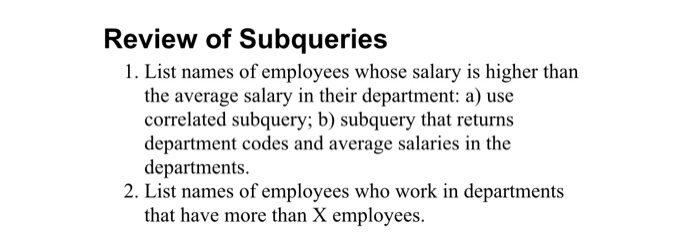
Review of Subqueries 1. List names of employees whose salary is higher than the average salary in their department: a) use correlated subquery; b) subquery that returns department codes and average salaries in the departments 2. List names of employees who work in departments that have more than X employees
Step by Step Solution
There are 3 Steps involved in it
1 Expert Approved Answer
Step: 1 Unlock

Question Has Been Solved by an Expert!
Get step-by-step solutions from verified subject matter experts
Step: 2 Unlock
Step: 3 Unlock
 Study Help