







Question: Create three fitting functions: const - tries to fit with f(2)= lin - tries to fit with f(2)=2+Co quad - tries to fit with
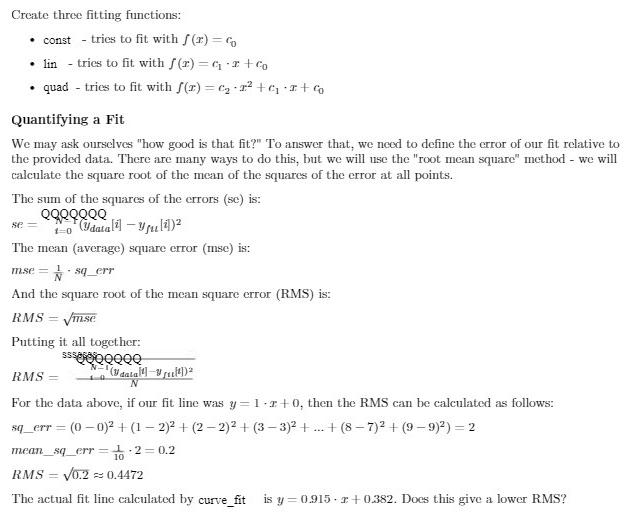
Create three fitting functions: const - tries to fit with f(2)= lin - tries to fit with f(2)=2+Co quad - tries to fit with f(2)=C 2 +1+% Quantifying a Fit We may ask ourselves "how good is that fit?" To answer that, we need to define the error of our fit relative to the provided data. There are many ways to do this, but we will use the "root mean square" method - we will calculate the square root of the mean of the squares of the error at all points. The sum of the squares of the errors (se) is: QQQQQQQ se= 1-0 data-u) The mean (average) square error (mse) is: mse= - sq_err And the square root of the mean square error (RMS) is: RMS = mse Putting it all together: 5550000000 (datal-ful]) RMS N For the data above, if our fit line was y=1-2 +0, then the RMS can be calculated as follows: sq_err = (0-0)+(1-2)+(2-2)+(3-3)+...+(8-7)+(99)) = 2 mean_sq_err = 02=0.2 10 RMS = 0.2 = 0.4472 The actual fit line calculated by curve fit is y=0.915-r+0.382. Does this give a lower RMS?
Step by Step Solution
There are 3 Steps involved in it
Replace the fitparams tuple with the coefficients from your actual curve fit in this case the coeffi... View full answer

Get step-by-step solutions from verified subject matter experts
 Study Help