







Question: Create your own compensation plan that you think would be best. Be sure to include a recommendation for how to handle expenses. How would you

Create your own compensation plan that you think would be best. Be sure to include a recommendation for how to handle expenses.
How would you approach Mr.Marshall to convince him to go with your own (the best) plan?
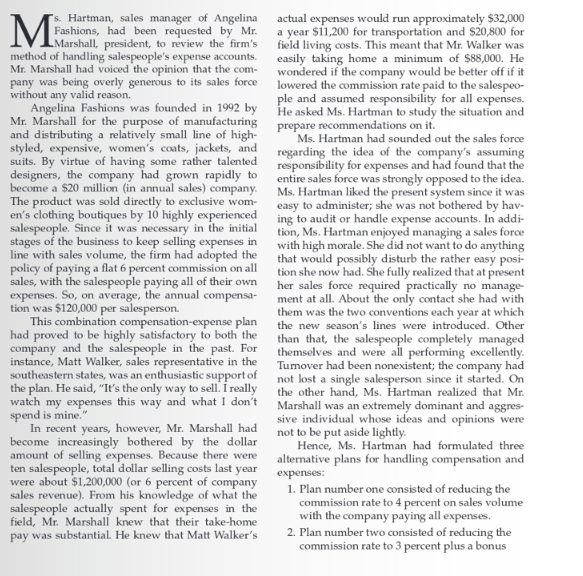
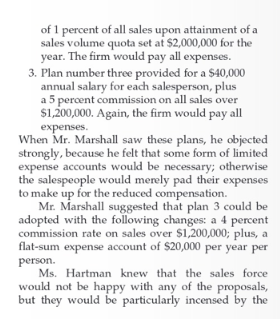
M 's. Hartman, sales manager of Angelina actual expenses would run approximately $32,000 Fashions, had been requested by Mr. a year $11,200 for transportation and $20,800 for Marshall, president, to review the firm's field living costs. This meant that Mr. Walker was method of handling salespeople's expense accounts. easily taking home a minimum of $88,000. He Mr. Marshall had voiced the opinion that the com- wondered if the company would be better off if it pany was being overly generous to its sales force lowered the commission rate paid to the salespeo- without any valid reason. ple and assumed responsibility for all expenses. Angelina Fashions was founded in 1992 by Mr. Marshall for the purpose of manufacturing He asked Ms. Hartman to study the situation and prepare recommendations on it. and distributing a relatively small line of high- Ms. Hartman had sounded out the sales force styled, expensive, women's coats, jackets, and regarding the idea of the company's assuming suits. By virtue of having some rather talented responsibility for expenses and had found that the designers, the company had grown rapidly to become a $20 million (in annual sales) company, entire sales force was strongly opposed to the idea. Ms. Hartman liked the present system since it was The product was sold directly to exclusive wom- easy to administer; she was not bothered by hav- en's clothing boutiques by 10 highly experienced ing to audit or handle expense accounts. In addi- salespeople. Since it was necessary in the initial tion, Ms. Hartman enjoyed managing a sales force stages of the business to keep selling expenses in with high morale. She did not want to do anything line with sales volume, the firm had adopted the that would possibly disturb the rather easy posi- policy of paying a flat 6 percent commission on all tion she now had. She fully realized that at present sales, with the salespeople paying all of their own her sales force required practically no manage expenses. So, on average, the annual compensa- ment at all. About the only contact she had with tion was $120,000 per salesperson them was the two conventions each year at which This combination compensation-expense plan the new season's lines were introduced. Other had proved to be highly satisfactory to both the than that, the salespeople completely managed company and the salespeople in the past. For themselves and were all performing excellently. instance, Matt Walker, sales representative in the Tumover had been nonexistent; the company had southeastern states, was an enthusiastic support of not lost a single salesperson since it started. On the plan. He said, "It's the only way to sell. I really the other hand, Ms. Hartman realized that Mr. watch my expenses this way and what I don't Marshall was an extremely dominant and aggres- spend is mine." sive individual whose ideas and opinions were In recent years, however, Mr. Marshall had not to be put aside lightly. become increasingly bothered by the dollar Hence, Ms. Hartman had formulated three amount of selling expenses. Because there were ten salespeople, total dollar selling costs last year alternative plans for handling compensation and expenses: were about $1,200,000 (or 6 percent of company sales revenue). From his knowledge of what the 1. Plan number one consisted of reducing the salespeople actually spent for expenses in the commission rate to 4 percent on sales volume field, Mr. Marshall knew that their take-home with the company paying all expenses. pay was substantial. He knew that Matt Walker's 2. Plan number two consisted of reducing the commission rate to 3 percent plus a bonus of 1 percent of all sales upon attainment of a sales volume quota set at $2,000,000 for the year. The firm would pay all expenses. 3. Plan number three provided for a $40,000 annual salary for each salesperson, plus a 5 percent commission on all sales over $1,200,000. Again, the firm would pay all expenses When Mr. Marshall saw these plans, he objected strongly, because he felt that some form of limited expense accounts would be necessary, otherwise the salespeople would merely pad their expenses to make up for the reduced compensation. Mr. Marshall suggested that plan 3 could be adopted with the following changes: a 4 percent commission rate on sales over $1,200,000; plus, a flat-sum expense account of $20,000 per year per person. Ms. Hartman knew that the sales force would not be happy with any of the proposals, but they would be particularly incensed by the fixed-expense plan. Further, she knew that the salespeople gained some tax advantages from the present system and that they would not look kind- ly upon having those advantages discontinuedStep by Step Solution
There are 3 Steps involved in it
1 Expert Approved Answer
Step: 1 Unlock

Question Has Been Solved by an Expert!
Get step-by-step solutions from verified subject matter experts
Step: 2 Unlock
Step: 3 Unlock
 Study Help