







Question: The glass electrode shown to in the image is similar to what you used in the Potentiometric Analyses experiment to measure pH. The processes
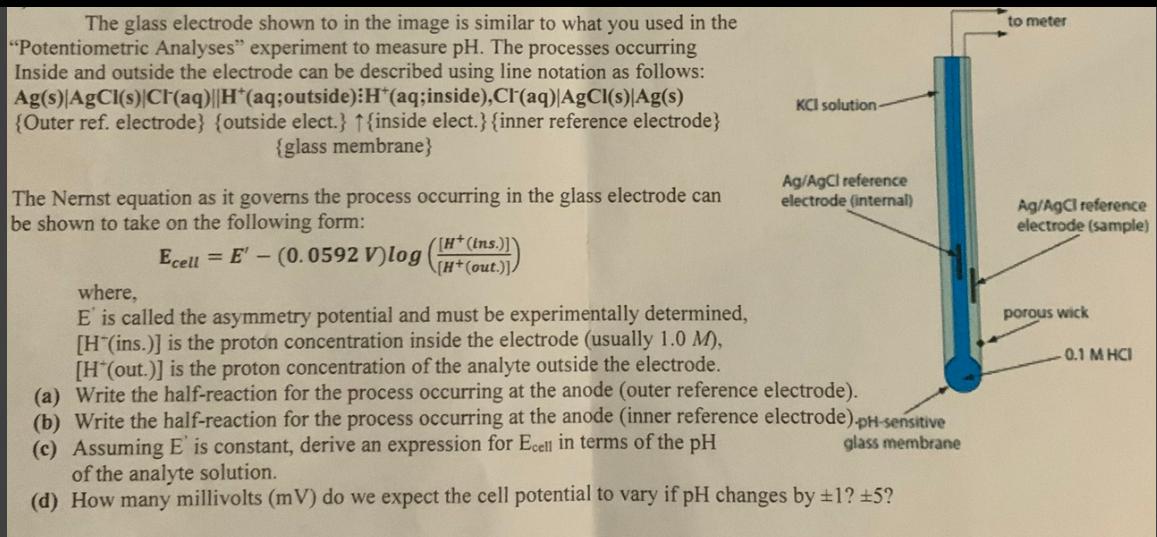
The glass electrode shown to in the image is similar to what you used in the "Potentiometric Analyses" experiment to measure pH. The processes occurring Inside and outside the electrode can be described using line notation as follows: Ag(s)|AgCl(s) CH(aq)||H(aq;outside):H(aq;inside),Cl(aq)|AgCl(s)|Ag(s) {Outer ref. electrode} {outside elect.} {inside elect.} {inner reference electrode} {glass membrane} The Nernst equation as it governs the process occurring in the glass electrode can be shown to take on the following form: where, Ecell = E' - (0.0592 V)log (* (in.)]) [H+(out.)] E' is called the asymmetry potential and must be experimentally determined, [H*(ins.)] is the proton concentration inside the electrode (usually 1.0 M), [H*(out.)] is the proton concentration of the analyte outside the electrode. KCI solution- Ag/AgCl reference electrode (internal) (a) Write the half-reaction for the process occurring at the anode (outer reference electrode). (b) Write the half-reaction for the process occurring at the anode (inner reference electrode).pH-sensitive (c) Assuming E' is constant, derive an expression for Ecell in terms of the pH of the analyte solution. glass membrane (d) How many millivolts (mV) do we expect the cell potential to vary if pH changes by 1? 5? to meter Ag/AgCl reference electrode (sample) porous wick 0.1 M HCI
Step by Step Solution
There are 3 Steps involved in it

Get step-by-step solutions from verified subject matter experts
 Study Help