Question: CRIM 104-Critical Reflection #2 Theory Selection This reflection aims to begin work on your major assignment by choosing the theory you will apply in your
CRIM 104-Critical Reflection #2
Theory Selection
This reflection aims to begin work on your major assignment by choosing the theory you will apply in your case and finding relevant academic sources. Please refer to the major assignment instructions posted on Canvas for additional information. You may use this Word document to write your answers, expanding each section.
1. What theory from CRIM 104 would you like to apply in your major assignment (use social learning theory) and why?
2. What theorist is often associated with your theory? What pages of our course textbook and what lecture can you find information about your theory?
3. In 150 words or fewer, please summarize the basic assumptions of your theory. For example, what are the fundamental building blocks of your theory?
4. In your own words, why have you chosen this theory to help your reader better understand the R v Dogdson/Holloway case? (under 150 words)
For your major assignment, you're asked to utilize 6 academic sources. For this submission, please find 3 academic sources on your chosen theory that you will use in your major assignment. Need help finding academic sources?https://www.lib.sfu.ca/help/research-assistance/format-type/journal-articles
Please use SFU source
When listing your 3 sources, please cite your sources in APA format (as they would appear on your reference page), and provide a brief 50-100-word summary below each source of why you have choseneachspecific source to support your major assignment
How to cite in-text and create a reference list in APA format:https://www.lib.sfu.ca/help/cite-write/citation-style-guides/apa#reference-list
Source #1
Source #2
Source #3
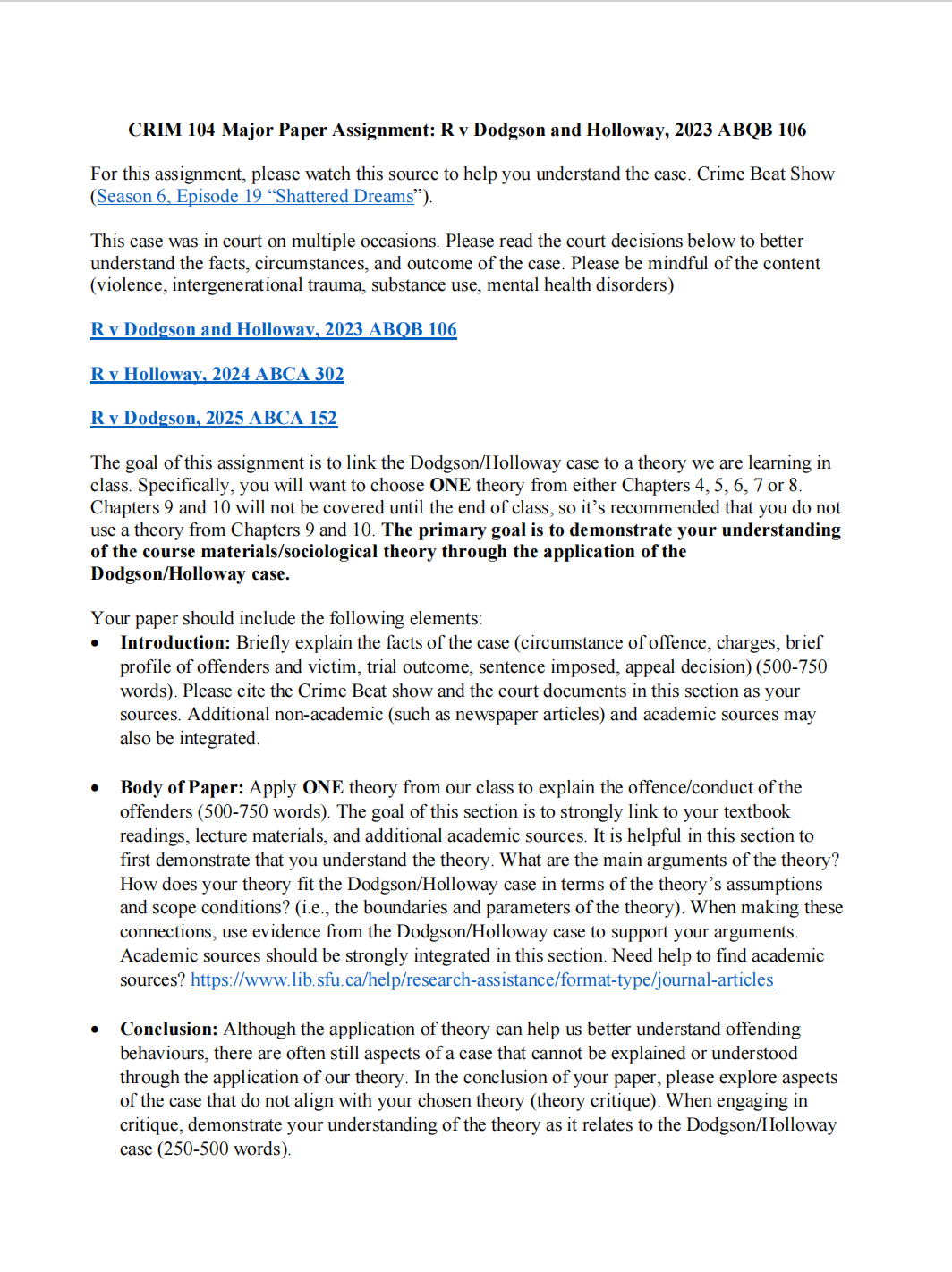
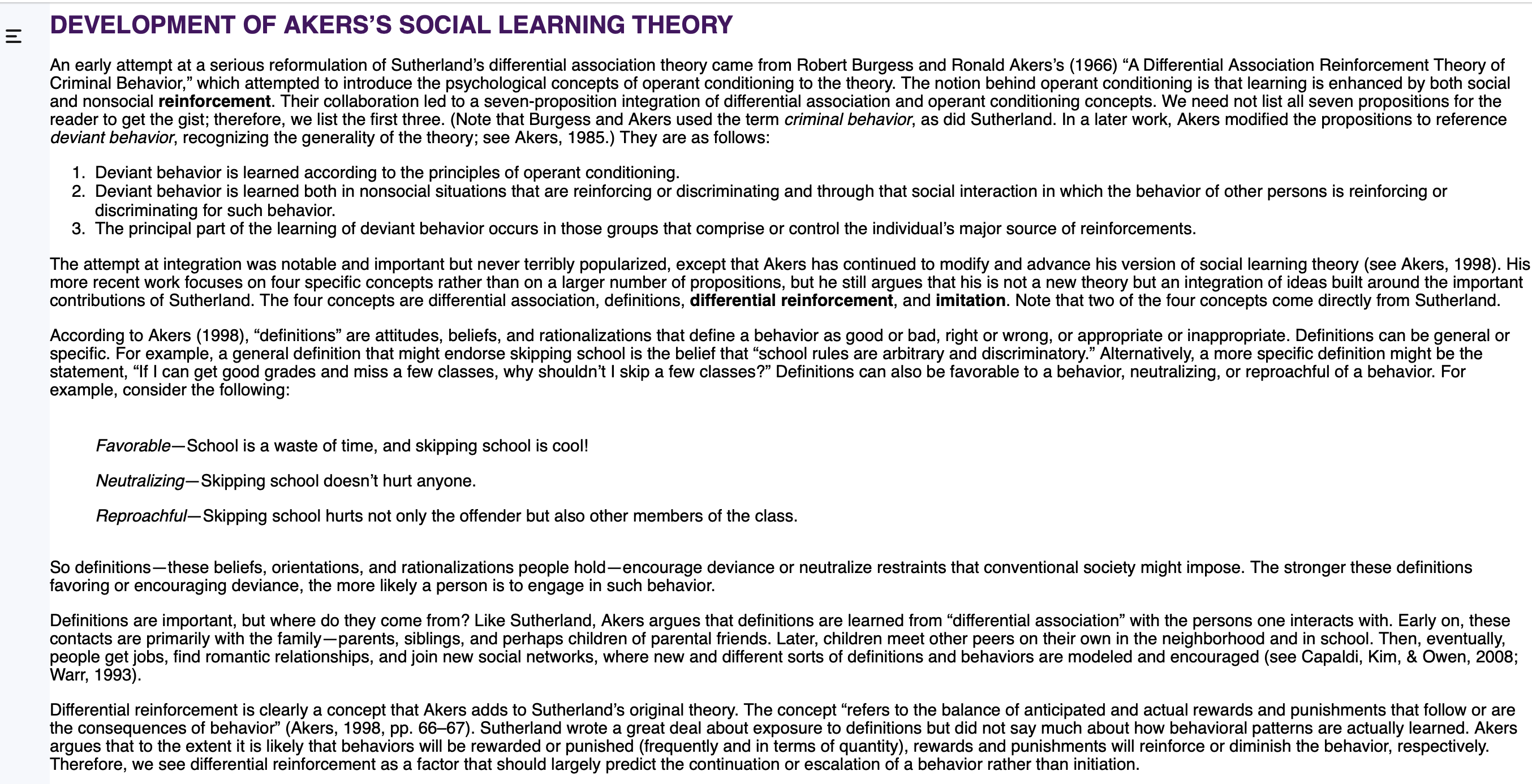
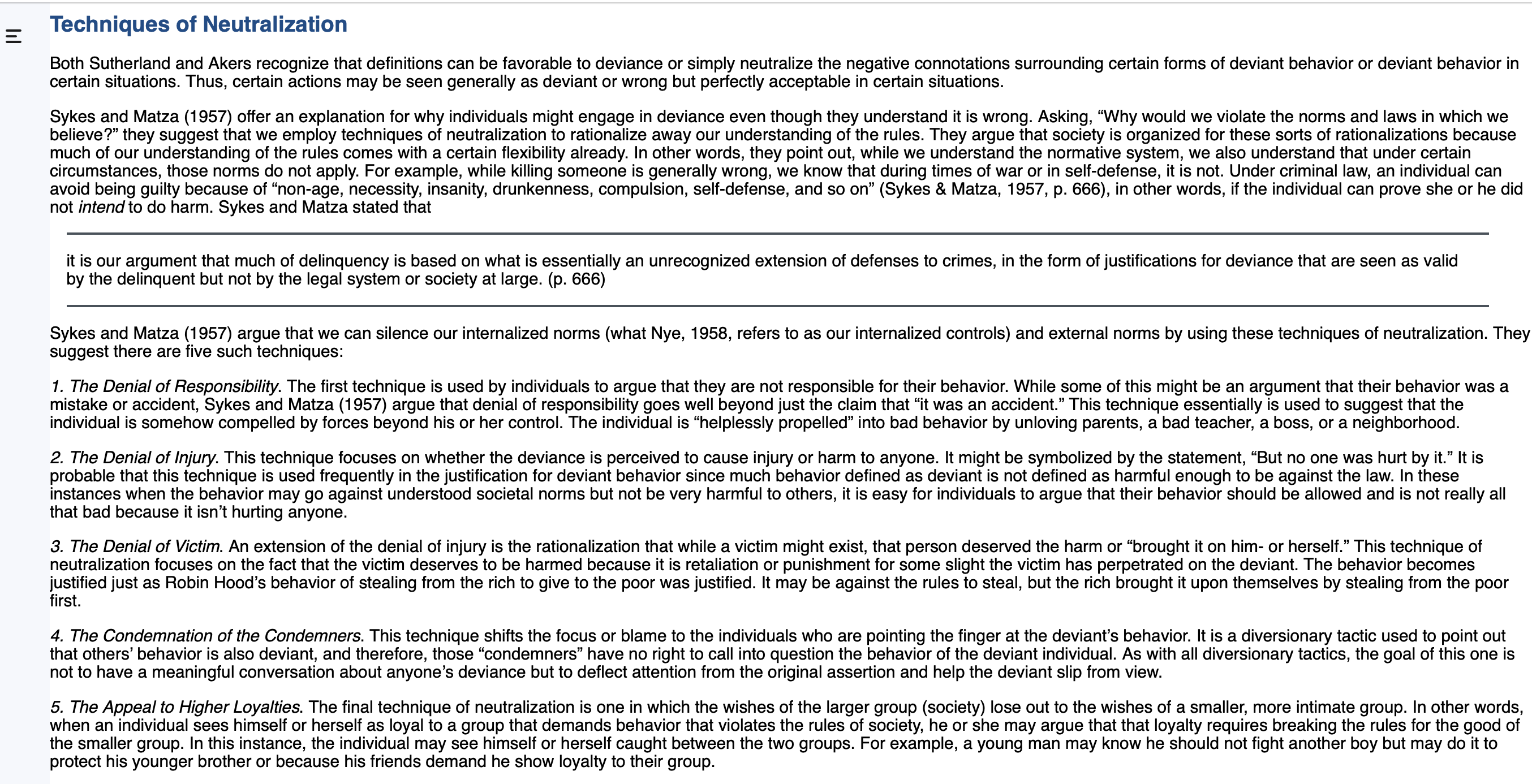
CRIM 104 Major Paper Assignment: R v Dodgson and Holloway, 2023 ABQB 106 For this assignment, please watch this source to help you understand the case. Crime Beat Show (Season 6, Episode 19 \"Shattered Dreams\"). This case was in court on multiple occasions. Please read the court decisions below to better understand the facts, circumstances, and outcome of the case. Please be mindful of the content (violence, intergenerational trauma, substance use, mental health disorders) R v Dodgson and Holloway, 2023 ABOB 106 The goal of this assignment ts to link the Dodgson/Holloway case to a theory we are learning in class. Specifically, you will want to choose ONE theory from either Chapters 4, 5, 6, 7 or 8. Chapters 9 and 10 will not be covered until the end of class, so it's recommended that you do not use a theory from Chapters 9 and 10. The primary goal is to demonstrate your understanding of the course materials/sociological theory through the application of the Dodgson/Holloway case. Your paper should include the following elements: e Introduction: Briefly explain the facts of the case (circumstance of offence, charges, brief profile of offenders and victim, trial outcome, sentence imposed, appeal decision) (500-750 words). Please cite the Crime Beat show and the court documents in this section as your sources. Additional non-academic (such as newspaper articles) and academic sources may also be integrated. e Body of Paper: Apply ONE theory from our class to explain the offence/conduct of the offenders (500-750 words). The goal of this section is to strongly link to your textbook readings, lecture materials, and additional academic sources. It is helpful in this section to first demonstrate that you understand the theory. What are the main arguments of the theory? How does your theory fit the Dodgson/Holloway case in terms of the theory's assumptions and scope conditions? (1.e., the boundaries and parameters of the theory). When making these connections, use evidence from the Dodgson/Holloway case to support your arguments. Academic sources should be strongly integrated in this section. Need help to find academic sources? https://www.lib.sfu. ca/help/research-assistance/format-type/journal-articles e Conclusion: Although the application of theory can help us better understand offending behaviours, there are often still aspects of a case that cannot be explained or understood through the application of our theory. In the conclusion of your paper, please explore aspects of the case that do not align with your chosen theory (theory critique). When engaging in critique, demonstrate your understanding of the theory as it relates to the Dodgson/Holloway case (250-500 words). DEVELOPMENT OF AKERS'S SOCIAL LEARNING THEORY An early attempt at a serious reformulation of Sutherland's differential association theory came from Robert Burgess and Ronald Akers's (1966) \"A Differential Association Reinforcement Theory of Criminal Behavior,\" which attempted to introduce the psychological concepts of operant conditioning to the theory. The notion behind operant conditioning is that learning is enhanced by both social and nonsocial reinforcement. Their collaboration led to a seven-proposition integration of differential association and operant conditioning concepts. We need not list all seven propositions for the reader to get the gist; therefore, we list the first three. (Note that Burgess and Akers used the term criminal behavior, as did Sutherland. In a later work, Akers modified the propositions to reference deviant behavior, recognizing the generality of the theory; see Akers, 1985.) They are as follows: 1. Deviant behavior is learned according to the principles of operant conditioning. 2. Deviant behavior is learned both in nonsocial situations that are reinforcing or discriminating and through that social interaction in which the behavior of other persons is reinforcing or discriminating for such behavior. 3. The principal part of the learning of deviant behavior occurs in those groups that comprise or control the individual's major source of reinforcements. The attempt at integration was notable and important but never terribly popularized, except that Akers has continued to modify and advance his version of social learning theory (see Akers, 1998). His more recent work focuses on four specific concepts rather than on a larger number of propositions, but he still argues that his is not a new theory but an integration of ideas built around the important contributions of Sutherland. The four concepts are differential association, definitions, differential reinforcement, and imitation. Note that two of the four concepts come directly from Sutherland. According to Akers (1998), \"definitions\" are attitudes, beliefs, and rationalizations that define a behavior as good or bad, right or wrong, or appropriate or inappropriate. Definitions can be general or specific. For example, a general definition that might endorse skipping school is the belief that \"school rules are arbitrary and discriminatory.\" Alternatively, a more specific definition might be the statement, \"If | can get good grades and miss a few classes, why shouldn't | skip a few classes?\" Definitions can also be favorable to a behavior, neutralizing, or reproachful of a behavior. For example, consider the following: FavorableSchool is a waste of time, and skipping school is cool! Neutralizing Skipping school doesn't hurt anyone. Reproachful Skipping school hurts not only the offender but also other members of the class. So definitionsthese beliefs, orientations, and rationalizations people holdencourage deviance or neutralize restraints that conventional society might impose. The stronger these definitions favoring or encouraging deviance, the more likely a person is to engage in such behavior. Definitions are important, but where do they come from? Like Sutherland, Akers argues that definitions are learned from \"differential association\" with the persons one interacts with. Early on, these contacts are primarily with the familyparents, siblings, and perhaps children of parental friends. Later, children meet other peers on their own in the neighborhood and in school. Then, eventually, people get jobs, find romantic relationships, and join new social networks, where new and different sorts of definitions and behaviors are modeled and encouraged (see Capaldi, Kim, & Owen, 2008; Warr, 1993). Differential reinforcement is clearly a concept that Akers adds to Sutherland's original theory. The concept \"refers to the balance of anticipated and actual rewards and punishments that follow or are the consequences of behavior\" (Akers, 1998, pp. 66-67). Sutherland wrote a great deal about exposure to definitions but did not say much about how behavioral patterns are actually learned. Akers argues that to the extent it is likely that behaviors will be rewarded or punished (frequently and in terms of quantity), rewards and punishments will reinforce or diminish the behavior, respectively. Therefore, we see differential reinforcement as a factor that should largely predict the continuation or escalation of a behavior rather than initiation. Techniques of Neutralization Both Sutherland and Akers recognize that definitions can be favorable to deviance or simply neutralize the negative connotations surrounding certain forms of deviant behavior or deviant behavior in certain situations. Thus, certain actions may be seen generally as deviant or wrong but perfectly acceptable in certain situations. Sykes and Matza (1957) offer an explanation for why individuals might engage in deviance even though they understand it is wrong. Asking, \"Why would we violate the norms and laws in which we believe?\" they suggest that we employ techniques of neutralization to rationalize away our understanding of the rules. They argue that society is organized for these sorts of rationalizations because much of our understanding of the rules comes with a certain flexibility already. In other words, they point out, while we understand the normative system, we also understand that under certain circumstances, those norms do not apply. For example, while killing someone is generally wrong, we know that during times of war or in self-defense, it is not. Under criminal law, an individual can avoid being guilty because of \"non-age, necessity, insanity, drunkenness, compulsion, self-defense, and so on\" (Sykes & Matza, 1957, p. 666), in other words, if the individual can prove she or he did not intend to do harm. Sykes and Maiza stated that it is our argument that much of delinquency is based on what is essentially an unrecognized extension of defenses to crimes, in the form of justifications for deviance that are seen as valid by the delinquent but not by the legal system or society at large. (p. 666) Sykes and Matza (1957) argue that we can silence our internalized norms (what Nye, 1958, refers to as our internalized controls) and external norms by using these techniques of neutralization. They suggest there are five such techniques: 1. The Denial of Responsibility. The first technique is used by individuals to argue that they are not responsible for their behavior. While some of this might be an argument that their behavior was a mistake or accident, Sykes and Matza (1957) argue that denial of responsibility goes well beyond just the claim that \"it was an accident.\" This technique essentially is used to suggest that the individual is somehow compelled by forces beyond his or her control. The individual is \"helplessly propelled\" into bad behavior by unloving parents, a bad teacher, a boss, or a neighborhood. 2. The Denial of Injury. This technique focuses on whether the deviance is perceived to cause injury or harm to anyone. It might be symbolized by the statement, \"But no one was hurt by it.\" It is probable that this technique is used frequently in the justification for deviant behavior since much behavior defined as deviant is not defined as harmful enough to be against the law. In these instances when the behavior may go against understood societal norms but not be very harmful to others, it is easy for individuals to argue that their behavior should be allowed and is not really all that bad because it isn't hurting anyone. 3. The Denial of Victim. An extension of the denial of injury is the rationalization that while a victim might exist, that person deserved the harm or \"brought it on him- or herself.\" This technique of neutralization focuses on the fact that the victim deserves to be harmed because it is retaliation or punishment for some slight the victim has perpetrated on the deviant. The behavior becomes justified just as Robin Hood's behavior of stealing from the rich to give to the poor was justified. It may be against the rules to steal, but the rich brought it upon themselves by stealing from the poor first. 4. The Condemnation of the Condemners. This technique shifts the focus or blame to the individuals who are pointing the finger at the deviant's behavior. It is a diversionary tactic used to point out that others' behavior is also deviant, and therefore, those \"condemners\" have no right to call into question the behavior of the deviant individual. As with all diversionary tactics, the goal of this one is not to have a meaningful conversation about anyone's deviance but to deflect attention from the original assertion and help the deviant slip from view. 5. The Appeal to Higher Loyalties. The final technique of neutralization is one in which the wishes of the larger group (society) lose out to the wishes of a smaller, more intimate group. In other words, when an individual sees himself or herself as loyal to a group that demands behavior that violates the rules of society, he or she may argue that that loyalty requires breaking the rules for the good of the smaller group. In this instance, the individual may see himself or herself caught between the two groups. For example, a young man may know he should not fight another boy but may do it to protect his younger brother or because his friends demand he show loyalty to their group
Step by Step Solution
There are 3 Steps involved in it
1 Expert Approved Answer
Step: 1 Unlock
Question Has Been Solved by an Expert!
Get step-by-step solutions from verified subject matter experts
Step: 2 Unlock
Step: 3 Unlock
Students Have Also Explored These Related Accounting Questions!