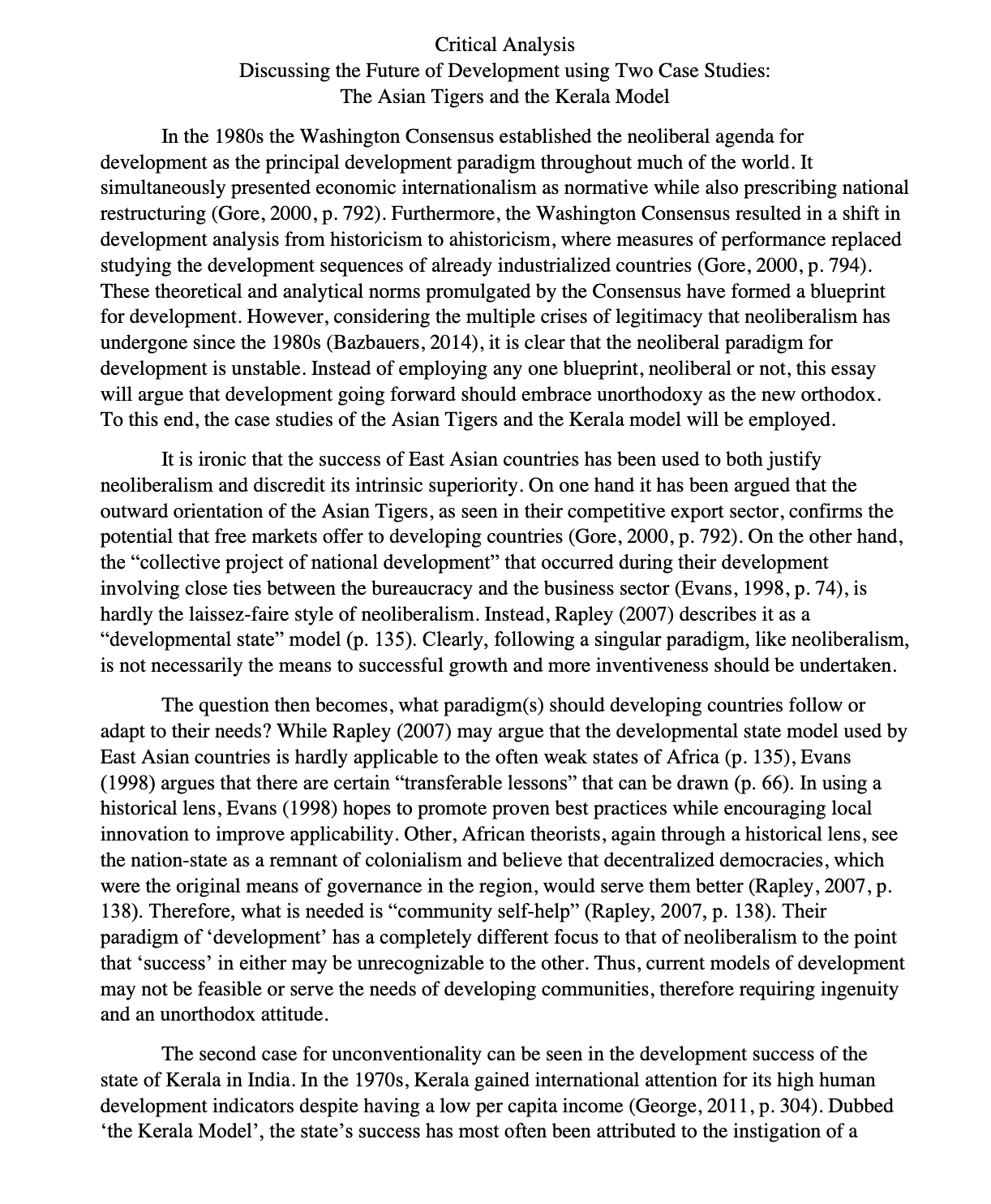
Question: Critical Analysis Discussing the Future of Development using Two Case Studies: The Asian Tigers and the Kerala Model In the 1980s the Washington Consensus established
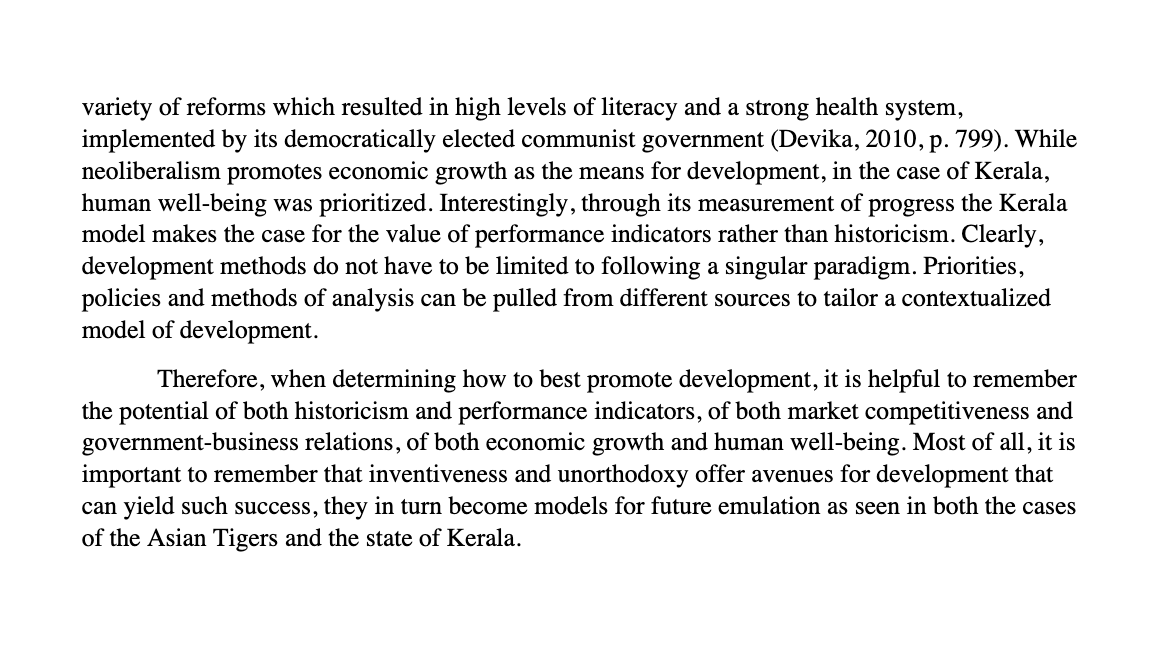
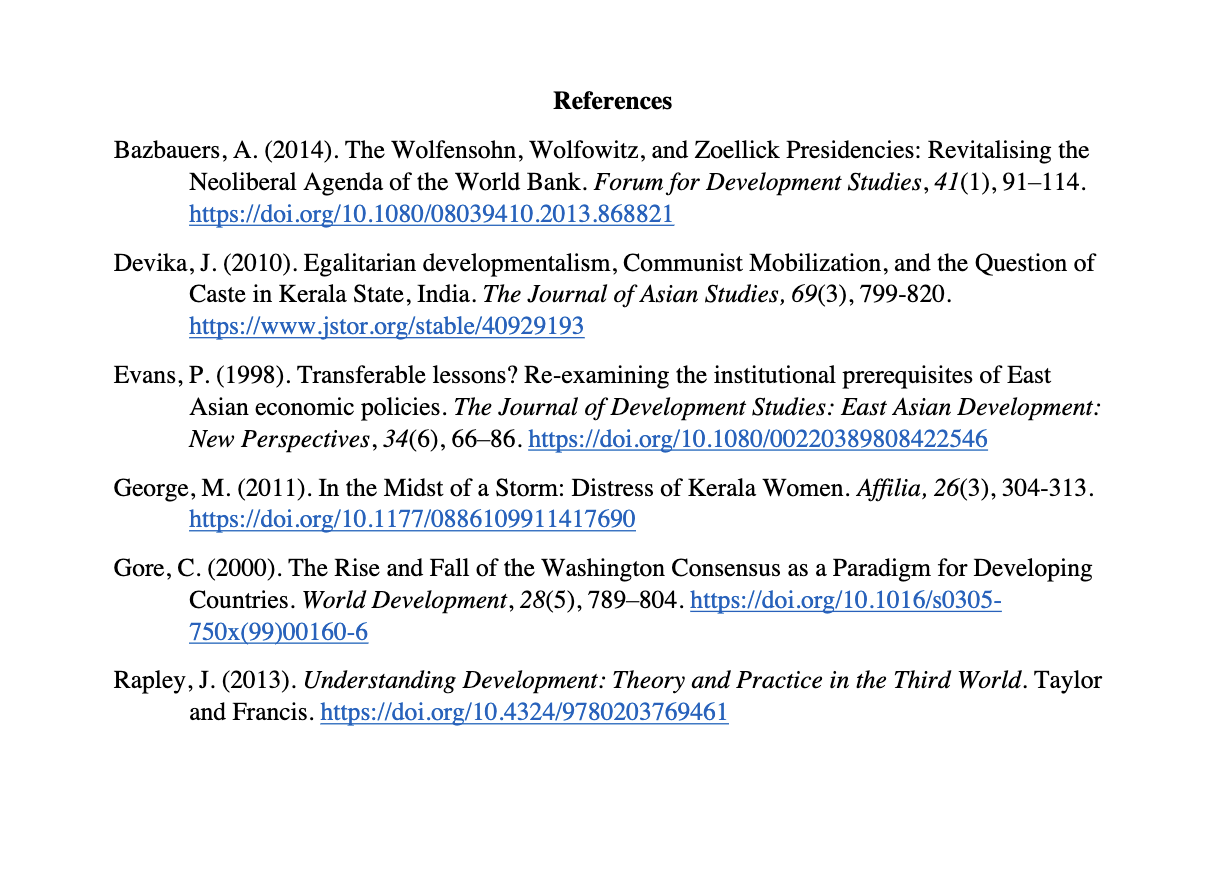
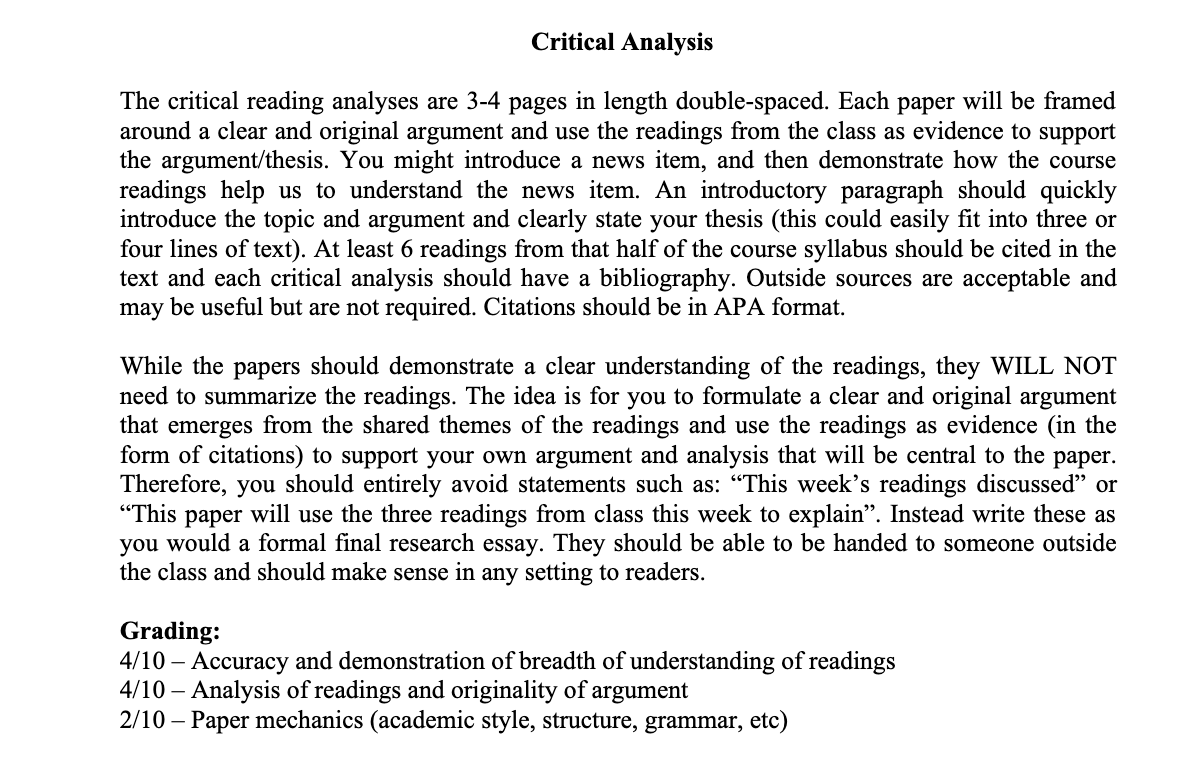
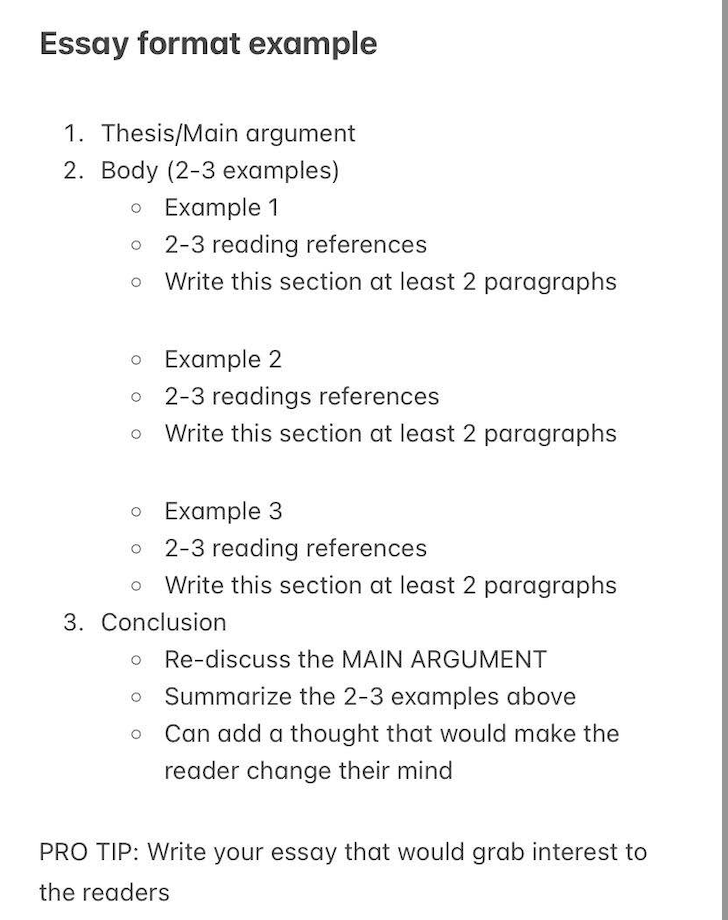
Critical Analysis Discussing the Future of Development using Two Case Studies: The Asian Tigers and the Kerala Model In the 1980s the Washington Consensus established the neoliberal agenda for development as the principal development paradigm throughout much of the world. It simultaneously presented economic internationalism as normative while also prescribing national restructuring (Gore, 2000, p. 792). Furthermore, the Washington Consensus resulted in a shift in development analysis from historicism to ahistoricism, where measures of performance replaced studying the development sequences of already industrialized countries (Gore, 2000, p. 794). These theoretical and analytical norms promulgated by the Consensus have formed a blueprint for development. However, considering the multiple crises of legitimacy that neoliberalism has undergone since the 1980s (Bazbauers, 2014), it is clear that the neoliberal paradigm for development is unstable. Instead of employing any one blueprint, neoliberal or not, this essay will argue that development going forward should embrace unorthodoxy as the new orthodox. To this end, the case studies of the Asian Tigers and the Kerala model will be employed. It is ironic that the success of East Asian countries has been used to both justify neoliberalism and discredit its intrinsic superiority. On one hand it has been argued that the outward orientation of the Asian Tigers, as seen in their competitive export sector, confirms the potential that free markets offer to developing countries (Gore, 2000, p. 792). On the other hand, the \"collective project of national development\" that occurred during their development involving close ties between the bureaucracy and the business sector (Evans, 1998, p. 74), is hardly the laissez-faire style of neoliberalism. Instead, Rapley (2007) describes it as a \"developmental state\" model (p. 135). Clearly, following a singular paradigm, like neoliberalism, is not necessarily the means to successful growth and more inventiveness should be undertaken. The question then becomes, what paradigm(s) should developing countries follow or adapt to their needs? While Rapley (2007) may argue that the developmental state model used by East Asian countries is hardly applicable to the often weak states of Africa (p. 135), Evans (1998) argues that there are certain \"transferable lessons that can be drawn (p. 66). In using a historical lens, Evans (1998) hopes to promote proven best practices while encouraging local innovation to improve applicability. Other, African theorists, again through a historical lens, see the nation-state as a remnant of colonialism and believe that decentralized democracies, which were the original means of governance in the region, would serve them better (Rapley, 2007, p. 138). Therefore, what is needed is \"community self-help\" (Rapley, 2007, p. 138). Their paradigm of 'development' has a completely different focus to that of neoliberalism to the point that 'success' in either may be unrecognizable to the other. Thus, current models of development may not be feasible or serve the needs of developing communities, therefore requiring ingenuity and an unorthodox attitude. The second case for unconventionality can be seen in the development success of the state of Kerala in India. In the 1970s, Kerala gained international attention for its high human development indicators despite having a low per capita income (George, 2011, p. 304). Dubbed 'the Kerala Model', the state's success has most often been attributed to the instigation of a variety of reforms which resulted in high levels of literacy and a strong health system, implemented by its democratically elected communist government (Devika, 2010, p. 799). While neoliberalism promotes economic growth as the means for development, in the case of Kerala, human well-being was prioritized. Interestingly, through its measurement of progress the Kerala model makes the case for the value of performance indicators rather than historicism. Clearly, development methods do not have to be limited to following a singular paradigm. Priorities, policies and methods of analysis can be pulled from different sources to tailor a contextualized model of development. Therefore, when determining how to best promote development, it is helpful to remember the potential of both historicism and performance indicators, of both market competitiveness and government-business relations, of both economic growth and human well-being. Most of all, it is important to remember that inventiveness and unorthodoxy offer avenues for development that can yield such success, they in turn become models for future emulation as seen in both the cases of the Asian Tigers and the state of Kerala. References Bazbauers, A. (2014). The Wolfensohn, Wolfowitz, and Zoellick Presidencies: Revitalising the Neoliberal Agenda of the World Bank. Forum for Development Studies, 41(1), 91-114. https://doi.org/10.1080/08039410.2013.868821 Devika, J. (2010). Egalitarian developmentalism, Communist Mobilization, and the Question of Caste in Kerala State, India. The Journal of Asian Studies, 69(3), 799-820. https://www.jstor.org/stable/40929193 Evans, P. (1998). Transferable lessons? Re-examining the institutional prerequisites of East Asian economic policies. The Journal of Development Studies: East Asian Development: New Perspectives, 34(6), 66-86. https://doi.org/10.1080/00220389808422546 George, M. (2011). In the Midst of a Storm: Distress of Kerala Women. Affilia, 26(3), 304-313. https://doi.org/10.1177/0886109911417690 Gore, C. (2000). The Rise and Fall of the Washington Consensus as a Paradigm for Developing Countries. World Development, 28(5), 789-804. https://doi.org/10.1016/s0305- 750x(99)00160-6 Rapley, J. (2013). Understanding Development: Theory and Practice in the Third World. Taylor and Francis. https://doi.org/10.4324/9780203769461Critical Analysis The critical reading analyses are 3-4 pages in length double-spaced. Each paper will be framed around a clear and original argument and use the readings from the class as evidence to support the argument/thesis. You might introduce a news item, and then demonstrate how the course readings help us to understand the news item. An introductory paragraph should quickly introduce the topic and argument and clearly state your thesis (this could easily fit into three or four lines of text). At least 6 readings from that half of the course syllabus should be cited in the text and each critical analysis should have a bibliography. Outside sources are acceptable and may be useful but are not required. Citations should be in APA format. While the papers should demonstrate a clear understanding of the readings, they WILL NOT need to summarize the readings. The idea is for you to formulate a clear and original argument that emerges from the shared themes of the readings and use the readings as evidence (in the form of citations) to support your own argument and analysis that will be central to the paper. Therefore, you should entirely avoid statements such as: \"This week's readings discussed\" or \"This paper will use the three readings from class this week to explain\". Instead write these as you would a formal final research essay. They should be able to be handed to someone outside the class and should make sense in any setting to readers. Grading: 4/10 Accuracy and demonstration of breadth of understanding of readings 4/10 Analysis of readings and originality of argument 2/10 Paper mechanics (academic style, structure, grammar, etc) Essay format example 1. Thesis/Main argument 2. Body (2-3 examples) 0 o o Q Q Q Example 1 2-3 reading references Write this section at least 2 paragraphs Example 2 2-3 readings references Write this section at least 2 paragraphs Example 3 2-3 reading references Write this section at least 2 paragraphs 3. Conclusion 0 0 0o PRO TIP: Write your essay that would grab interest to Re-discuss the MAIN ARGUMENT Summarize the 2-3 examples above Can add a thought that would make the reader change their mind the readers
Step by Step Solution
There are 3 Steps involved in it
1 Expert Approved Answer
Step: 1 Unlock
Question Has Been Solved by an Expert!
Get step-by-step solutions from verified subject matter experts
Step: 2 Unlock
Step: 3 Unlock
Students Have Also Explored These Related Business Writing Questions!









 Study Help