







Question: Critical Thinking Questions 1. Why is the probability that a continuous random variable is equal to a single number zero? [i.e. Why is P:j:(=a_i= for
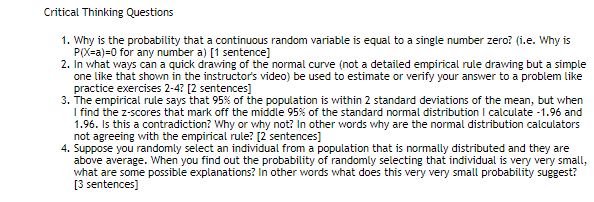
Critical Thinking Questions 1. Why is the probability that a continuous random variable is equal to a single number zero? [i.e. Why is P:j:(=a_i= for any number a] [1 sentence] 2. In what ways can a quick drawing of the normal cunre [not a detailed empirical rule drawing but a simple one like that shot-In in the instructor's video}- be used to estimate or verify your answer to a problem like practice exercises 2-4? [2 sentences] 3. The empirical rule says that 951'}: of the population is Iwithin 2 standard deviations of the mean. but when I find the z-scores that mark. off the middle 9522' of the standard normal distribution I calculate -1 .96: and 1.95. Is this a contradiction? 'n'u'hy or why not? In other Iwords why are the normal distribution calculators not agreeing with the empirical rule? [2 sentences] 4. Suppose you randomly select an individual from a population that is normally distributed and they are above average. When you nd out the probability of randomly selecting that individual is very very small. what are some possible explanations? In other words Iwhat does this very yery small probability suggest? [3 sentences]
Step by Step Solution
There are 3 Steps involved in it

Get step-by-step solutions from verified subject matter experts
 Study Help