







Question: Critical Thinking Questions: 1. Write a brief note about Apple social responsibility. (400 words) 2. Who are the stakeholders with regard to Steve Jobss health?
Critical Thinking Questions:
1. Write a brief note about Apple social responsibility. (400 words)
2. Who are the stakeholders with regard to Steve Jobss health?
3. Does Steve Jobs have a responsibility to Apples stakeholders to inform them about his health?
Can anyone please answer these critical thinking questions for me? It is about business ethics. Thank you.
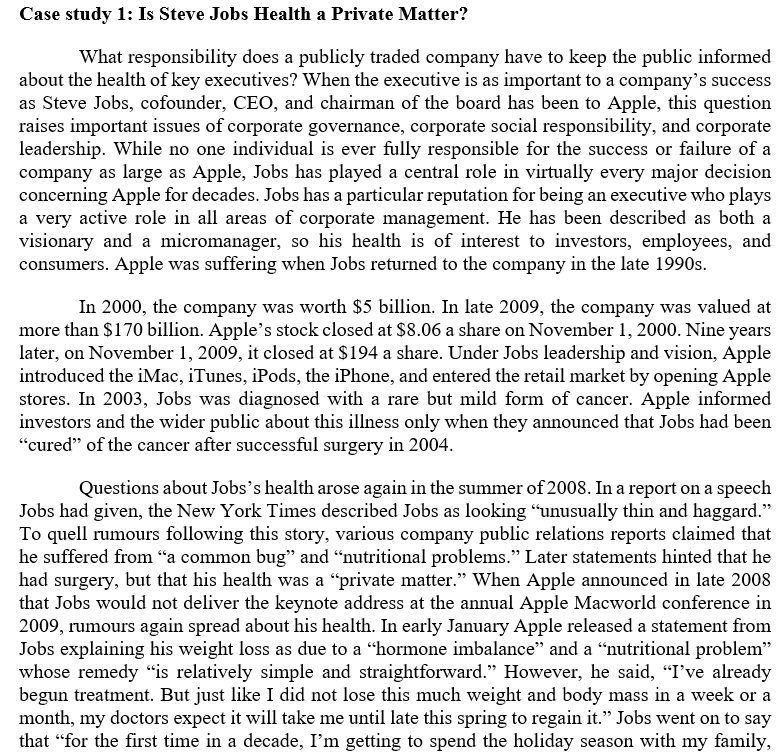
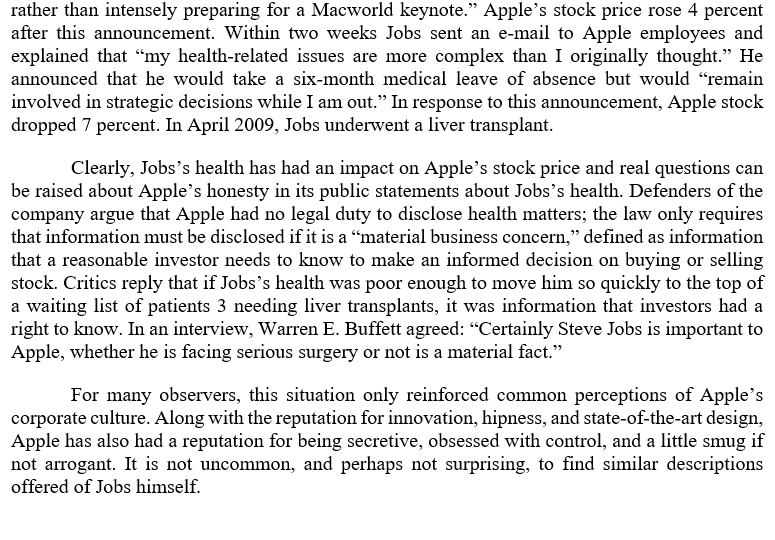
Case study 1: Is Steve Jobs Health a Private Matter? What responsibility does a publicly traded company have to keep the public informed about the health of key executives? When the executive is as important to a company's success as Steve Jobs, cofounder, CEO, and chairman of the board has been to Apple, this question raises important issues of corporate governance, corporate social responsibility, and corporate leadership. While no one individual is ever fully responsible for the success or failure of a company as large as Apple, Jobs has played a central role in virtually every major decision concerning Apple for decades. Jobs has a particular reputation for being an executive who plays a very active role in all areas of corporate management. He has been described as both a visionary and a micromanager, so his health is of interest to investors, employees, and consumers. Apple was suffering when Jobs returned to the company in the late 1990s. In 2000, the company was worth $5 billion. In late 2009, the company was valued at more than $170 billion. Apple's stock closed at $8.06 a share on November 1, 2000. Nine years later, on November 1, 2009, it closed at $194 a share. Under Jobs leadership and vision, Apple introduced the iMac, iTunes, iPods, the iPhone, and entered the retail market by opening Apple stores. In 2003, Jobs was diagnosed with a rare but mild form of cancer. Apple informed investors and the wider public about this illness only when they announced that Jobs had been "cured of the cancer after successful surgery in 2004. Questions about Jobs's health arose again in the summer of 2008. In a report on a speech Jobs had given, the New York Times described Jobs as looking "unusually thin and haggard." To quell rumours following this story, various company public relations reports claimed that he suffered from a common bug and nutritional problems. Later statements hinted that he had surgery, but that his health was a private matter. When Apple announced in late 2008 that Jobs would not deliver the keynote address at the annual Apple Macworld conference in 2009, rumours again spread about his health. In early January Apple released a statement from Jobs explaining his weight loss as due to a hormone imbalance and a nutritional problem whose remedy is relatively simple and straightforward. However, he said, "I've already begun treatment. But just like I did not lose this much weight and body mass in a week or a month, my doctors expect it will take me until late this spring to regain it. Jobs went on to say that for the first time in a decade, I'm getting to spend the holiday season with my family, rather than intensely preparing for a Macworld keynote. Apple's stock price rose 4 percent after this announcement. Within two weeks Jobs sent an e-mail to Apple employees and explained that my health-related issues are more complex than I originally thought. He announced that he would take a six-month medical leave of absence but would remain involved in strategic decisions while I am out. In response to this announcement, Apple stock dropped 7 percent. In April 2009, Jobs underwent a liver transplant. Clearly, Jobs's health has had an impact on Apple's stock price and real questions can be raised about Apple's honesty in its public statements about Jobs's health. Defenders of the company argue that Apple had no legal duty to disclose health matters; the law only requires that information must be disclosed if it is a material business concern, defined as information that a reasonable investor needs to know to make an informed decision on buying or selling stock. Critics reply that if Jobs's health was poor enough to move him so quickly to the top of a waiting list of patients 3 needing liver transplants, it was information that investors had a right to know. In an interview, Warren E. Buffett agreed: "Certainly Steve Jobs is important to Apple, whether he is facing serious surgery or not is a material fact. For many observers, this situation only reinforced common perceptions of Apple's corporate culture. Along with the reputation for innovation, hipness, and state-of-the-art design, Apple has also had a reputation for being secretive, obsessed with control, and a little smug if not arrogant. It is not uncommon, and perhaps not surprising, to find similar descriptions offered of Jobs himselfStep by Step Solution
There are 3 Steps involved in it
1 Expert Approved Answer
Step: 1 Unlock

Question Has Been Solved by an Expert!
Get step-by-step solutions from verified subject matter experts
Step: 2 Unlock
Step: 3 Unlock
 Study Help