







Question: Critically analyse ChatGPT's answer to the question posed below. In other words, which of its arguments are valid and which of its arguments are invalid
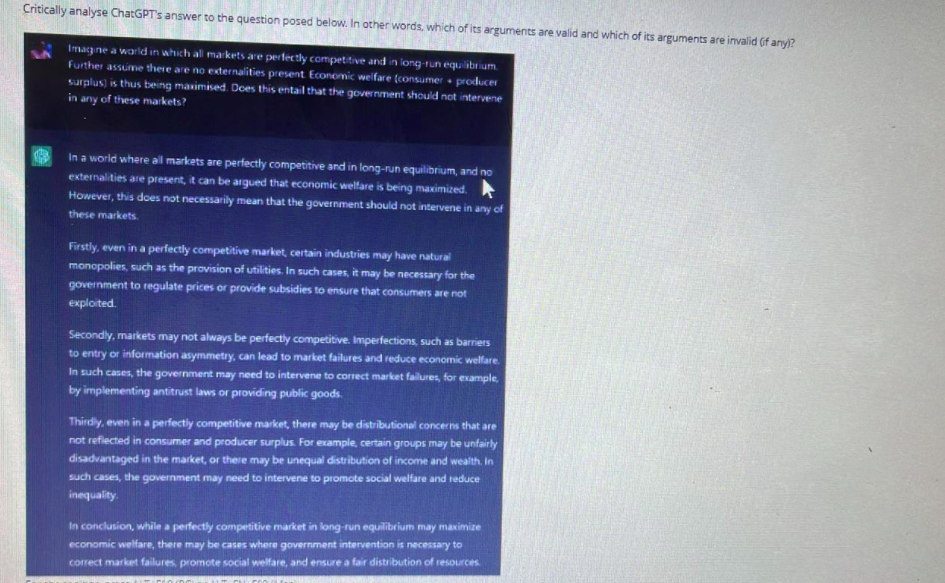
Critically analyse ChatGPT's answer to the question posed below. In other words, which of its arguments are valid and which of its arguments are invalid (if any)? Imagine a world in which all markets are perfectly competitive and in long-run equilibrium. Further assume there are no externalities present Economic welfare (consumer . producer surplus) is thus being maximised. Does this entail that the government should not intervene in any of these markets? In a world where all markets are perfectly competitive and in long-run equilibrium, and no externalities are present, it can be argued that economic welfare is being maximized. However, this does not necessarily mean that the government should not intervene in any of these markets. Firstly, even in a perfectly competitive market, certain industries may have natural monopolies, such as the provision of utilities. In such cases, it may be necessary for the government to regulate prices or provide subsidies to ensure that consumers are not exploited. Secondly, markets may not always be perfectly competitive. Imperfections, such as barriers to entry or information asymmetry, can lead to market failures and reduce economic welfare. In such cases, the government may need to intervene to correct market failures, for example, by implementing antitrust laws or providing public goods. Thirdly, even in a perfectly competitive market, there may be distributional concerns that are not reflected in consumer and producer surplus. For example, certain groups may be unfairly disadvantaged in the market, or there may be unequal distribution of income and wealth, In such cases, the government may need to intervene to promote social welfare and reduce inequality In conclusion, while a perfectly competitive market in long-run equilibrium may maximize economic welfare, there may be cases where government intervention is necessary to correct market failures, promote social welfare, and ensure a fair distribution of resources
Step by Step Solution
There are 3 Steps involved in it

Get step-by-step solutions from verified subject matter experts
 Study Help