



Question: Critically evaluate the research design in the attached case ('Marketing Analysts and Promotional Specialists Inc.') with respect to internal and external validity. Recommend a better
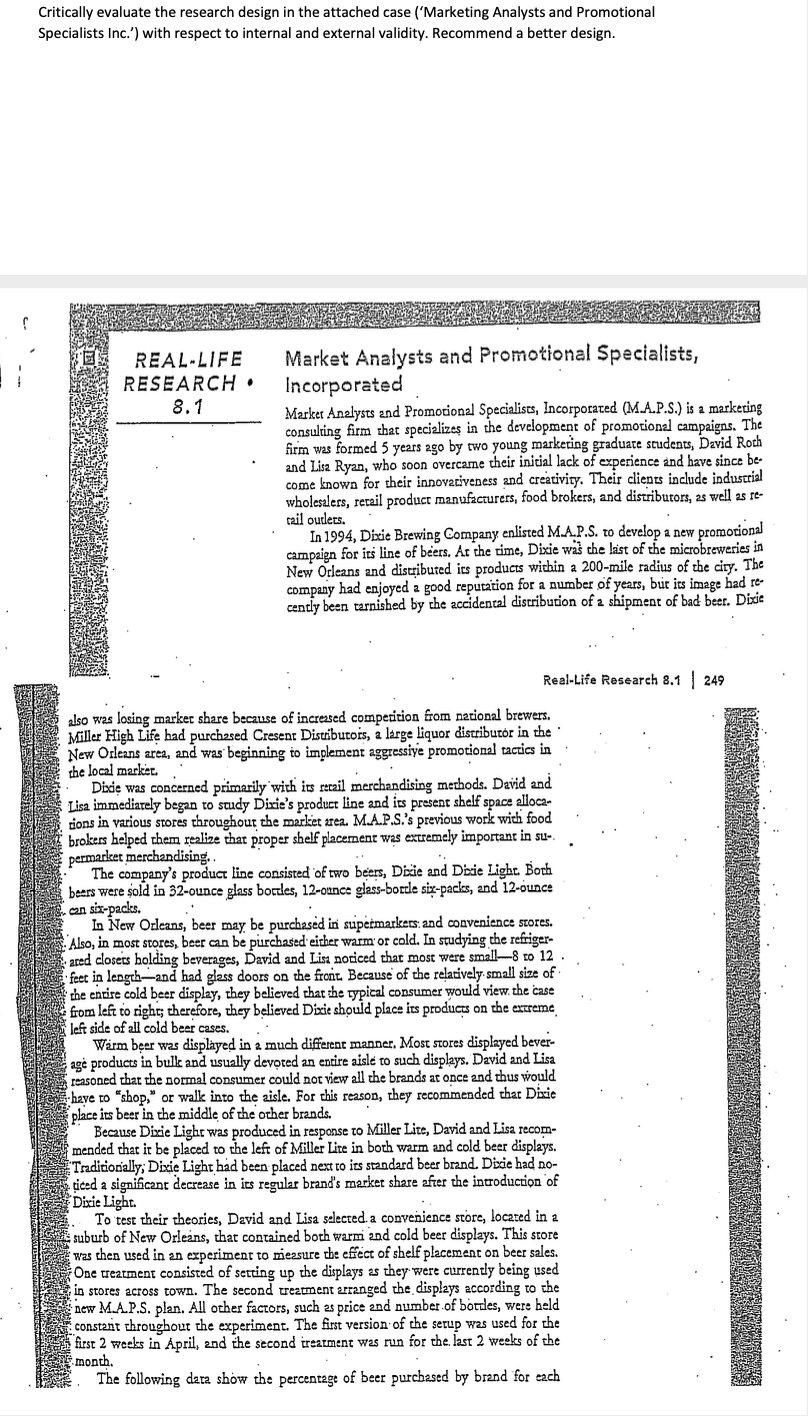
Critically evaluate the research design in the attached case ('Marketing Analysts and Promotional Specialists Inc.') with respect to internal and external validity. Recommend a better design. REAL-LIFE RESEARCH 8.1 Market Analysts and Promotional Specialists, Incorporated Market Analysts and Promotional Specialists, Incorporated (M.A.P.S.) is a marketing consulting firm that specializes in the development of promotional campaigns. The firm was formed 5 years ago by two young marketing graduate students, David Roch and Lisa Ryan, who soon overcame their initial lack of experience and have since be- come known for their innovativeness and creativity. Their clients include industrial wholesalers, retail product manufacturers, food brokers, and distributors, as well as re- tail outlers. In 1994, Dixie Brewing Company enlisted M.A.P.S. to develop a new promotional campaign for its line of beers. At the time, Dixie was the last of the microbreweries in New Orleans and distributed its products within a 200-mile radius of the city. The company had enjoyed a good reputation for a number of years, bur its image had re- cently been tarnished by the accidental distribution of a shipment of bad beer. Dixie Real-Life Research 8.1 | 249 Se BS . ari also was losing market share because of increased competition from national brewers. Miller High Life had purchased Cresent Distributors, a large liquor distributor in the New Orleans area, and was beginning to implement aggressiye promotional tactics in the local market. Dide was concerned primarily with its retail merchandising methods. David and Lisa immediately began to study Dixie's product line and its present shelf space alloca- tions in various stores throughout the market area. M.A.P.S.'s previous work with food brokers helped them realize that proper shelf placement was extremely important in su- . permarket merchandising The company's product line consisted of two beers, Dizzie and Dicie Light. Both beers were sold in 32-ounce glass bordes, 12-ounce glass-borde six-packs, and 12-ounce can six-packs. In New Orleans, beer may be purchased in supermarkers and convenience stores. Also, in most stores, beer can be purchased eicher warm or cold. In studying the refriger- ared closets holding beverages, David and Liss noticed that most were small 8 to 12. feer in length and had glass doors on the front. Because of the relatively small size of the entire cold beer display, they believed that the typical consumer would view the case from left to right; therefore, they believed Dixie should place its products on the extreme left side of all cold beer cases. Warm beer was displayed in a much different manner. Most stores displayed bever- age products in bulk and usually devoted an entire aisld to such displays. David and Lisa reasoned that the normal consumer could not view all the brands at once and thus would have to "shop," or walk into the aisle. For this reason, they recommended thar Dixie place its beer in the middle of the other brands. Because Dixie Light was produced in response to Miller Lite, David and Lisa recom- mended that it be placed to the left of Miller Lite in both warm and cold beer displays. Traditionally, Dixic Light had been placed next to its standard beer brand. Discie had no- ticed a significant decrease in its regular brand's market share after the introduction of Dixie Light. To test their theories, David and Lisa selected a convenience store, located in a suburb of New Orleans, that contained both warm and cold beer displays. This store was then used in an experiment to measure the effect of shelf placement on beer sales. One treatment consisted of setting up the displays as they were currently being used in stores across town. The second treatment arranged the displays according to the new M.A.P.S. plan. All other factors, such as price and number of borcles, were held constant throughout the experiment. The first version of the setup was used for the first 2 weeks in April, and the second treatment was run for the last 2 weeks of the NE Va 2 month. E The following data show the percentage of beer purchased by brand for each Critically evaluate the research design in the attached case ('Marketing Analysts and Promotional Specialists Inc.') with respect to internal and external validity. Recommend a better design. REAL-LIFE RESEARCH 8.1 Market Analysts and Promotional Specialists, Incorporated Market Analysts and Promotional Specialists, Incorporated (M.A.P.S.) is a marketing consulting firm that specializes in the development of promotional campaigns. The firm was formed 5 years ago by two young marketing graduate students, David Roch and Lisa Ryan, who soon overcame their initial lack of experience and have since be- come known for their innovativeness and creativity. Their clients include industrial wholesalers, retail product manufacturers, food brokers, and distributors, as well as re- tail outlers. In 1994, Dixie Brewing Company enlisted M.A.P.S. to develop a new promotional campaign for its line of beers. At the time, Dixie was the last of the microbreweries in New Orleans and distributed its products within a 200-mile radius of the city. The company had enjoyed a good reputation for a number of years, bur its image had re- cently been tarnished by the accidental distribution of a shipment of bad beer. Dixie Real-Life Research 8.1 | 249 Se BS . ari also was losing market share because of increased competition from national brewers. Miller High Life had purchased Cresent Distributors, a large liquor distributor in the New Orleans area, and was beginning to implement aggressiye promotional tactics in the local market. Dide was concerned primarily with its retail merchandising methods. David and Lisa immediately began to study Dixie's product line and its present shelf space alloca- tions in various stores throughout the market area. M.A.P.S.'s previous work with food brokers helped them realize that proper shelf placement was extremely important in su- . permarket merchandising The company's product line consisted of two beers, Dizzie and Dicie Light. Both beers were sold in 32-ounce glass bordes, 12-ounce glass-borde six-packs, and 12-ounce can six-packs. In New Orleans, beer may be purchased in supermarkers and convenience stores. Also, in most stores, beer can be purchased eicher warm or cold. In studying the refriger- ared closets holding beverages, David and Liss noticed that most were small 8 to 12. feer in length and had glass doors on the front. Because of the relatively small size of the entire cold beer display, they believed that the typical consumer would view the case from left to right; therefore, they believed Dixie should place its products on the extreme left side of all cold beer cases. Warm beer was displayed in a much different manner. Most stores displayed bever- age products in bulk and usually devoted an entire aisld to such displays. David and Lisa reasoned that the normal consumer could not view all the brands at once and thus would have to "shop," or walk into the aisle. For this reason, they recommended thar Dixie place its beer in the middle of the other brands. Because Dixie Light was produced in response to Miller Lite, David and Lisa recom- mended that it be placed to the left of Miller Lite in both warm and cold beer displays. Traditionally, Dixic Light had been placed next to its standard beer brand. Discie had no- ticed a significant decrease in its regular brand's market share after the introduction of Dixie Light. To test their theories, David and Lisa selected a convenience store, located in a suburb of New Orleans, that contained both warm and cold beer displays. This store was then used in an experiment to measure the effect of shelf placement on beer sales. One treatment consisted of setting up the displays as they were currently being used in stores across town. The second treatment arranged the displays according to the new M.A.P.S. plan. All other factors, such as price and number of borcles, were held constant throughout the experiment. The first version of the setup was used for the first 2 weeks in April, and the second treatment was run for the last 2 weeks of the NE Va 2 month. E The following data show the percentage of beer purchased by brand for each
Step by Step Solution
There are 3 Steps involved in it

Get step-by-step solutions from verified subject matter experts