







Question: Cryptography and Network Security: Principles and Practice, 7th Edition Chapter 2: Chapter 3: 2.22 Use Fermat's theorem to find a number x between 0 and
Cryptography and Network Security: Principles and Practice, 7th Edition
Chapter 2:


Chapter 3:
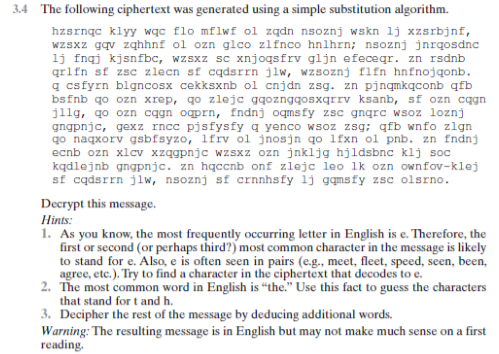
2.22 Use Fermat's theorem to find a number x between 0 and 37 with x3 congruent to 4 modulo 37. (You should not need to use any brute-force searching.) 2.24 Use Euler's theorem to find a number x between 0 and 14 with x6 congruent to 7 modulo 15. (You should not need to use any brute-force searching.) 3.4 The following ciphertext was generated using a simple substitution algorithm wzsxz gqy zqhhnf ol ozn glco zlfnco hnlhrn: nsoznj jrgosdnc 1j fnqj kjsnfbc, wzsxz Sc xnjoqsfrv gljn efeceqr. zn rsdnb bsfnb qo ozn xrep, qo zlejc gqoznggosxqrrv ksanb, sf ozn cqgn j11g, qo ozn cqgn oqprn, fndnj oqmsfy zsc gngrc wsoz loznj gngpnjc, gexz rncc pjsfysfy q yenco wsoz zsg: qfb wnfo zlgn 2 2 ecnb ozn xlcv xzqgpnjc wzsxz ozn jnkljg hjldsbnc klj soc kqdlejnb gngpnjc. zn hqccnb onf zlejc leo lk ozn ownfov-klej 3 Hints I. As you know, the most frequently occurring letter in English is e. Therefore, the first or second (or perhaps third?) most common character in the message is likely to stand for e. Also, e is often seen in pairs (e.g., meet, fleet, speed, seen, been, agree, etc.). Try to find a character in the ciphertext that decodes to e. 2 The most common word in English is "the." Use this fact to guess the characters that stand for t and h. Decipher the rest of the message by deducing additional words Warning: The resulting message is in English but may not make much sense on a first reading. 2.22 Use Fermat's theorem to find a number x between 0 and 37 with x3 congruent to 4 modulo 37. (You should not need to use any brute-force searching.) 2.24 Use Euler's theorem to find a number x between 0 and 14 with x6 congruent to 7 modulo 15. (You should not need to use any brute-force searching.) 3.4 The following ciphertext was generated using a simple substitution algorithm wzsxz gqy zqhhnf ol ozn glco zlfnco hnlhrn: nsoznj jrgosdnc 1j fnqj kjsnfbc, wzsxz Sc xnjoqsfrv gljn efeceqr. zn rsdnb bsfnb qo ozn xrep, qo zlejc gqoznggosxqrrv ksanb, sf ozn cqgn j11g, qo ozn cqgn oqprn, fndnj oqmsfy zsc gngrc wsoz loznj gngpnjc, gexz rncc pjsfysfy q yenco wsoz zsg: qfb wnfo zlgn 2 2 ecnb ozn xlcv xzqgpnjc wzsxz ozn jnkljg hjldsbnc klj soc kqdlejnb gngpnjc. zn hqccnb onf zlejc leo lk ozn ownfov-klej 3 Hints I. As you know, the most frequently occurring letter in English is e. Therefore, the first or second (or perhaps third?) most common character in the message is likely to stand for e. Also, e is often seen in pairs (e.g., meet, fleet, speed, seen, been, agree, etc.). Try to find a character in the ciphertext that decodes to e. 2 The most common word in English is "the." Use this fact to guess the characters that stand for t and h. Decipher the rest of the message by deducing additional words Warning: The resulting message is in English but may not make much sense on a first reading
Step by Step Solution
There are 3 Steps involved in it

Get step-by-step solutions from verified subject matter experts
 Study Help