







Question: cryptography/security engineering Let Ek(x) be the block encryption function of a block cipher. In particular, E is the block encryption algorithm, k is the symmetric
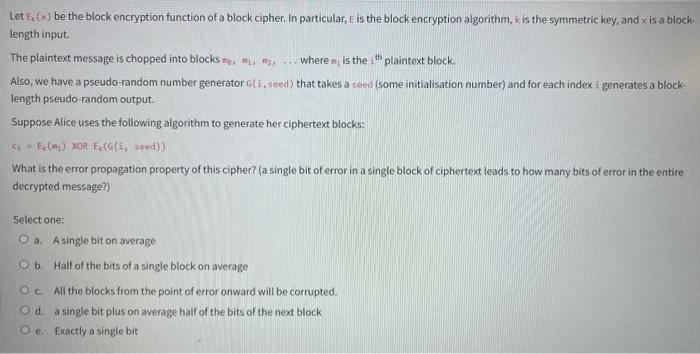
Let Ek(x) be the block encryption function of a block cipher. In particular, E is the block encryption algorithm, k is the symmetric key, and x is a block: length input. The plaintext message is chopped into blocks m0,m1,n2..... where m1 is the it th plaintext block. Also, we have a pseudo-random number generator 6 (i, seed) that takes a seed (some initialisation number) and for each index i generates a block. length pseudo-random output. Suppose Alice uses the following algorithm to generate her ciphertext blocks: c1=Ek(m1)0REk(G(i,send)) What is the error propagation property of this cipher? (a single bit of error in a single block of ciphertext leads to how many bits of error in the entire decrypted message?) Select one: a. A single bit on average b. Half of the bits of a single block on average c. All the blocks from the point of error onward will be corrupted. d. a single bit plus on average half of the bits of the next block e. Exactly a single bit
Step by Step Solution
There are 3 Steps involved in it

Get step-by-step solutions from verified subject matter experts
 Study Help