







Question: CSC330 Object Oriented Design Inheritance, Composition Lab2 Problem: Generate a C++ object-oriented project that models the following descriptions: . . . . A circle is
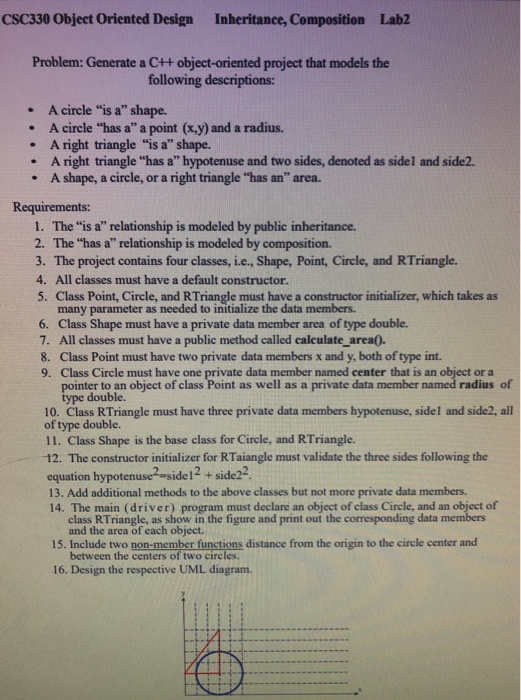
CSC330 Object Oriented Design Inheritance, Composition Lab2 Problem: Generate a C++ object-oriented project that models the following descriptions: . . . . A circle "is a" shape. A circle "has a" a point (x,y) and a radius. A right triangle "is a" shape. A right triangle "has a" hypotenuse and two sides, denoted as sidel and side2. A shape, a circle, or a right triangle "has an area. Requirements: 1 The "is a" relationship is modeled by public inheritance. 2. The "has a" relationship is modeled by composition. 3. The project contains four classes, i.e., Shape, Point, Circle, and RTriangle. 4. All classes must have a default constructor. 5. Class Point, Circle, and RTriangle must have a constructor initializer, which takes as many parameter as needed to initialize the data members. 6. Class Shape must have a private data member area of type double. 7. All classes must have a public method called calculate_area0 8. Class Point must have two private data members x and y, both of type int. 9. Class Circle must have one private data member named center that is an object or a pointer to an object of class Point as well as a private data member radius of type double. 10. Class RTriangle must have three private data members hypotenuse, sidel and side2, all of type double. 11. Class Shape is the base class for Circle, and RTriangle. 12. The constructor initializer for RTaiangle must validate the three sides following the equation hypotenuse2-side12 + side22 13. Add additional methods to the above classes but not more private data members. 14. The main (driver) program must declare an object of class Circle, and an object of class RTriangle, as show in the figure and print out the corresponding data members and the area of each object. 15. Include two non-member functions distance from the origin to the circle center and between the centers of two circles. 16. Design the respective UML diagram
Step by Step Solution
There are 3 Steps involved in it

Get step-by-step solutions from verified subject matter experts
 Study Help