







Question: Current Attempt in Progress The drawing shows three point charges fixed in place. The charge at the coordinate origin has a value of q1 =
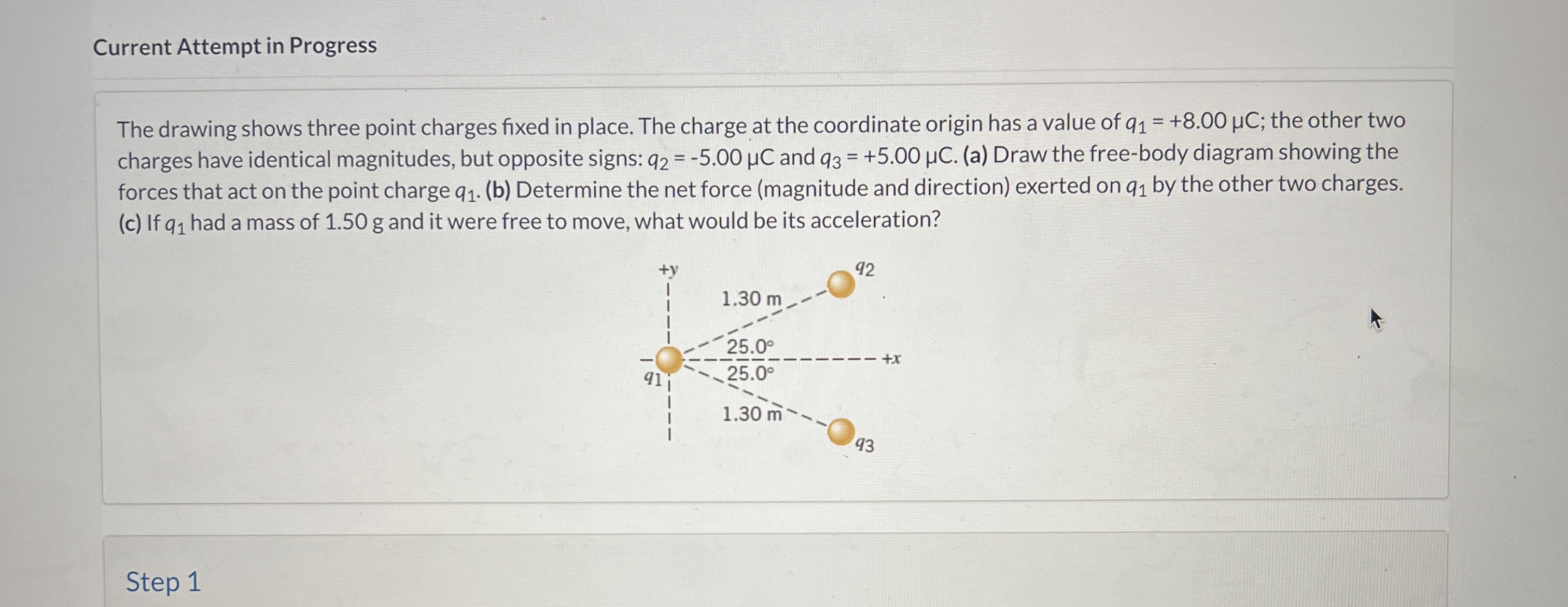
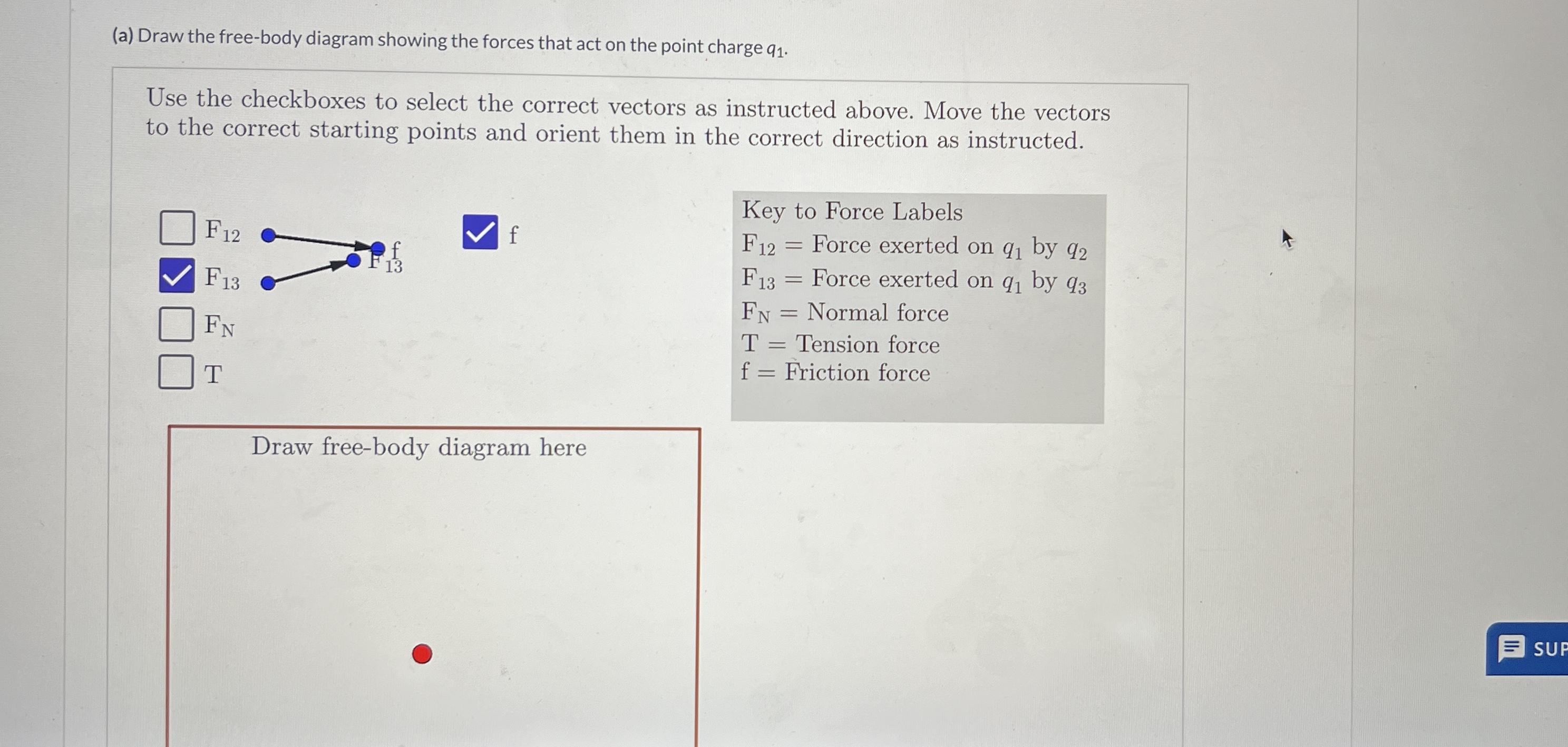
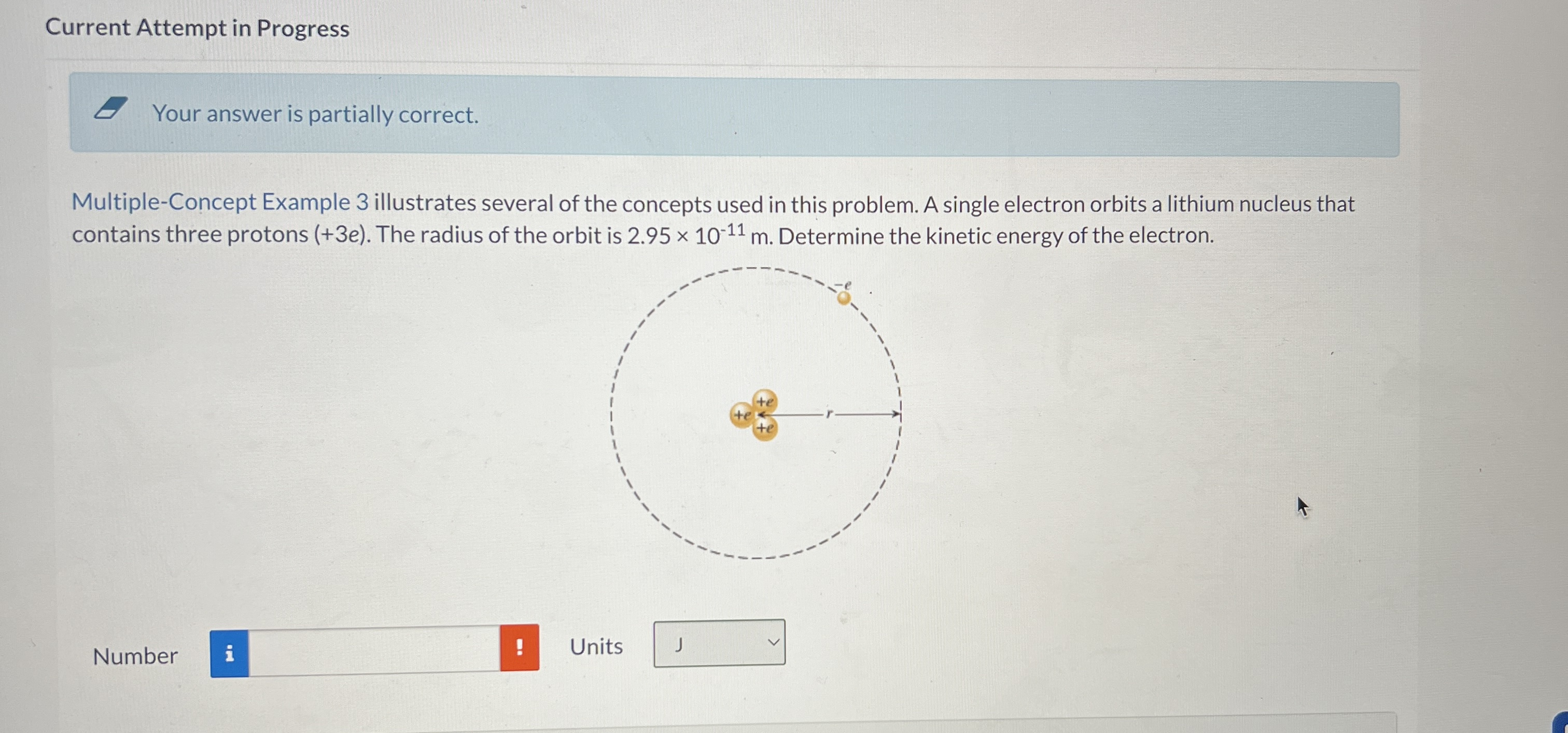
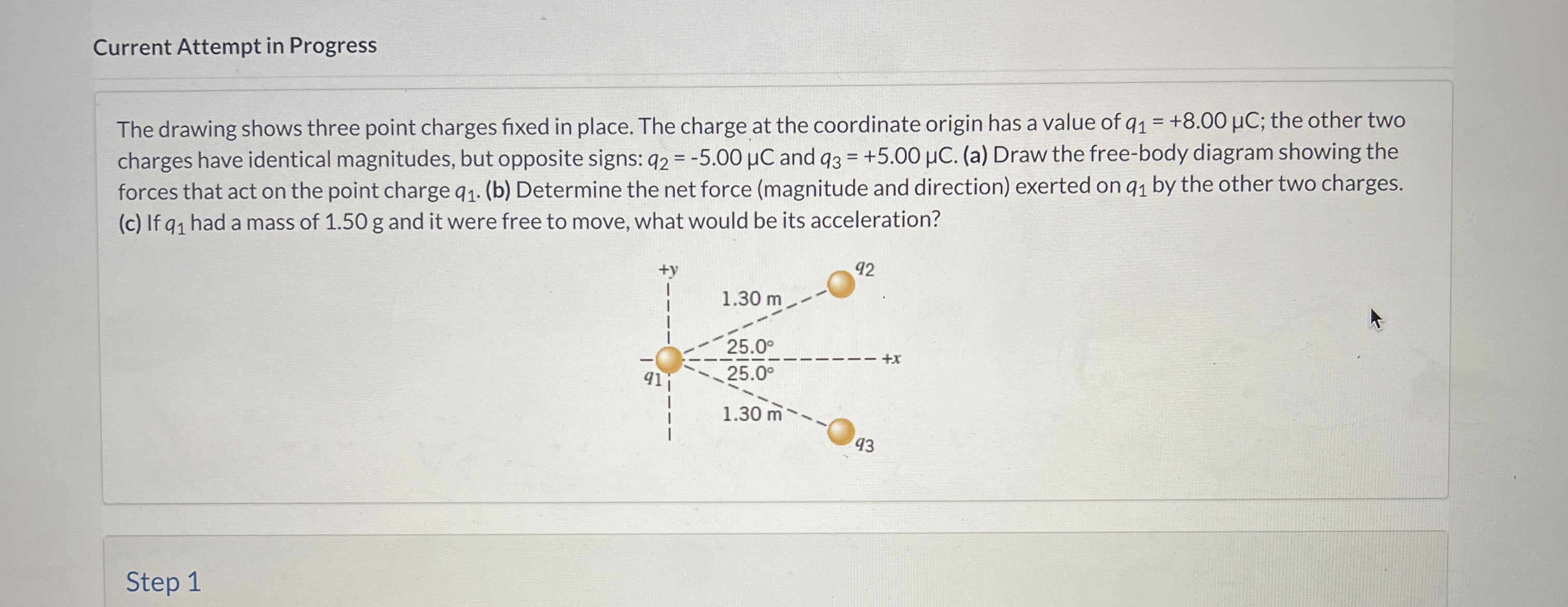
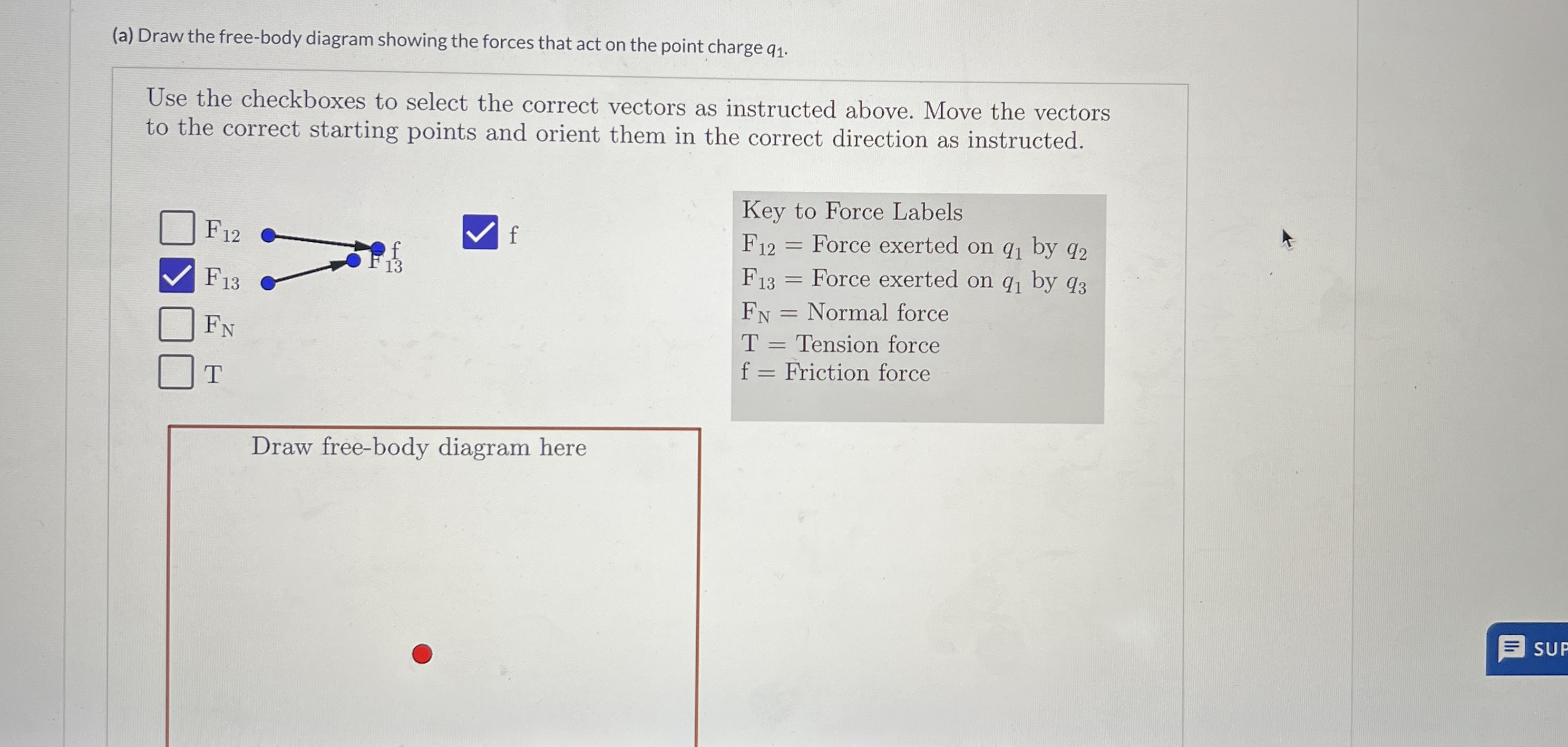
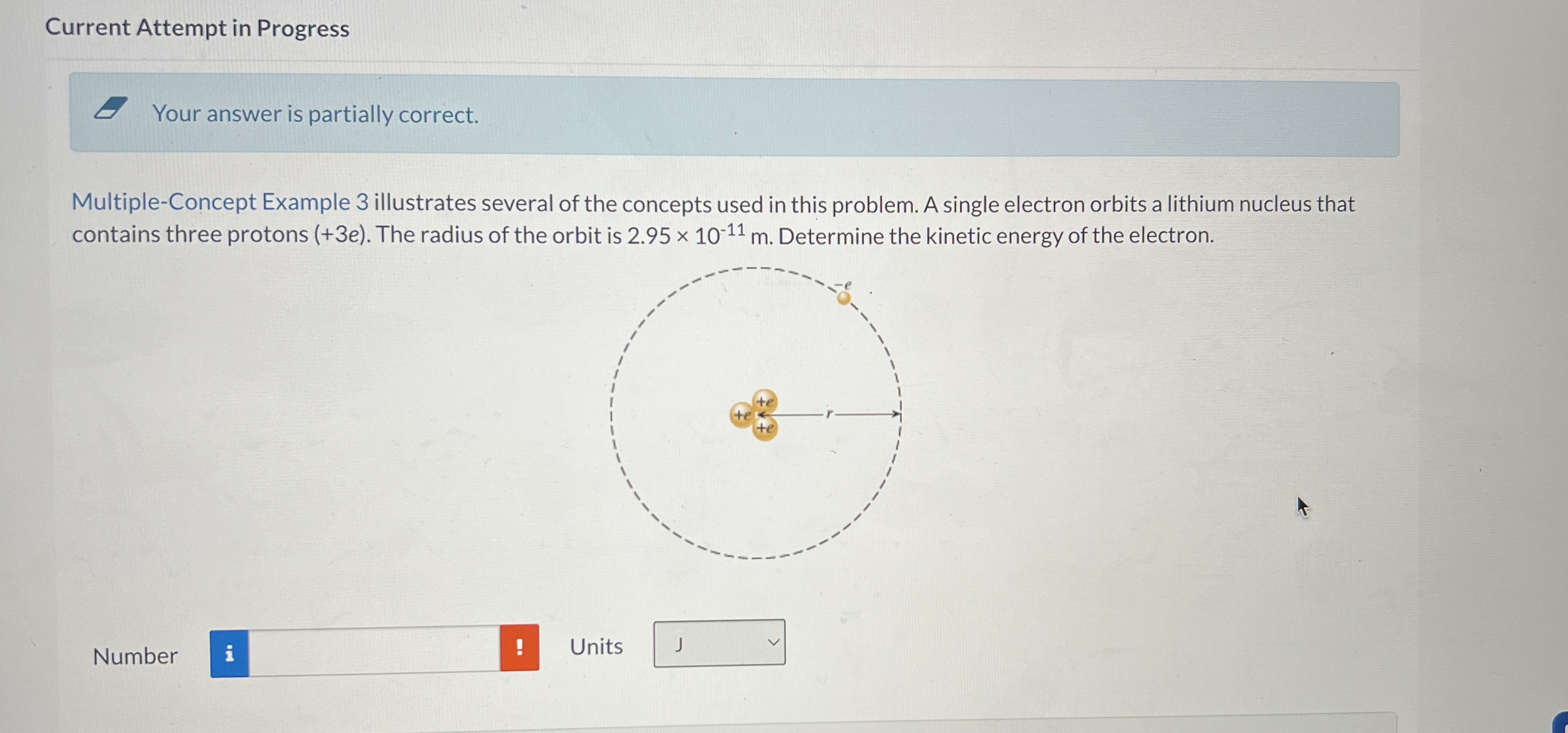
Current Attempt in Progress The drawing shows three point charges fixed in place. The charge at the coordinate origin has a value of q1 = +8.00 JC; the other two charges have identical magnitudes, but opposite signs: q2 = -5.00 JC and q3 = +5.00 UC. (a) Draw the free-body diagram showing the forces that act on the point charge q1. (b) Determine the net force (magnitude and direction) exerted on q1 by the other two charges. (c) If q1 had a mass of 1.50 g and it were free to move, what would be its acceleration? 92 1.30 m 25.0 - +x 25.0 1.30 m - Step 1(a) Draw the free-body diagram showing the forces that act on the point charge q1. Use the checkboxes to select the correct vectors as instructed above. Move the vectors to the correct starting points and orient them in the correct direction as instructed. Key to Force Labels F12 V F12 = Force exerted on q1 by q2 F13 F13 = Force exerted on q1 by 93 FN = Normal force FN T = Tension force T f = Friction force Draw free-body diagram here SUPYour Answer Correct Answer Your answer is partially correct. Multiple-Concept Example 3 provides some pertinent background for this problem. Suppose a single electron orbits about a nucleus containing two protons (+2e), as would be the case for a helium atom from which one of the naturally occurring electrons is removed. The radius of the orbit is 3.08 x 10⁻¹ m. Determine the magnitude of the electron's centripetal acceleration. Number i Units m/s^2Current Attempt in Progress Your answer is partially correct. Multiple-Concept Example 3 illustrates several of the concepts used in this problem. A single electron orbits a lithium nucleus that contains three protons (+3e). The radius of the orbit is 2.95 x 10⁻¹¹ m. Determine the kinetic energy of the electron. te te Number Units J V
Step by Step Solution
There are 3 Steps involved in it

Get step-by-step solutions from verified subject matter experts
 Study Help