







Question: Currently struggling with lecture problem, please explain thoroughly if possible, thank you! Problem 1 A box contains one yellow, two red, and three green balls.
Currently struggling with lecture problem, please explain thoroughly if possible, thank you!
Problem 1
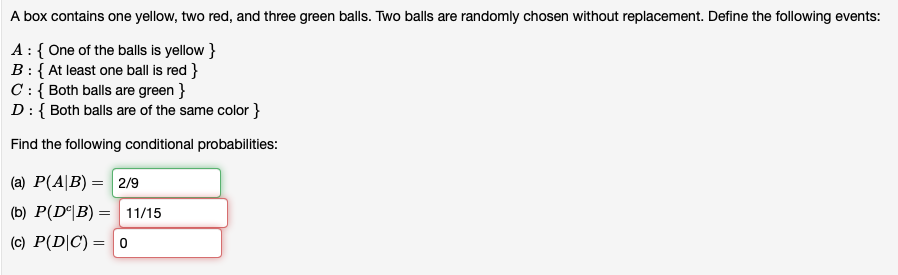
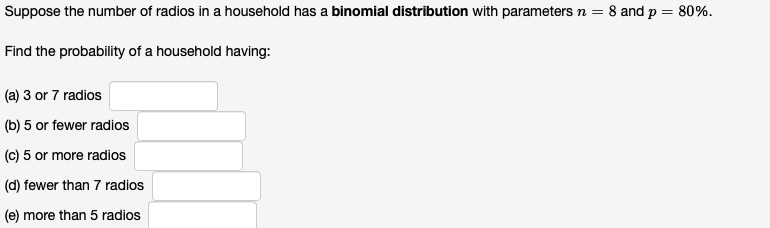
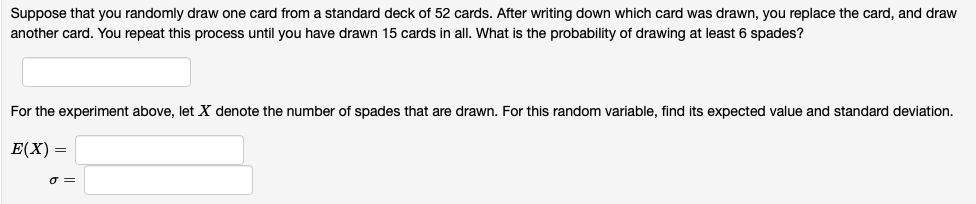


A box contains one yellow, two red, and three green balls. Two balls are randomly chosen without replacement. Define the following events: A : { One of the balls is yellow } B : { At least one ball is red } C : { Both balls are green } D : { Both balls are of the same color } Find the following conditional probabilities: (a) P(A B) = 2/9 (b) P(D'(B) = 11/15 (C) P(D|C) : 0Suppose the number of radios in a household has a binomial distribution with parameters n = 8 and p = 80%. Find the probability of a household having: (a) 3 or 7 radios (b) 5 or fewer radios (c) 5 or more radios (d) fewer than 7 radios (e) more than 5 radiosSuppose that you randomly draw one card from a standard deck of 52 cards. After writing down which card was drawn, you replace the card, and draw another card. You repeat this process until you have drawn 15 cards in all. What is the probability of drawing at least 6 spades? For the experiment above, let X denote the number of spades that are drawn. For this random variable, find its expected value and standard deviation. E(X) = O =Let X represent the difference between the number of heads and the number of tails when a coin is tossed 45 times. Then P(X = 11) =4 men and 6 women are ranked according to their scores on an exam. Assume that no two scores are alike, and that all 10! possible rankings are equally likely. Let X denote the highest ranking achieved by a man (so X = 1 indicates that a man achieved the highest score on the exam). Find each of the following: P(X = 2) = 4/15 P(X = 4) = 2/21 P(X = 6) 0.019 P(X = 8) = 0
Step by Step Solution
There are 3 Steps involved in it

Get step-by-step solutions from verified subject matter experts
 Study Help