







Question: Currently very confused about lecture problems, please explain thoroughly in R programming. To get started set A=bmatrix (NA, nrow = le5, ncol=3) to gener- ate
Currently very confused about lecture problems, please explain thoroughly in R programming.
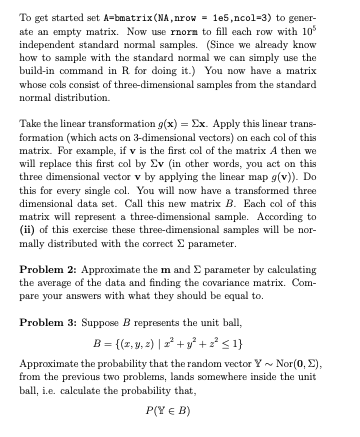
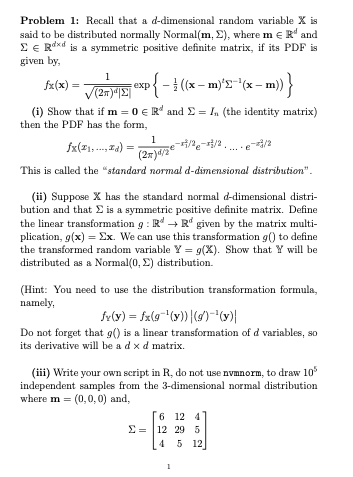
To get started set A=bmatrix (NA, nrow = le5, ncol=3) to gener- ate an empty matrix. Now use rnorm to fill each row with 10" independent standard normal samples. (Since we already know how to sample with the standard normal we can simply use the build-in command in R for doing it.) You now have a matrix whose cols consist of three-dimensional samples from the standard normal distribution. Take the linear transformation g(x) = Ex. Apply this linear trans- formation (which acts on 3-dimensional vectors) on each col of this matrix. For example, if v is the first col of the matrix A then we will replace this first col by Ev (in other words, you act on this three dimensional vector v by applying the linear map g(v)). Do this for every single col. You will now have a transformed three dimensional data set. Call this new matrix B. Each col of this matrix will represent a three-dimensional sample. According to (ii) of this exercise these three-dimensional samples will be nor- mally distributed with the correct > parameter. Problem 2: Approximate the m and > parameter by calculating the average of the data and finding the covariance matrix. Com- pare your answers with what they should be equal to. Problem 3: Suppose B represents the unit ball, Approximate the probability that the random vector Y ~ Nor(0, E), from the previous two problems, lands somewhere inside the unit ball, i.e. calculate the probability that, P(Y E B)Problem 1: Recall that a d-dimensional random variable X is said to be distributed normally Normal(m, E), where me R and E c Rudd is a symmetric positive definite matrix, if its PDF is given by, 1 fx (x) = V(2 ) |2 exp - 1 ((x - m)'s '(x - m)) . (i) Show that if m = 0 6 R and ) = In (the identity matrix) then the PDF has the form, 1 fx($1; mmm, Id) = This is called the "standard normal d-dimensional distribution". (ii) Suppose X has the standard normal d-dimensional distri- bution and that _ is a symmetric positive definite matrix. Define the linear transformation g : " - R" given by the matrix multi- plication, g(x) = Ex. We can use this transformation g() to define the transformed random variable Y = g(X). Show that Y will be distributed as a Normal(0, _) distribution. (Hint: You need to use the distribution transformation formula, namely, fly) = ho '())() ()) Do not forget that g() is a linear transformation of d variables, so its derivative will be a d x d matrix. (iii) Write your own script in R, do not use nvmnorm, to draw 10" independent samples from the 3-dimensional normal distribution where m = (0, 0, 0) and, 6 12 E = 12 29 5 12
Step by Step Solution
There are 3 Steps involved in it

Get step-by-step solutions from verified subject matter experts
 Study Help