







Question: cussion 1: p 1: Read this article. Important: I am aware that you won't understand all of the technical guage used in the article. I
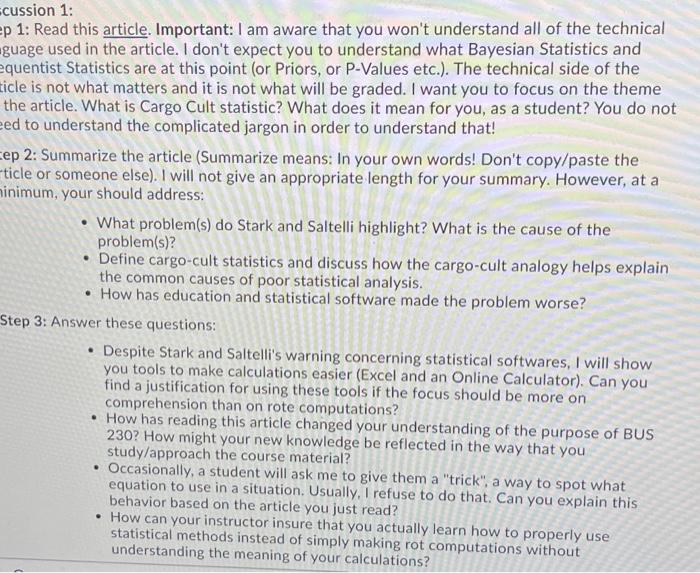
cussion 1: p 1: Read this article. Important: I am aware that you won't understand all of the technical guage used in the article. I don't expect you to understand what Bayesian Statistics and equentist Statistics are at this point (or Priors, or P-Values etc.). The technical side of the ticle is not what matters and it is not what will be graded. I want you to focus on the theme the article. What is Cargo Cult statistic? What does it mean for you, as a student? You do not eed to understand the complicated jargon in order to understand that! Cep 2: Summarize the article (Summarize means: In your own words! Don't copy/paste the ticle or someone else). I will not give an appropriate length for your summary. However, at a minimum, your should address: What problem(s) do Stark and Saltelli highlight? What is the cause of the problem(s)? Define cargo-cult statistics and discuss how the cargo-cult analogy helps explain the common causes of poor statistical analysis. How has education and statistical software made the problem worse? Step 3: Answer these questions: Despite Stark and Saltelli's warning concerning statistical softwares, I will show you tools to make calculations easier (Excel and an Online Calculator). Can you find a justification for using these tools if the focus should be more on comprehension than on rote computations? How has reading this article changed your understanding of the purpose of BUS 230? How might your new knowledge be reflected in the way that you study/approach the course material? Occasionally, a student will ask me to give them a "trick", a way to spot what equation to use in a situation. Usually, I refuse to do that. Can you explain this behavior based on the article you just read? How can your instructor insure that you actually learn how to properly use statistical methods instead of simply making rot computations without understanding the meaning of your calculations? cussion 1: p 1: Read this article. Important: I am aware that you won't understand all of the technical guage used in the article. I don't expect you to understand what Bayesian Statistics and equentist Statistics are at this point (or Priors, or P-Values etc.). The technical side of the ticle is not what matters and it is not what will be graded. I want you to focus on the theme the article. What is Cargo Cult statistic? What does it mean for you, as a student? You do not eed to understand the complicated jargon in order to understand that! Cep 2: Summarize the article (Summarize means: In your own words! Don't copy/paste the ticle or someone else). I will not give an appropriate length for your summary. However, at a minimum, your should address: What problem(s) do Stark and Saltelli highlight? What is the cause of the problem(s)? Define cargo-cult statistics and discuss how the cargo-cult analogy helps explain the common causes of poor statistical analysis. How has education and statistical software made the problem worse? Step 3: Answer these questions: Despite Stark and Saltelli's warning concerning statistical softwares, I will show you tools to make calculations easier (Excel and an Online Calculator). Can you find a justification for using these tools if the focus should be more on comprehension than on rote computations? How has reading this article changed your understanding of the purpose of BUS 230? How might your new knowledge be reflected in the way that you study/approach the course material? Occasionally, a student will ask me to give them a "trick", a way to spot what equation to use in a situation. Usually, I refuse to do that. Can you explain this behavior based on the article you just read? How can your instructor insure that you actually learn how to properly use statistical methods instead of simply making rot computations without understanding the meaning of your calculations
Step by Step Solution
There are 3 Steps involved in it

Get step-by-step solutions from verified subject matter experts
 Study Help