







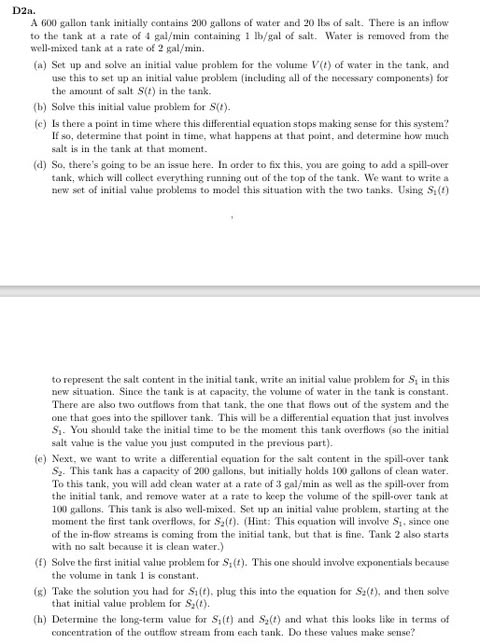
Question: D 2 a . A 6 0 0 gallon tank initially contains 2 0 0 gallons of water and 2 0 ltss of salt. There
Da
A gallon tank initially contains gallons of water and ltss of salt. There is an inflow to the tank at a rate of mathrmgalmathrmmin containing mathrmlbmathrmgal of salt. Water is removed from the wellmixed tank at a rate of mathrmgalmathrmmin
a Set up and solve an initial value problem for the volume Vt of water in the tank, and use this to set up an initial value problem including all of the necessary components for the amount of salt St in the tank.
b Solve this initial value problem for St
c Is there a point in time where this differential equation stops making sense for this system? If so determine that point in time, what happens at that point, and determine how much salt is in the tank at that moment.
d So there's going to be an issue here. In order to fix this, you are going to add a spillover tank, which will collect everything running out of the top of the tank. We want to write a new set of initial value problems to model this situation with the two tanks. Using St
to represent the salt content in the initial tank, write an initial value problem for S in this new situation. Since the tank is at capacity, the volume of water in the tank is constant. There are also two outflows from that tank. the one that flows out of the system and the one that goes into the spillover tank. This will be a differential equation that just involves S You should take the initial time to be the moment this tank overflows so the initial salt value is the value you just computed in the previous part
e Next, we want to write a differential equation for the salt content in the spillover tank S This tank has a capacity of gallous, but initially holds gallons of clean water. To this tank, you will add clean water at a rate of mathrmgalmathrmmin as well as the spillover from the initial tank, and remove water at a rate to keep the volume of the spillover tank at gallons. This tank is abo wellmixed. Set up an initial value problem, starting at the moment the first tank overflows, for StHint: This equation will involve S since one of the inflow streams is coming from the initial tank, but that is fine. Tank also starts with no salt because it is clean water.
f Solve the first initial value problem for St This one should involve exponentials because the volume in tank is constant.
g Take the solution you had for St plug this into the equation for St and then solve that initial value problem for St
h Determine the longterm value for St and St and what this looks like in terms of concentration of the outflow stream from each tank. Do these values make sense?
Step by Step Solution
There are 3 Steps involved in it
1 Expert Approved Answer
Step: 1 Unlock

Question Has Been Solved by an Expert!
Get step-by-step solutions from verified subject matter experts
Step: 2 Unlock
Step: 3 Unlock
 Study Help