







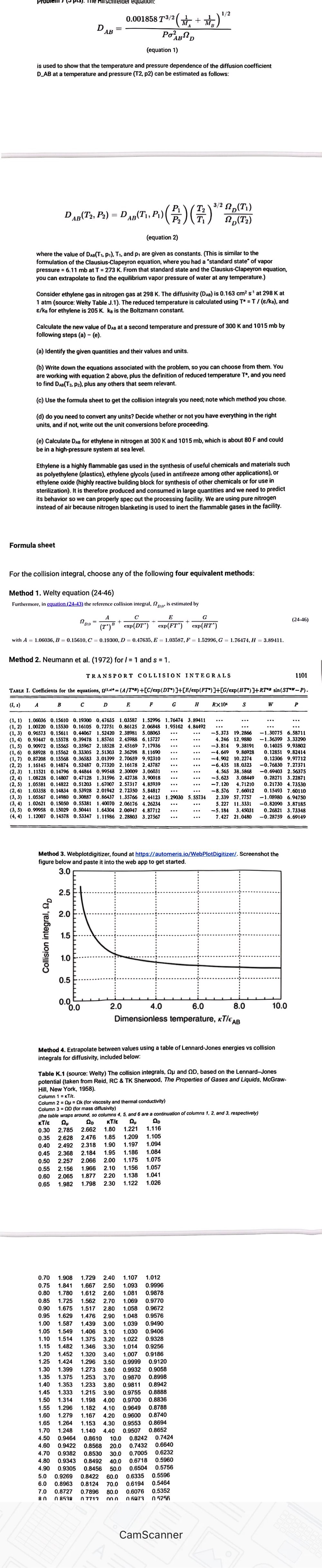
Question: D A B = 0 . 0 0 1 8 5 8 T 3 2 ( 1 M A + 1 M B ) 1
is used to show that the temperature and pressure dependence of the diffusion coefficient at a temperature and pressure can be estimated as follows:
where the value of and are given as constants. This is similar to the formulation of the ClausiusClapeyron equation, where you had a "standard state" of vapo
formulation of the ClausiusClapeyron equation, where you had a "standard state" of vapor pressure at From that standard state and the ClausiusClapeyron equation, you can extrapolate to find the equilibrium vapor pressure of water at any temperature
Consider ethylene gas in nitrogen gas at The diffusivity is at at atm source: Welty Table J The reduced temperature is calculated using and
Calculate the new value of at a second temperature and pressure of and by following steps ae
a Identify the given quantities and their values and units.
b Write down the equations associated with the problem, so you can choose from them. You are working with equation above, plus the definition of reduced temperature and you need to find plus any others that seem relevant.
c Use the formula sheet to get the collision integrals you need; note which method you chose.
d do you need to convert any units? Decide whether or not you have everything in the right units, and if not, write out the unit conversions before proceeding.
e Calculate for ethylene in nitrogen at and which is about and could be in a highpressure system at sea level.
Step by Step Solution
There are 3 Steps involved in it
1 Expert Approved Answer
Step: 1 Unlock

Question Has Been Solved by an Expert!
Get step-by-step solutions from verified subject matter experts
Step: 2 Unlock
Step: 3 Unlock
 Study Help