







Question: d and e are dependant on answer c, so here are d and c Problem 3: Operating Systems [4.5 points] Consider this table when answering
d and e are dependant on answer c, so here are d and c
![d and c Problem 3: Operating Systems [4.5 points] Consider this table](https://dsd5zvtm8ll6.cloudfront.net/si.experts.images/questions/2024/09/66f0dbea84bf8_97066f0dbea3abcf.jpg)
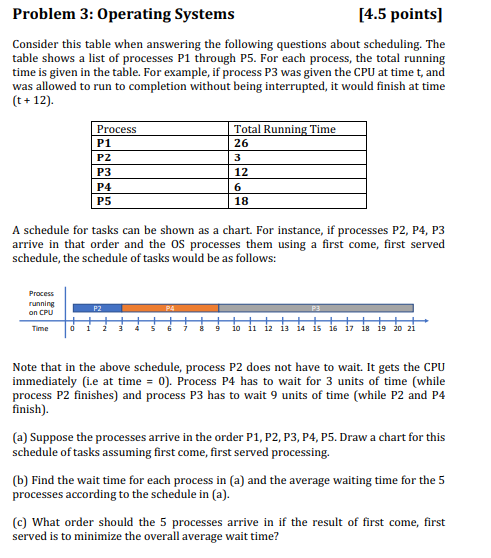
Problem 3: Operating Systems [4.5 points] Consider this table when answering the following questions about scheduling. The table shows a list of processes P1 through P5. For each process, the total running time is given in the table. For example, if process P3 was given the CPU at time t, and was allowed to run to completion without being interrupted, it would finish at time (t 12). Process P1 PZ P3 P4 P5 Total Running Time 26 12 6 18 A schedule for tasks can be shown as a chart. For instance, if processes P2, P4, P3 arrive in that order and the OS processes them using a first come, first served schedule, the schedule of tasks would be as follows: running 10 14 15 16 17 18 19 Note that in the above schedule, process P2 does not have to wait. It gets the CPU immediately (i.e at time-0). Process P4 has to wait for 3 units of time (while process P2 finishes) and process P3 has to wait 9 units of time (while P2 and P4 finish) (a) Suppose the processes arrive in the order P1, P2, P3, P4, P5. Draw a chart for this schedule of tasks assuming first come, first served processing. (b) Find the wait time for each process in (a) and the average waiting time for the 5 processes according to the schedule in (a). (c) What order should the 5 processes arrive in if the result of first come, first served is to minimize the overall average wait time? Problem 3: Operating Systems [4.5 points] Consider this table when answering the following questions about scheduling. The table shows a list of processes P1 through P5. For each process, the total running time is given in the table. For example, if process P3 was given the CPU at time t, and was allowed to run to completion without being interrupted, it would finish at time (t 12). Process P1 PZ P3 P4 P5 Total Running Time 26 12 6 18 A schedule for tasks can be shown as a chart. For instance, if processes P2, P4, P3 arrive in that order and the OS processes them using a first come, first served schedule, the schedule of tasks would be as follows: running 10 14 15 16 17 18 19 Note that in the above schedule, process P2 does not have to wait. It gets the CPU immediately (i.e at time-0). Process P4 has to wait for 3 units of time (while process P2 finishes) and process P3 has to wait 9 units of time (while P2 and P4 finish) (a) Suppose the processes arrive in the order P1, P2, P3, P4, P5. Draw a chart for this schedule of tasks assuming first come, first served processing. (b) Find the wait time for each process in (a) and the average waiting time for the 5 processes according to the schedule in (a). (c) What order should the 5 processes arrive in if the result of first come, first served is to minimize the overall average wait time
Step by Step Solution
There are 3 Steps involved in it

Get step-by-step solutions from verified subject matter experts
 Study Help