







Question: d. Balance the line using sequential restrictions and the longest-operating-time rule. (Leave no cells blank - be certain to enter 0 wherever required. Round your
 d. Balance the line using sequential restrictions and the longest-operating-time rule. (Leave no cells blank - be certain to enter "0" wherever required. Round your answers to 1 decimal place.)
e. What is the efficiency of the line balanced as in part (d) assuming it is running at the cycle time determined in part (a)? (Round your answer to 1 decimal place.)
f. Suppose that demand rose from 900 to 1,000 units per day. What would you do? (Round your answer for cycle time down to the nearest whole number.)
g. Suppose that demand rose from 900 to 1,100 units per day. What would you do? (Round your answer for cycle time down to the nearest whole number.)
Please include calculations!
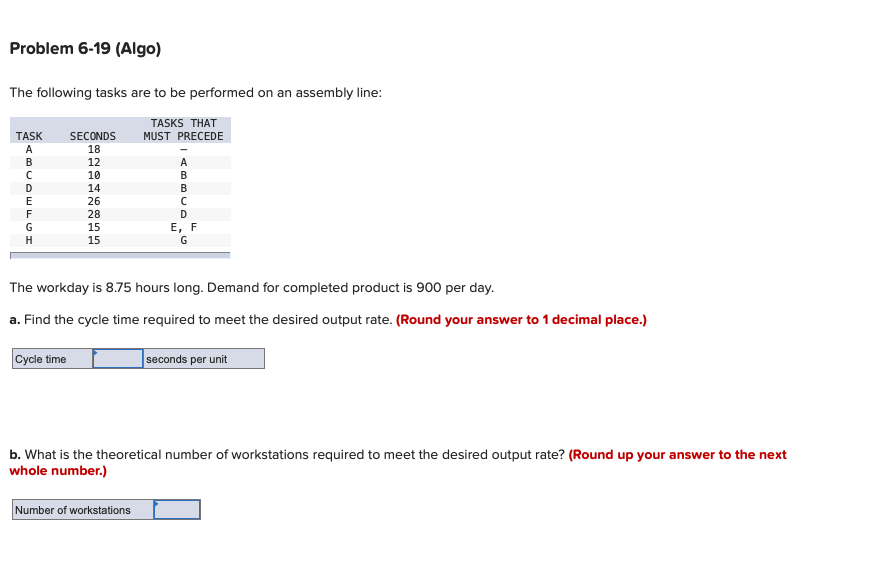
Problem 6-19 (Algo) The following tasks are to be performed on an assembly line: TASKS THAT MUST PRECEDE TASK A B C D E F G H SECONDS 18 12 10 14 26 28 15 15 A B B D E, F G The workday is 8.75 hours long. Demand for completed product is 900 per day. a. Find the cycle time required to meet the desired output rate. (Round your answer to 1 decimal place.) Cycle time seconds per unit b. What is the theoretical number of workstations required to meet the desired output rate? (Round up your answer to the next whole number.) Number of workstationsStep by Step Solution
There are 3 Steps involved in it

Get step-by-step solutions from verified subject matter experts
 Study Help