



Question: (d) Based on all available information in the scenario and supporting documents, what are the considerations when carrying out a COSHH risk assessment for the
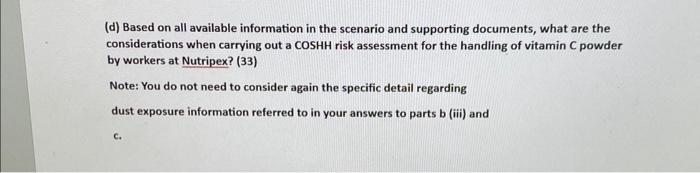
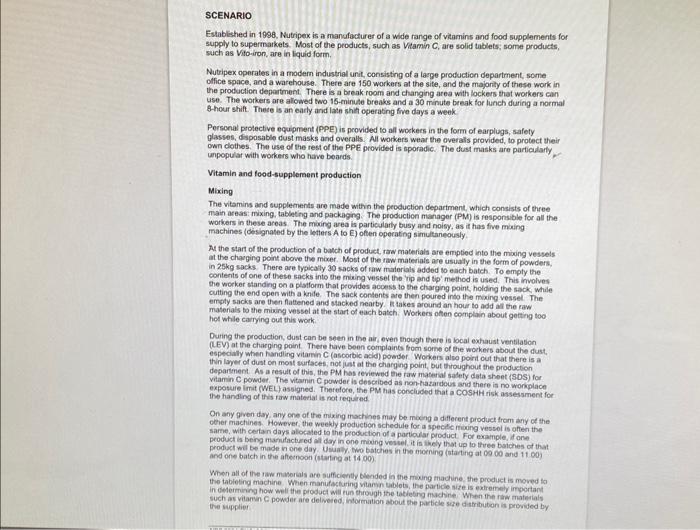
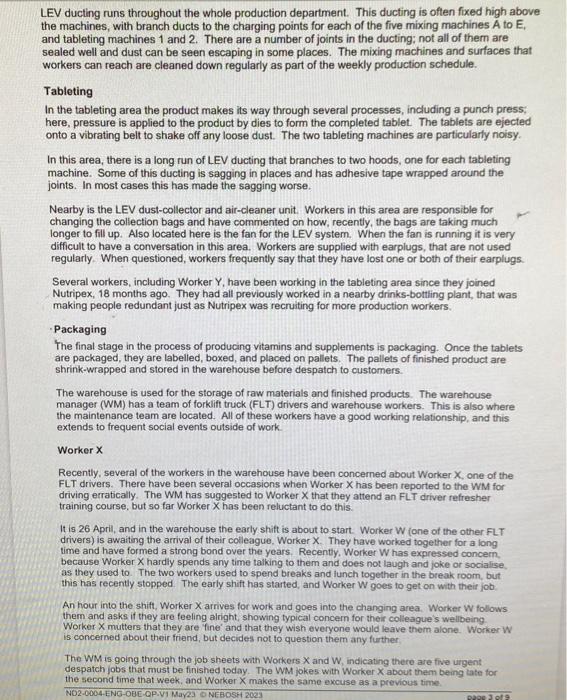
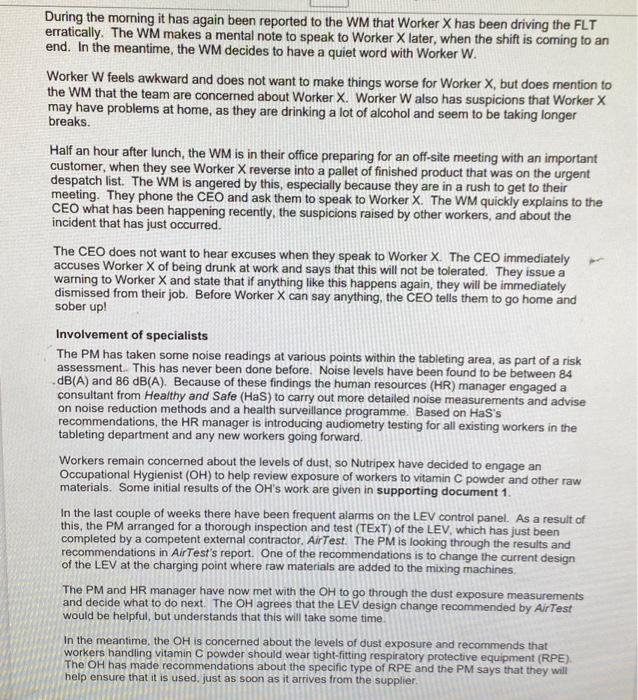
(d) Based on all available information in the scenario and supporting documents, what are the considerations when carrying out a COSHH risk assessment for the handling of vitamin C powder by workers at Nutripex? (33) Note: You do not need to consider again the specific detail regarding dust exposure information referred to in your answers to parts b (iii) and c. Establshed in 1998, Nutripex is a manufacturer of a wide range of vitamins and food supplements for supply to supermarkets. Mast of the products, such as Viamin C, are solid tablets; some products, such as Vito-iron, ars in liquid form. Nutripex operates in a modem industrial unit, consisting of a larpe production department, some office space, and a warehouse. There are 150 workers at the site, and the majonity of these work in the production department. There is a break room and at the site, andid the majonty of these work in use. The workers are aliowed two 15 -eninule breaks and a 30 minute break for lunch during a normal 8hour shift. Thece is an early and late shit operating frve days a week. Personal ptotective equpment (PPE) is provided to all woekers in the form of earplugs, safety glasses, disposable dust masks and overalls. Al workers wear the overalls provided, to protect their own clothes. The use of the rest of the PPE provided is sporadic. The dust masks are particularly unpopular with workers who hame beards. Vitamin and food-supplement production Mixing The vitamins and supplements are made witha the peoduction department, which consists of three main areas: mixing. tableting and packaging. The production manager (PM) is responsible for all the workers in these areas. The mieing area is particulatly busy and noisy, as it has five mieing machines (designated by the letters A to E) often opecating simultaneously. At the start of the production of a bulch of product, raw materials are emptied into the miving vesseis at the chavging point above the moxer. Most of the raw materials are usualy in the form of powders, in 25kg sacks. There are bypically 30 sacks of raw materials added to each batch. To emply the contents of one of these sacks inte the mining vessel the 'rip and tip' method is used. This involves the worker standing on a platform that provides acoess to the charging point holding the sack while cutting the end open with a knife. The sack contents are then poured into the moing vessel. The empty sacks are then flattened and stacked nearby. I lakes around an hour to add al the row. materials to the miking vessel at the start of each batch. Workers otten complain about getting too hot while cairying out this work. During the groduction, dust can be seen in the air; even thoogh there is local extaust ventilation (LEV) at the charging point. There have been complaints from sorne of the workers about the dust, especialy when handing vitaren C (ascorbic acid) powder. Workers also point out that there is a thin layer of dust on mont surfaces; not juat at the charging point, but throughout the production department As a result of this, the PM has reviewod me raw material sadety data sheet (SDS) for vitamin C ponder. The vitamin C powder is described as nonhazardous and there is no workplace expoture imit (WEL) assigned. Therefore, the PM has concluded that a COSHH risk assessment for the handling of this raw material is not required. On any given day, any one of the mixing machioes may be moeng a diflerent groduct from any of the oener machines. However, the weekly production schedule for a spectic miong vessol is often the same, with certan days alocaled to the production of a partioular product. For example, it one product is being marutactured al dsy in one miong vessel. it in likely that up to the betches of that prodyct wi te made in one day. Usaaly. Woo bstches in the miorning (atarting at 00.00 and 11.00 ) and one batch in the aftecnoon (otarting at 1400 ) When all of the raw makorials are sufficievity blended in the muing machine. the product is moved to the tableting machine. Wrien manufosturing vitars tiblets, the particle site is extremelis important in determineng how weli the product will pun throught the tatieting machine. When the rat materials such as vilamin C powder are delivered, intormation about the particle scze distritution is provided by the supplier LEV ducting runs throughout the whole production department. This ducting is often fixed high above the machines, with branch ducts to the charging points for each of the five mixing machines A to E, and tableting machines 1 and 2 . There are a number of joints in the ducting; not all of them are sealed well and dust can be seen escaping in some places. The mixing machines and surfaces that workers can reach are cleaned down regularly as part of the weekly production schedule. Tableting In the tableting area the product makes its way through several processes, including a punch press; here, pressure is applied to the product by dies to form the completed tablet. The tablets are ejected onto a vibrating belt to shake off any loose dust. The two tableting machines are particularly noisy. In this area, there is a long run of LEV ducting that branches to two hoods, one for each tableting machine. Some of this ducting is sagging in places and has adhesive tape wrapped around the joints. In most cases this has made the sagging worse. Nearby is the LEV dust-collector and air-cleaner unit. Workers in this area are responsible for changing the collection bags and have commented on how, recently, the bags are taking much longer to fill up. Also located here is the fan for the LEV system. When the fan is running it is very difficult to have a conversation in this area. Workers are supplied with earplugs, that are not used regularly. When questioned, workers frequently say that they have lost one or both of their earplugs. Several workers, including Worker Y, have been working in the tableting area since they joined Nutripex, 18 months ago. They had all previously worked in a nearby drinks-bottling plant, that was making people redundant just as Nutripex was recruiting for more production workers. Packaging The final stage in the process of producing vitamins and supplements is packaging. Once the tablets are packaged, they are labelled, boxed, and placed on pallets. The pallets of finished product are shrink-wrapped and stored in the warehouse before despatch to customers. The warehouse is used for the storage of raw materials and finished products. The warehouse manager (WM) has a team of forklift truck (FLT) drivers and warehouse workers. This is also where the maintenance team are located. All of these workers have a good working relationship, and this extends to frequent social events outside of work. Worker X Recently, several of the workers in the warehouse have been concerned about Worker X, one of the FLT drivers. There have been several occasions when Worker X has been reported to the WM for driving erratically. The WM has suggested to Worker X that they attend an FLT driver refresher training course, but so far Worker X has been reluctant to do this. It is 26 April, and in the warehouse the early shift is about to start. Worker W (one of the other FLT drivers) is awaiting the arrival of their colleague, Worker X. They have worked together for a long time and have formed a strong bond over the years. Recently, Worker W has expressed concern. because Worker X hardly spends any time talking to them and does not laugh and joke or socialise. as they used to. The two workers used to spend breaks and lunch together in the break room, but this has recently stopped. The early shift has started, and Worker W goes to get on with their, job: An hour into the shift, Worker X arrives for work and goes into the changing area. Worker W follows them and asks if they are feeling alright, showing typical concem for theirg colleague's wellbeing Worker X mutters that they are 'ine' and that they wish everyone would leave them alone. Worker W is concerned about their friend, but decides not to question them any further The WM is going through the job sheets with Wockers X and W, indicating there are five urgent despatch jobs that must be finished today. The WM jokes with Worker X about them being tate tor the second time that week, and Worker X makes the same excuse as a previous time. During the morning it has again been reported to the WM that Worker X has been driving the FLT erratically. The WM makes a mental note to speak to Worker X later, when the shift is coming to an end. In the meantime, the WM decides to have a quiet word with Worker W. Worker W feels awkward and does not want to make things worse for Worker X, but does mention to the WM that the team are concerned about Worker X. Worker W also has suspicions that Worker X may have problems at home, as they are drinking a lot of alcohol and seem to be taking longer breaks. Half an hour after lunch, the WM is in their office preparing for an off-site meeting with an important customer, when they see Worker X reverse into a pallet of finished product that was on the urgent despatch list. The WM is angered by this, especially because they are in a rush to get to their meeting. They phone the CEO and ask them to speak to Worker X. The WM quickly explains to the CEO what has been happening recently, the suspicions raised by other workers, and about the incident that has just occurred. The CEO does not want to hear excuses when they speak to Worker X. The CEO immediately accuses Worker X of being drunk at work and says that this will not be tolerated. They issue a warning to Worker X and state that if anything like this happens again, they will be immediately dismissed from their job. Before Worker X can say anything, the CEO tells them to go home and sober upl Involvement of specialists The PM has taken some noise readings at various points within the tableting area, as part of a risk assessment. This has never been done before. Noise levels have been found to be between 84 dB(A) and 86dB(A). Because of these findings the human resources (HR) manager engaged a consultant from Healthy and Safe (HaS) to carry out more detailed noise measurements and advise on noise reduction methods and a health surveillance programme. Based on HaS's recommendations, the HR manager is introducing audiometry testing for all existing workers in the tableting department and any new workers going forward. Workers remain concerned about the levels of dust, so Nutripex have decided to engage an Occupational Hygienist (OH) to help review exposure of workers to vitamin C powder and other raw materials. Some initial results of the OH's work are given in supporting document 1 . In the last couple of weeks there have been frequent alarms on the LEV control panel. As a result of this, the PM arranged for a thorough inspection and test (TExT) of the LEV, which has just been completed by a competent external contractor. AirTest. The PM is looking through the results and recommendations in AirTest's report. One of the recommendations is to change the current design of the LEV at the charging point where raw materials are added to the mixing machines. The PM and HR manager have now met with the OH to go through the dust exposure measurements and decide what to do next. The OH agrees that the LEV design change recommended by AirTest would be helpful, but understands that this will take some time. In the meantime, the OH is concerned about the levels of dust exposure and recommends that workers handling vitamin C powder should wear tight-fitting respiratory protective equipment (RPE) The OH has made recommendations about the specific type of RPE and the PM says that they will help ensure that it is used. just as soon as it arrives from the supplier
Step by Step Solution
There are 3 Steps involved in it

Get step-by-step solutions from verified subject matter experts