







Question: D Bookmark this page Homework due Aug 7 , 2 0 2 4 1 7 : 2 9 IST Consider the following mixture of two
D Bookmark this page
Homework due Aug : IST
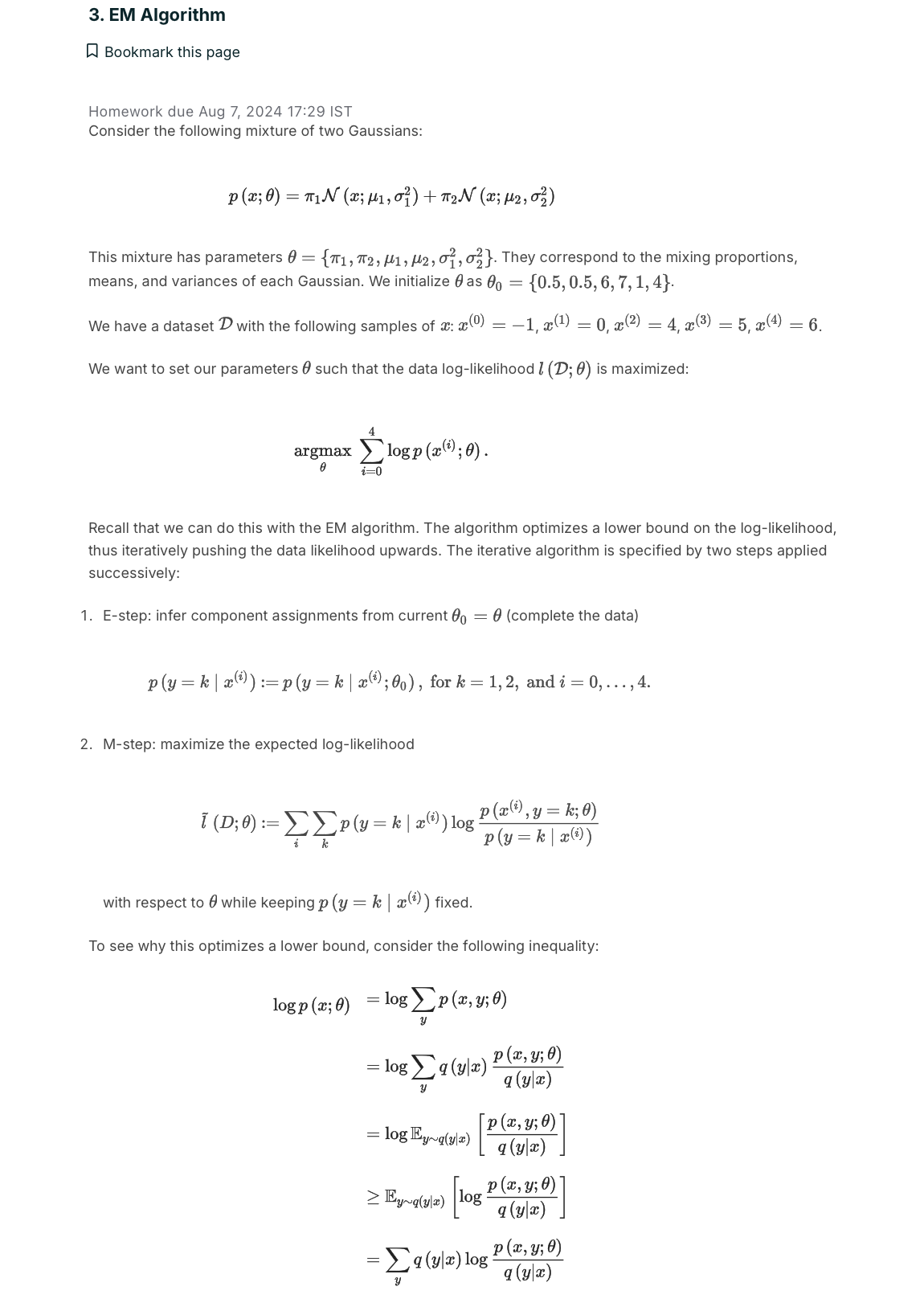
Consider the following mixture of two Gaussians:
;;;
This mixture has parameters They correspond to the mixing proportions,
means, and variances of each Gaussian. We initialize as
We have a dataset with the following samples of :
We want to set our parameters such that the data loglikelihood ; is maximized:
;
Recall that we can do this with the EM algorithm. The algorithm optimizes a lower bound on the loglikelihood,
thus iteratively pushing the data likelihood upwards. The iterative algorithm is specified by two steps applied
successively:
Estep: infer component assignments from current complete the data
:; for and dots,
Mstep: maximize the expected loglikelihood
tilde;:;
with respect to while keeping fixed.
To see why this optimizes a lower bound, consider the following inequality:
;;
Step by Step Solution
There are 3 Steps involved in it
1 Expert Approved Answer
Step: 1 Unlock

Question Has Been Solved by an Expert!
Get step-by-step solutions from verified subject matter experts
Step: 2 Unlock
Step: 3 Unlock
 Study Help