







Question: D. Conservation of mass -integral form - challenge problem (25 points) A device (picture on the right) is designed to reproduce a specific type of
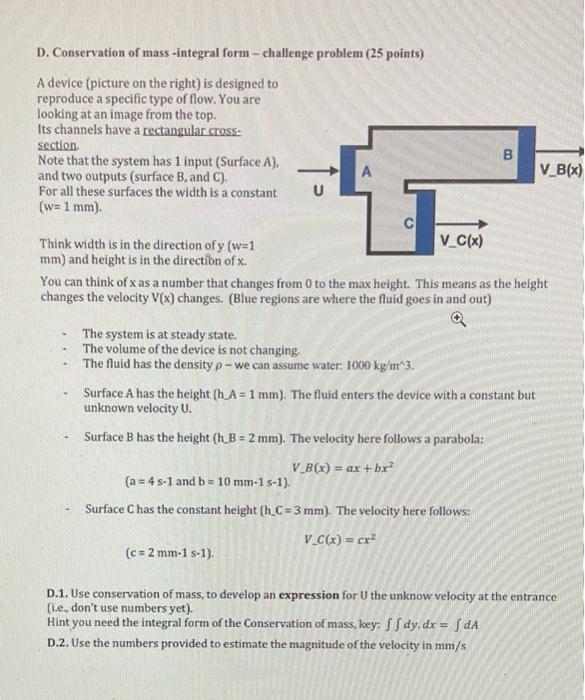
D. Conservation of mass -integral form - challenge problem (25 points) A device (picture on the right) is designed to reproduce a specific type of flow. You are looking at an image from the top. Its channels have a rectangular crosssection. Note that the system has 1 input (Surface A ), and two outputs (surface B, and C). For all these surfaces the width is a constant (w=1mm). Think width is in the direction of y(w=1 mm ) and height is in the direction of x. You can think of x as a number that changes from 0 to the max height. This means as the height changes the velocity V(x) changes. (Blue regions are where the fluid goes in and out) - The system is at steady state. - The volume of the device is not changing. - The fluid has the density - we can assume water. 1000kg/m3. - Surface A has the height (hA=1mm ). The fluid enters the device with a constant but unknown velocity U. - Surface B has the height (h.B =2mm ). The velocity here follows a parabola: (a=4s1andb=10mm1s1).VB(x)=ax+bx2 - Surface C has the constant height (hC=3mm ). The velocity here follows: (c=2mm1s1).Vc(x)=cx2 D.1. Use conservation of mass, to develop an expression for U the unknow velocity at the entrance (i.e. don't use numbers yet). Hint you need the integral form of the Conservation of mass, key: dydx=dA D.2. Use the numbers provided to estimate the magnitude of the velocity in mm/s
Step by Step Solution
There are 3 Steps involved in it

Get step-by-step solutions from verified subject matter experts
 Study Help