Question: d ) Create a database schema (or relations) based on the ER diagram created in 2. above. Explain how the key concepts of the relational
 d
d
- ) Create a database schema (or relations) based on the ER diagram created in 2. above.
- Explain how the key concepts of the relational database are implemented in your database schema. Make sure to use specific examples from your database schema created in 3. above.
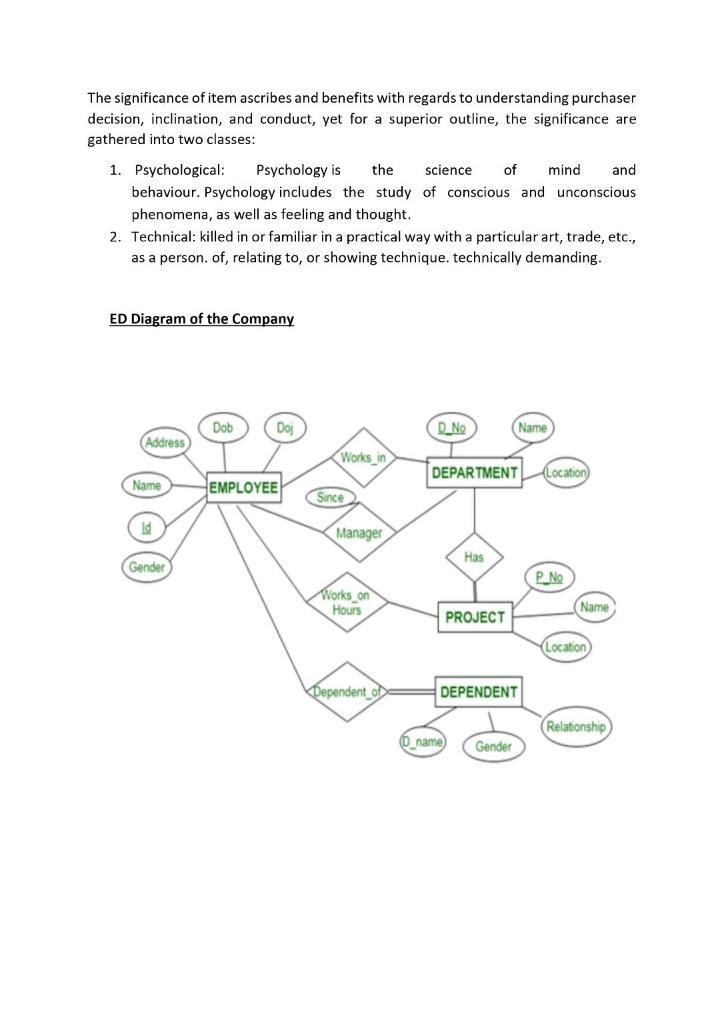
Solution 1 Elements are the essential information object about which data is to be gathered. Elements are normally unmistakable ideas, either concrete or unique, like individual, spots, things, or occasions which have importance to the information base. Some particular instances of substances are EMPLOYEES, PROJECTS, INVOICES. An element is similar to a table in the social model. Traits depict the substance of which they are related. A specific occasion of a property is a worth. The area of a characteristic is the assortment of all potential qualities a trait can have. The area of Name is a character string Entities and their Attributes are: Representative Entity: Attributes of Employee Entity are Name, Id, Address, Gender, Dob and Doj. ID is Primary key for Employee Entity. Office Entity: Attributes of Department Entity are Department No, Name and Location. Office No is Primary key for Department Entity. Subordinate Entity: Attributes of Dependent Entity are D No, Gender and relationship. Office No is Dependent Entity for Dependent Entity. Solution 2 1. Representatives works in Departments - Many representatives work in one Department yet one worker can't work in numerous divisions. 2. Director controls a Department - Employee works under the supervisor of the Department and the chief records the date of joining of representative in the office. 3. Division has numerous Projects - One office has numerous activities; however, one venture can't go under numerous offices. 4. Representative works on project - One worker deal with a few ventures and the quantity of hours worked by the representative on a solitary undertaking is recorded. 5. Representative has wards - Each Employee has wards. Every needy is needy of only one worker. Network and Cardinality The network of a relationship depicts the planning of related substance occasions in the relationship. The estimations of availability are "one" or "many". The cardinality of a relationship is the real number of related events for every one of the two elements. The essential sorts of availability for relations are: coordinated, one-to-many, and many-to-many. A balanced (1:1) relationship is when at most one occasion of a substance An is related with one occurrence of element B. For instance, "workers in the organization are each allocated their own office. For every worker there exists an exceptional office and for every office there exists an interesting representative. A one-to-many (1:N) connections is when for one occurrence of element A, there are zero, one, or numerous occasions of substance B, yet for one example of element B, there is just one case of element A. An illustration of a 1:N connections is an office has numerous workers every representative is allotted to one office. A many-to-many (M:N) relationship, now and again called vague, is when for one case of substance A, there are zero, one, or numerous occasions of element B and for one example of element B there are zero, one, or numerous occurrences of element A. A model is, representatives can be alloted to close to two tasks simultaneously; projects probably allocated in any event three workers. A solitary representative can be appointed to numerous tasks; then again, a solitary venture can have relegated to it numerous workers. Here the cardinality for the connection among workers and activities is two and the cardinality among task and representative is three. Many-to-numerous connections can't be straightforwardly meant social tables, yet rather should be changed into at least two one-to-numerous connections utilizing cooperative elements. Solution 3 Entity: Traits of Project Entity are Project No, Name and Location. Venture No is Primary key for Project Entity. Undertaking Entity implies each and the entirety of the Subsidiaries distinguished as "Venture Entities" in that and their present and future Subsidiaries and some other existing or future Subsidiary of the Company assigned by the Company, by composed notification to the Administrative Agent, as framed or obtained for the main role of developing, getting, claiming, renting or potentially working at least one destinations, offices or projects and any arrangements related thereto and the Subsidiaries of such Subsidiary, along with any middle of the road holding organizations of any such Subsidiary. Item credits are the parts of an item that depict its highlights. Item ascribes are solid, objective, and can be noticed. The credits of an item don't change. Yet, which ascribes you decide to show will change contingent upon mission, client, or brand. Item benefits, then again, are the highlights that are generally essential to the client. Usually these are calculated and change as indicated by the individual customer or client fragment. The significance of item ascribes and benefits with regards to understanding purchaser decision, inclination, and conduct, yet for a superior outline, the significance are gathered into two classes: 1. Psychological: Psychology is the science of mind and behaviour. Psychology includes the study of conscious and unconscious phenomena, as well as feeling and thought. 2. Technical: killed in or familiar in a practical way with a particular art, trade, etc., as a person. of, relating to, or showing technique, technically demanding. ED Diagram of the Company Dob Doj D_No Name Address Works_in DEPARTMENT Location Name EMPLOYEE Since id Manager Has Gender P.NO Works on Hours Name PROJECT Location









 Study Help