







Question: d dx (a) Is the operator (b) Is the operator dx d a Hermitian operator? Prove your answer a Hermitian operator? Prove your answer.
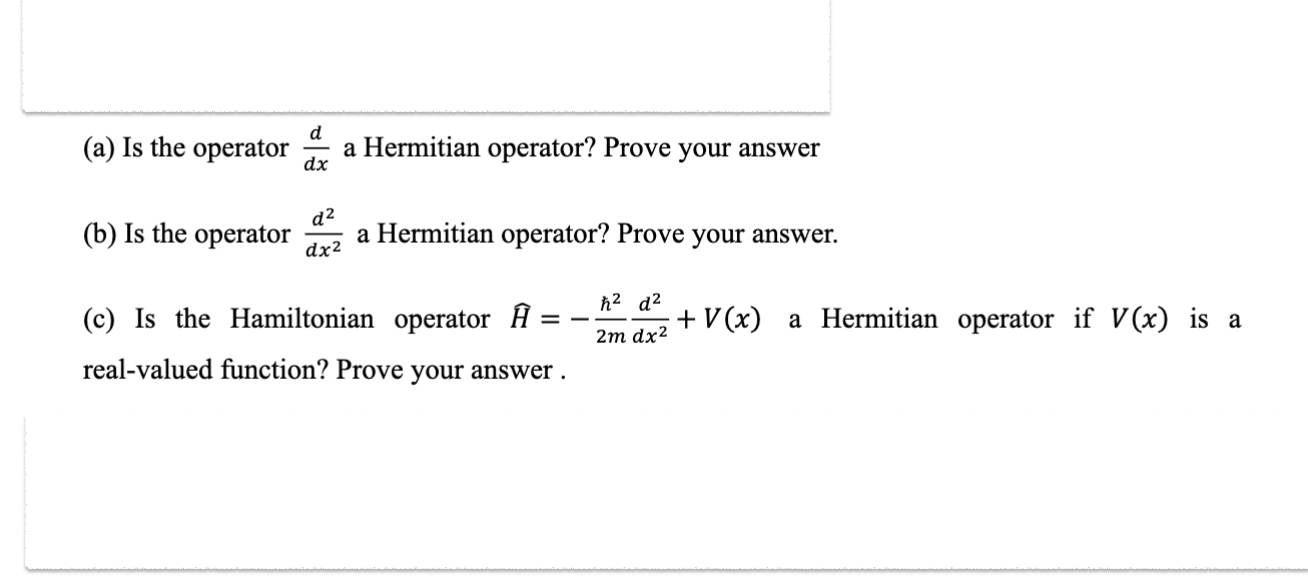
d dx (a) Is the operator (b) Is the operator dx d a Hermitian operator? Prove your answer a Hermitian operator? Prove your answer. (c) Is the Hamiltonian operator == real-valued function? Prove your answer. h d 2m dx +V(x) a Hermitian operator if V(x) is a
Step by Step Solution
There are 3 Steps involved in it
1 Expert Approved Answer
Step: 1 Unlock

Question Has Been Solved by an Expert!
Get step-by-step solutions from verified subject matter experts
Step: 2 Unlock
Step: 3 Unlock
 Study Help