







Question: D, E, F please In this problem set we consider a quantum mechanical bouncy ball hopping between three cups. 1 2 3 Being a bouncy
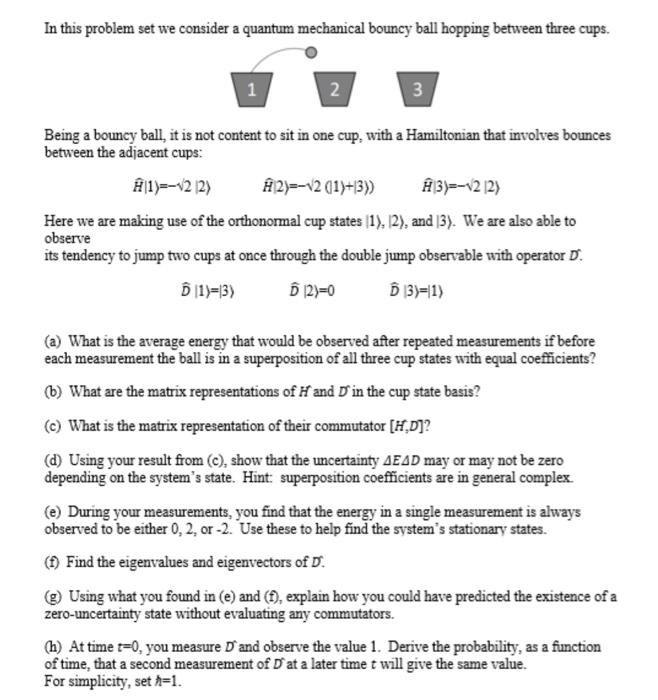
In this problem set we consider a quantum mechanical bouncy ball hopping between three cups. 1 2 3 Being a bouncy ball, it is not content to sit in one cup, with a Hamiltonian that involves bounces between the adjacent cups: 1)=-v212) 2)=-v2 (1)+3)) 3)=-1212) Here we are making use of the orthonormal cup states (1), (2), and 3). We are also able to observe its tendency to jump two cups at once through the double jump observable with operator D. 6 |1=3) 2)=0 3}=(1) (a) What is the average energy that would be observed after repeated measurements if before each measurement the ball is in a superposition of all three cup states with equal coefficients? b) What are the matrix representations of Hand D'in the cup state basis? (c) What is the matrix representation of their commutator [H.D]? (d) Using your result from (C), show that the uncertainty AE AD may or may not be zero depending on the system's state. Hint: superposition coefficients are in general complex. (e) During your measurements, you find that the energy in a single measurement is always observed to be either 0, 2, or -2. Use these to help find the system's stationary states. (1) Find the eigenvalues and eigenvectors of D. Using what you found in (e) and (1), explain how you could have predicted the existence of a zero-uncertainty state without evaluating any commutators. (h) At time t=0, you measure and observe the value 1. Derive the probability, as a function of time, that a second measurement of Dat a later time t will give the same value. For simplicity, set n=1. In this problem set we consider a quantum mechanical bouncy ball hopping between three cups. 1 2 3 Being a bouncy ball, it is not content to sit in one cup, with a Hamiltonian that involves bounces between the adjacent cups: 1)=-v212) 2)=-v2 (1)+3)) 3)=-1212) Here we are making use of the orthonormal cup states (1), (2), and 3). We are also able to observe its tendency to jump two cups at once through the double jump observable with operator D. 6 |1=3) 2)=0 3}=(1) (a) What is the average energy that would be observed after repeated measurements if before each measurement the ball is in a superposition of all three cup states with equal coefficients? b) What are the matrix representations of Hand D'in the cup state basis? (c) What is the matrix representation of their commutator [H.D]? (d) Using your result from (C), show that the uncertainty AE AD may or may not be zero depending on the system's state. Hint: superposition coefficients are in general complex. (e) During your measurements, you find that the energy in a single measurement is always observed to be either 0, 2, or -2. Use these to help find the system's stationary states. (1) Find the eigenvalues and eigenvectors of D. Using what you found in (e) and (1), explain how you could have predicted the existence of a zero-uncertainty state without evaluating any commutators. (h) At time t=0, you measure and observe the value 1. Derive the probability, as a function of time, that a second measurement of Dat a later time t will give the same value. For simplicity, set n=1
Step by Step Solution
There are 3 Steps involved in it

Get step-by-step solutions from verified subject matter experts
 Study Help